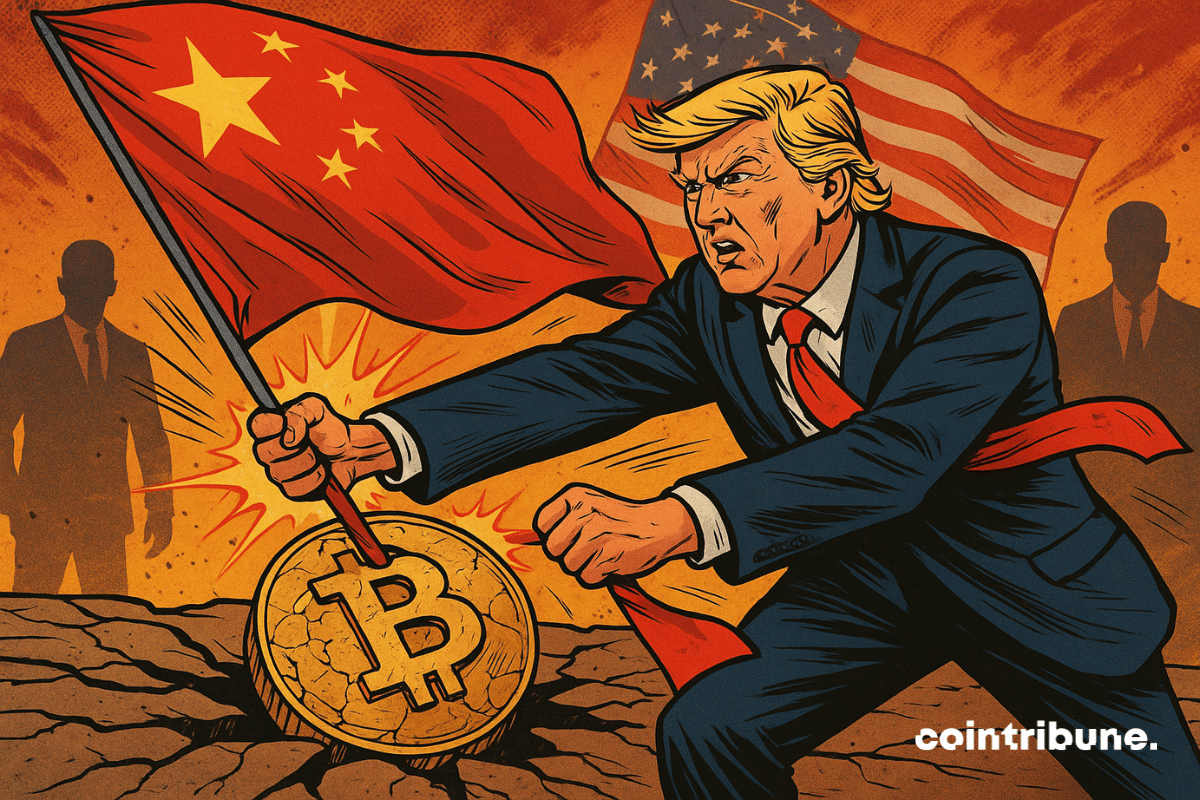
At the heart of a trade war that is not weakening, Donald Trump is relaunching an old promise: making the United States the bitcoin superpower. The stage is set. Faced with China's rise in digital technologies, the American president, just re-elected, is putting crypto back at the center of national strategy. This comeback is not insignificant. He draws on the foundations of his campaign speech to propose an economic model centered on innovation, digital assets and monetary autonomy.
In brief
- Trump promises an American response to China's crypto offensive and the digital yuan.
- Washington wants to attract crypto players with clear rules and mandatory reserves.
- Hong Kong loosens the regulatory grip, reigniting the China-United States monetary rivalry.
- The president links crypto leadership and dollar sovereignty in his recent speeches.
Bitcoin as standard, regulation as leverage: Washington unfolds its plan
President Trump, still in search of the Nobel Peace Prize, did not beat around the bush in Miami during the America Business Forum. In front of business leaders, he hammered : “ We are making the United States the bitcoin superpower, the crypto capital of the world, and the undisputed leader in artificial intelligence “.
This message resonates as a turning point. Since January 2025, the Trump administration has signed executive orders to lift regulatory blocks and encourage the crypto industry. Among the key measures: the GENIUS Act, passed in July, imposes mandatory reserves on issuers of stablecoins, with monthly publication of their composition.
But it is not just a matter of the legal framework. For Trump, crypto also serves to support the dollar, while strengthening the American position in innovation. He states:
This takes a lot of pressure off the dollar. This brings a lot of positive things, and we believe in it.
The message is clear: crypto is a tool of monetary power as much as a technological lever.
China: banning crypto while drawing inspiration from it
Officially, China remains hostile to cryptos. Since 2021, Beijing has banned bitcoin trading and mining. However, this apparent caution masks a finer strategy. Trump was concerned:
China wants to do it. She's starting to do it, but she really wants to go. Other countries also want to go there. If we don't get it right, it's a major industry.
China is banking on its own digital currency, the digital yuan, and on centralized control of flows. But from Hong Kong, the door is ajar. This special administrative region has relaxed some restrictions, allowing registered platforms to offer more services around digital assets.
Meanwhile, China is expanding its influence through the deployment of the digital yuan and the systematic refusal of any private crypto competition. Behind the scenes, Beijing is therefore advancing its pawns. Trump, by denouncing this tactic, repositions the United States as a bulwark of free crypto against centralized state models.
Crypto voting, a new electorate to conquer
This pro-crypto turn did not only respond to geopolitical issues. He also targeted an electorate. Before the election, Trump explained that his campaign supported digital assets from the start, and that Biden came on board late after seeing him losing ground with crypto voters.
The crypto industry is no longer a niche topic. It carries weight in public opinion. It embodies a new promise: that of earnings, social mobility, financial independence. For Trump, this dynamic can make America a new economic engine.
The designed future combines AI, blockchain, tokenization and energy sovereignty via local mining. This table appeals to investors and small investors alike. It gives an image of modernity and reconquest, at a time when China is trying to dictate its own digital roadmap.
Dates, figures, realities: what to remember
- July 2025: vote on the GENIUS Act on stablecoins;
- 200,000 BTC estimated in the hands of the American state;
- 70% of global bitcoin hashrate was Chinese before 2021;
- The digital yuan is in the national deployment phase.
If Trump continues in this direction, he will have to face a brutal reality. China maintains a control over rare earths, essential for the manufacture of AI chips. This strategic imbalance could weaken the dollar according to some analysts.
Maximize your Tremplin.io experience with our 'Read to Earn' program! For every article you read, earn points and access exclusive rewards. Sign up now and start earning benefits.