The creation of a strategic bitcoin reserve promises to be the biggest monetary earthquake since the end of the Bretton Woods agreements.
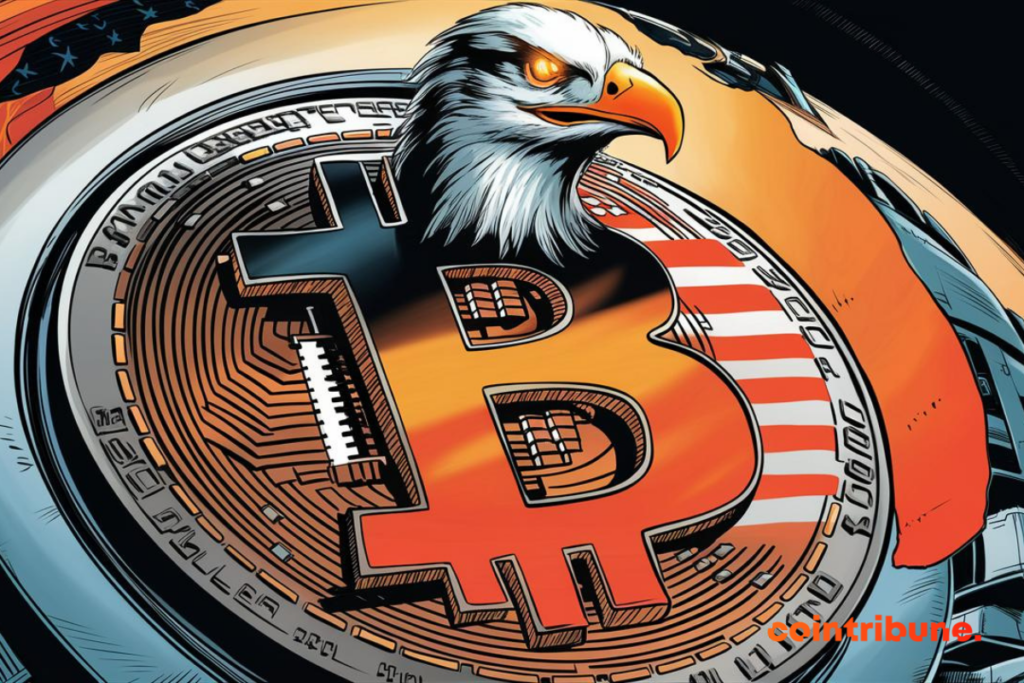
The Dilemma
American Senator Cynthia Lummis could lay the foundation stone for an overhaul of the international monetary system.
As it stands, its bill bipartisan (Bitcoin Act) plans to buy one million bitcoins, or 5% of the total supply. The accumulation should be done over five years with the aim of keeping them for at least 20 years.
Rather than financing this reserve with debt, Cynthia Lummis proposes selling the gold reserves and tapping into the profits made by the Fed. The Fed collects interest on several trillions of Treasury bonds purchased via the famous Quantitative Easing.
This strategy should be compared with the rapid decline in the dollar's share of global foreign exchange reserves. Faced with global distrust of the dollar, it is enlightening to take a small historical detour to understand the scope of the creation of an American bitcoin reserve.
It was at Bretton Woods that the Pound Sterling was officially dethroned by the dollar, more than a year before the end of the Second World War. The United States imposed the greenback as the pivotal currency against which all other currencies would float.
Gold was established as a safeguard so that international trade was carried out on an equal footing. In other words, Washington had to convert the dollar into gold on demand, which prevented it from abusing the printing press to finance imports.
This system, however, carried within it the germ of its own destruction. The pitfall was articulated in 1960 by Joseph Triffin. The Triffin dilemma explains that countries whose currency is an international reserve currency must necessarily be in a trade deficit to allow other countries to have a reserve.
This mathematical imperative means that a permanent trade deficit is the necessary condition to replenish the world with its currency.
From gold to the petrodollar
The United States was to provide the international currency while promising to convert it into gold. But faced with the growth of international trade, it quickly became impossible to keep this promise by maintaining a fixed parity of 35 dollars per ounce of gold.
So much so that after only two short decades, there were already seven times more dollars in circulation in the world than gold at Fort Knox. Particularly responsible for the costly Vietnam War and peak oil, the United States began to import a lot of oil from the Middle East.
The Bretton Woods agreement collapsed when France and other European countries demanded the conversion of their dollars into gold. President Richard Nixon finally ended the Gold Standard in 1971.
This was followed by the advent of the so-called petrodollar system. What was expected to be a serious economic weakness (peak oil in 1971) turned out to be a boon the likes of which we rarely see in history. The geopolitical masterstroke was to force OPEC nations to sell their oil exclusively in dollars.
Oil being the lifeblood of any industrialized economy, the whole world was forced to remain loyal to the dollar. So the United States was able to let its trade deficit slip away without the dollar depreciating. The United States is the only nation with this privilege.
The explanation lies in the fact that the dollars accumulated by exporting nations are not converted into their national currencies, but invested in American debt (to earn interest). This is the exorbitant privilege: displaying a chronically negative trade balance while easily incurring debt at a low cost.
The other side of the coin is that the American public debt now represents 37% of global public debt. The US government must 7 trillion dollars to the rest of the world…
Getting your hands on bitcoins before (almost) everyone else would reduce the bill. This is the objective stated by Senator Cynthia Lummis.
BRICS and dedollarization
Many nations fear that the United States will not repay and the “freezing” of Russian reserves (300 billion euros and dollars) has not helped matters. Dedollarization is now an objective assumed by the BRICS, recently joined by three major oil exporters (Iran, United Arab Emirates and Saudi Arabia).
The balance of power is no longer the same as in the 1970s. China has become the world's leading economy in terms of purchasing power parity. The BRICS+ comprise 46% of the world's population and represent 35% of global GDP (PPP).
Among other metrics, the club is responsible for approximately 25% of overall exports. It also produces 42% of wheat, 52% of rice and 46% of soya. It is also 43% of oil production (and 44% of world reserves). Or even 35.5% of its gas production (and 53% of reserves).
An evolution of the international monetary system is inevitable over the coming years. Washington knows this and geopolitical tensions are the direct consequence of this fear. It is in this context that we must analyze the American ambition to create a bitcoin reserve.
Bitcoin has all the attributes of a perfect international reserve currency. The first reason is that it resolves the Triffin paradox by being stateless. The second is that it can circulate easily, a requirement that gold has always lacked.
Thus, after the windfalls of purchasing the territories of Manhattan, Louisiana, California and Alaska, the United States is once again preparing to make the deal of the century.
It was natural that the United States would be the first to take the plunge given that they have the most to lose if bitcoin emerges as the reserve asset of the next millennium. If everything goes according to plan, Michael Saylor predicts that a single bitcoin will reach $13 million.
Maximize your Tremplin.io experience with our 'Read to Earn' program! For every article you read, earn points and access exclusive rewards. Sign up now and start earning benefits.