Everyone is anxiously waiting for the approval of a cash ETF. One of the main reasons is that such an event could bring a lot of flow to the cryptocurrency market. As several ETF producers will find themselves in the process of buying bitcoin to create a spot ETF and meet growing demand, this may affect the price movement. This is where we will look together at the impacts of creating a bitcoin spot ETF.
The principle of a spot ETF
Before moving a little further into the analysis, we will look at the principle of a spot ETF. ETFs have now been around for several decades. Their purpose is to track or follow the movement of a stock index, a commodity, a sector, fixed income and much more. Moreover, we can see the evolution of different ETFs over the last two decades.
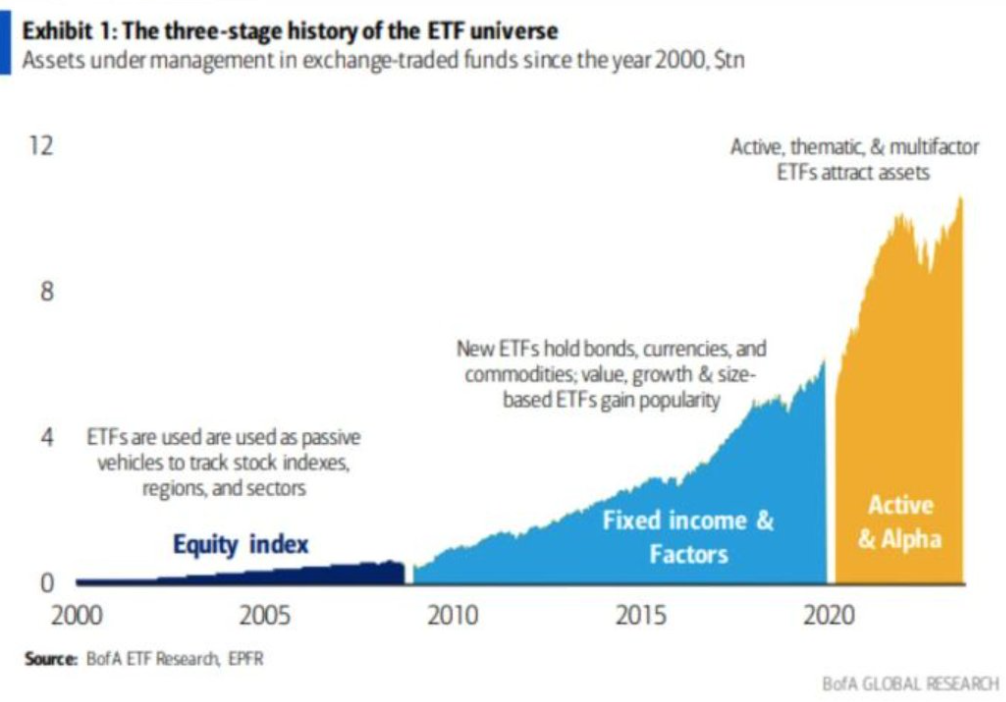
It is a constantly evolving market, and as the demand for bitcoin is growing. It is completely legitimate to integrate a new ETF.
An ETF producer like blackrock or ishare is like a chocolate maker. He will offer you different packages which bring together several types of chocolates. The package being the ETF and the chocolates, the stocks.
For example: if the aim of the fund is to reproduce the evolution of an index, the fund will buy the components of the index to follow its evolution as much as possible. Investors can buy exchange-traded funds in the form of shares. Therefore, supply and demand will also have an impact on the price of the share. Obviously, the more demand there is, the more the underlying component will have to be purchased.
ETFs have a very important place in North America as can be seen in the table below.
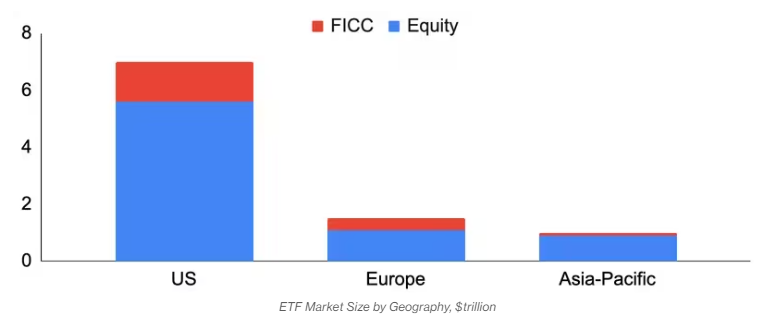
Traders are attracted to ETFs for several reasons. For example, like the costs which are quite low or the liquidity which is also important. On the other hand, it gives investors access to different possibilities, which makes it possible to diversify a portfolio. Being able to put this type of product in tax-advantaged accounts is also an asset and an incentive to invest. Therefore, as the market share is quite large, the arrival of a spot ETF could have an impact on the evolution of bitcoin.
A spot ETF, an incentive in tax-advantaged accounts
Until then, to hold bitcoin truly, you had to buy it on an external platform specializing in the exchange of cryptocurrency. So yes, there are already ETFs but they do not hold bitcoin because they are linked to futures and not the BTC spot. On the other hand, there is also premium-based GBTC, but the product structure does not always reflect the evolution of bitcoin.
As for cryptocurrency brokerage platforms, they do not provide access to different account types that can offer tax advantages. In North America we have several account types on this. I give some examples:
- The 401k in the US which is a retirement savings account whose one of its advantages is to save taxes.
- The tax-free account in Canada (TFSA) whose earnings and interest are tax-free.
- The registered retirement savings plan account in Canada (RRSP) which also offers tax savings
There are many more, but I won’t name them all. This type of account is an incentive to invest in financial or other markets. However, not all types of products are accepted in this type of account. For example, we could include ETFs, funds, stocks, etc. For products related to bitcoin, we just had an ETF on Bitcoin futures for this type of account. The arrival of a bitcoin spot ETF will allow investors to have the opportunity to buy bitcoin. All this without going through an external brokerage platform specializing in cryptocurrencies. In addition, this will also allow you to benefit from tax-advantaged accounts.
The other good news is that fund managers will be able to respond to demand and include cryptocurrency as an allocation and optimize diversification.
Return to the GOLD ETF
As I explained previously, over the last two decades we have seen the release of several types of ETFs. Let’s take the example of those that were created on gold. Before its creation, it was quite difficult to hold gold. For what ? Physical gold must first be able to be stored securely and in another register, the liquidity to resell it is less flexible.
We will take the example of gold because bitcoin can be considered digital gold for some. On the other hand, both assets have a like point because they have a limited supply. In North America, we have two ETFs that are quite popular: GLD and XAU. The GLD ETF was created in 2004, here is its evolution in the years that followed. We can see a performance of more than 300% over the years.
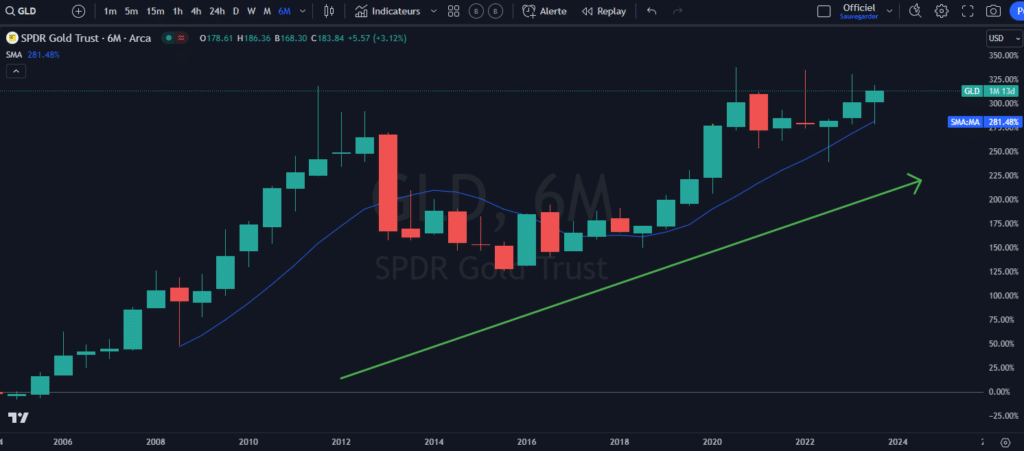
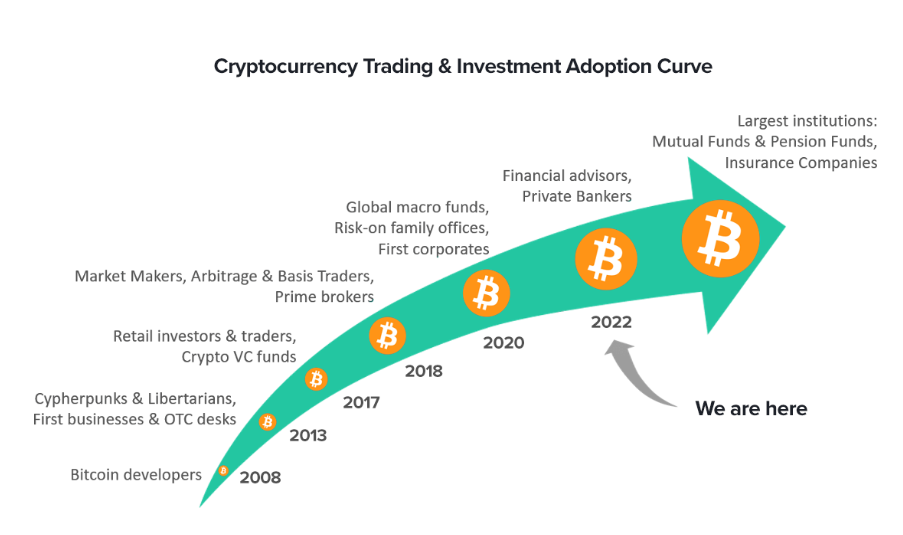
The capitalization of gold in general was around 2 trillion when it was created. Now we are around 13 trillion. On the other hand, the capitalization of bitcoin is currently around 700 billion, which is still significantly less. Moreover, according to the adoption curve, we are just before the adoption phase of institutions:
Parallel with numbers
Speaking of numbers, the growth rate of gold’s supply is higher than that of bitcoin. It is 2% for gold vs 1.5% for bitcoin. On the other hand, the share of gold ETFs is only between 1 and 2% of capitalization. This remains a fairly low figure compared to the share of capitalization that we currently have on some products related to bitcoin. Let’s take the example with GBTC (grayscale) or BITO (etf future), we can see that GBTC has a capitalization of 20 billion and BITO of 1.5 billion. Therefore, together they represent around 3% of the capitalization of bitcoin. On the other hand, the evolution of the price of bitcoin is initially more volatile than that of gold. Therefore, this could have a greater impact on bitcoin in the future.
The impacts of a spot ETF on bitcoin
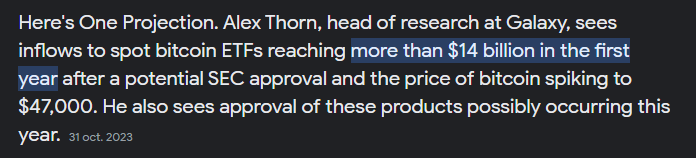
Even if we are never certain of the evolution of the price of an asset, there are still certain points that will impact the price of bitcoin. Already, initially, accessibility to bitcoin will be easier for certain investors who did not wish to spend time on cryptocurrency platforms. On the other hand, the institutionalization of bitcoin gives it more credibility, particularly with regard to regulation. Consequently, investors will have more confidence. Just like the gold ETF, its capitalization risks growing as demand persists knowing that supply is limited and the process slows down every 4 years. Some will already make assumptions about the potential flow towards ETFs like Alex Thorn who projects an inflow of 14 billion in the first year of release.
In the short term, we can be in the narrative of “buying the rumor of an ETF and selling the news of an ETF”. We don’t really know 100% what could happen. That said, there is likely to be strong demand right away, which will likely cause the price to move a lot. But in the long term, the flows will probably stabilize once allocated to the portfolio, and the bitcoin risks varying depending on the factors which influence it at the base.
The other important element concerns allocation, you should know that bitcoin remains a fairly volatile asset but it also has a positive correlation with several other assets. Consequently, the allocation in terms of % is not likely to be enormous within a portfolio, I would say around 5%. This is why once allocated in the portfolio, the flows risk exploding at the beginning and slowing down later.
CONCLUSION
As previously stated, the demand for ETFs is very popular in the US, greater than in the rest of the world. Therefore, this is likely to meet several criteria on the part of investors and ultimately contribute to the demand for bitcoin.
Receive a summary of the news in the world of cryptocurrencies by subscribing to our new service daily and weekly so you don’t miss anything of the Tremplin.io essentials!