More than six million bitcoins are based on public keys already visible on the blockchain, according to the latest data from Glassnode. This situation revives concerns around the security of wallets in the face of advances in artificial intelligence and quantum computing. While this share represents 31.2% of the circulating supply, Justin Drake calls on players in the sector to anticipate possible attacks against the cryptographic systems used today.
In brief
- More than 6 million bitcoins are based on public keys already visible on the blockchain.
- This exposure represents 31.2% of the circulating supply, according to Glassnode data.
- Binance displays 83% of bitcoins exposed, compared to 10% for Coinbase.
- Justin Drake warns of the risk of AI-related attacks against wallet cryptography.
Bitcoin: more than six million tokens exposed to cryptographic risks
According to Rafael Schultze-Kraft, co-founder of Glassnode, the exposed supply has increased by 222,000 BTC since report published in May. This increase represents approximately $18.2 billion, while the total supply of bitcoin increased by only 64,000 BTC. In total, more than six million tokens are based on already visible public keys. They now represent 31.2% of the circulating supply, approximately five to six points more than the trough reached in 2023.
Exchange platforms explain an important part of this evolution. They concentrate an additional 123,000 BTC in the increase measured by Glassnode and now hold 1.79 million BTC behind visible public keys. However, their level of exposure varies greatly depending on the actors. Coinbase has a proportion of 10%, compared to 83% for Binance. These differences illustrate the differences between fund management practices and portfolio exposure.
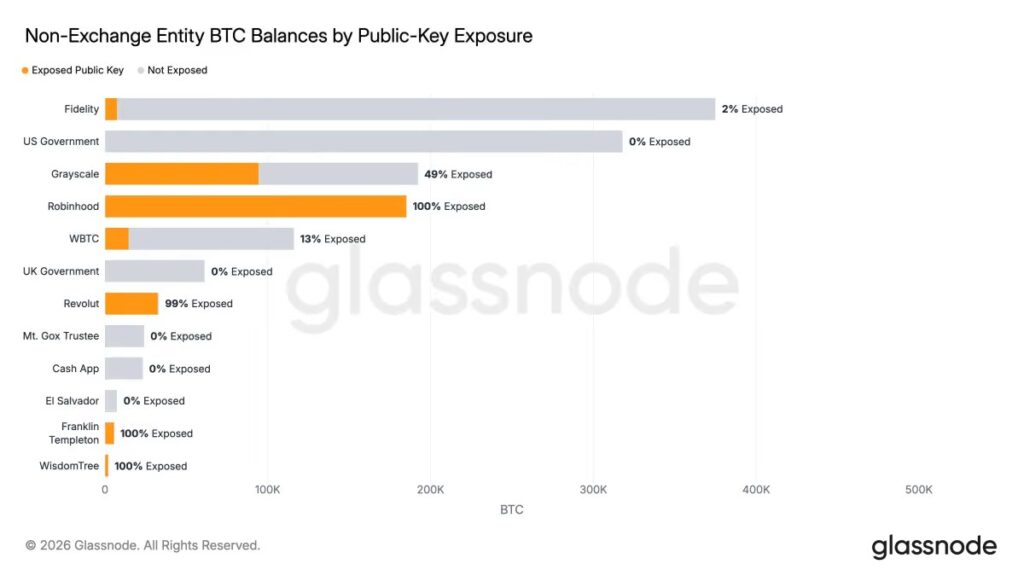
Other companies also present contrasting situations. Fidelity holds approximately 375,000 BTC, of which only 2% is in the exposed category using this method. Grayscale is at 49%, while Revolut is at 99% and Robinhood is at 100%. These numbers describe the visibility of public keys, but do not mean that the funds involved have been compromised. Glassnode’s methodology notably excludes the holdings of the American, British and Salvadoran governments.
Artificial intelligence: why bitcoin public keys are worrying
Public keys may become visible when users reuse certain addresses or use particular transaction formats. Glassnode cites in particular the old “pay-to-public-key” type releases and Taproot releases. This exposure alone is not enough to provide access to funds. However, a sufficiently powerful quantum computer or a major mathematical breakthrough could theoretically make it possible to find the corresponding private keys.
These concerns take on a new dimension with Justin Drake’s warningsresearcher on Ethereum. It encourages players in the sector to prepare for a reinforced defense scenario, described as “bunker mode”. According to him, artificial intelligence could discover a flaw capable of breaking wallet cryptography in a few months, in the worst case. This scenario could occur even before the arrival of sufficiently efficient quantum computers.
The evolution of public key exposure and AI alerts therefore highlight two distinct but related issues. On the one hand, Glassnode data measures exposure that is already observable on the blockchain. On the other hand, Drake’s statements evoke a possible threat whose timetable remains uncertain. The progression of computing capacities could thus increase pressure on current methods of protecting digital assets.
In the short term, monitoring these indicators will remain essential to assess the evolution of risks. Bitcoin holders and platforms will need to keep up with advances in artificial intelligence and cryptography to anticipate possible security breaches. However, the current exposure does not constitute evidence of an imminent attack. The actual level of threat will depend on technical advances and the sector’s ability to adapt its protections to new risks.
Maximize your Tremplin.io experience with our ‘Read to Earn’ program! For every article you read, earn points and access exclusive rewards. Sign up now and start earning benefits.