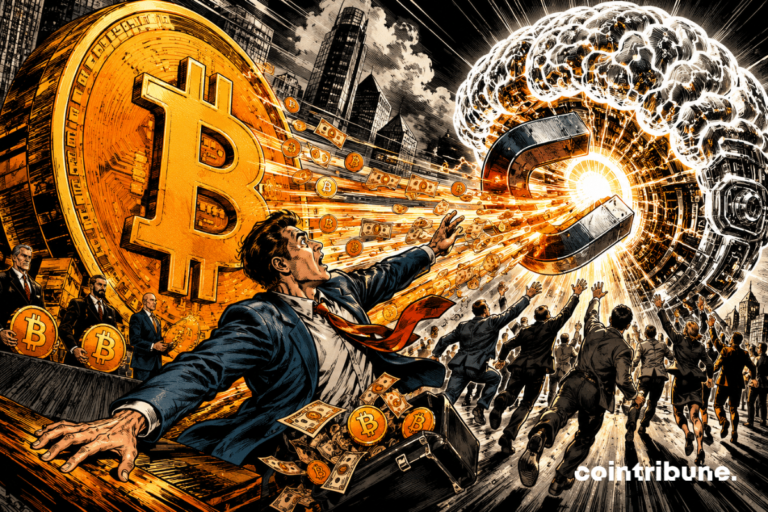
Bitcoin, often considered a refuge against the volatility of traditional markets, is found this week taken in a global storm, fueled by trade tensions between the United States and the rest of the world. After a series of economic shocks, some analysts do not hesitate to compare the current situation to a black Monday 2.0. But is it really the end of the Haussier market for Bitcoin or a simple correction phase? Here are five essential points to remember this week to understand the challenges that Bitcoin is faced.

1. A death cross: an alert signal for traders
Recently, Bitcoin has crossed the $ 75,000 mark downwards, a threshold which nevertheless seemed almost impregnable.
This passage from this key level, accompanied by the formation of a death cross – a crossing of the mobile average at 50 days under that of the 200 days – immediately attracted the attention of traders, many of which fear a more marked correction.
Indeed, this lowering signal aroused the concerns of analysts, who believe that the BTC could drop around $ 69,000, a level that has not been reached since March 2021.
This decline is part of a price compression context, where Bitcoin is currently evolving between $ 68,000 and $ 85,000, and where global macroeconomic tensions, supplied by a strong US dollar and upward yields on treasury bills, accentuate market volatility.
The passage under these historical supports raises a crucial question: is the BTC on the verge of testing its stockings of 2021, or will we witness a rapid reversal, supported by a corrective action? Market players are shared.
Some analysts call for caution, while others evoke the possibility of a short -term technical rebound. Especially since, according to Ryan Lee, chief analyst at Bitget Research:
Bitcoin stability around $ 70,000 could benefit from indirect support thanks to mining costs. Indeed, the current cost to undermine a BTC, estimated between $ 60,000 and $ 65,000 for operators using advanced ASIC equipment, could create a price floor that would strengthen market resilience. This dynamic, combined with long -term accumulation behavior, could offer a buffer against deeper corrections, also providing indirect support in Ethereum.
2. American customs tariffs: a wind contrary for bitcoin
The impact of new customs tariffs imposed by the United States has exacerbated tensions on traditional and crypto markets.
These measures may prolong the pressure on Bitcoin, which has always tended to react negatively to a tense global economic context.
While the prices of risky assets fall, inflation could start upwards, further weakening cryptocurrencies.
Expectations concerning a rate reduction by the Federal Reserve (Fed) could offer a short -term respite. But if the prices continue to weigh on the economy, Bitcoin could be at the mercy of extreme fluctuations.
3. The return of the spectrum of “black Monday” and parallels with 2020
Some experts do not hide their concern about the replica of a blacksimilar to that of 1987, or to the Krach of COVID-19 in 2020.
Such an event could see Bitcoin collapse even more under the pressure of economic uncertainty. Many traders fear an additional fall, with fears of long -term repercussions on the entire cryptocurrency market.
The comparison with the Krach of 2020 is not trivial. While the world markets plunged into chaos, Bitcoin had shown signs of resistance, but the lack of structural support could weaken it this time.
According to Some analyststhe only way to stop this spiral would be a rapid action of the Fed to lower interest rates and revive liquidity on the markets.
4. Speculation: a key factor in the volatility of Bitcoin
Speculative investors are the most exposed to current market fluctuations. Due to price instability, shorts (sales positions) are increasingly popular, and the losses of new investors, who have bought bitcoin at the highest, are now a factor that accentuates the agitation of the market.
If short -term holders are starting to panic, this could lead to a massive sale, pushing the prices of Bitcoin even lower.
THE SOPR ratio Short -term investors, an indicator of profitability, shows that the latter are mostly in loss. If this trend persists, a capitulation effect could occur, even more destabilizing the market.
5. A possible rebound despite everything: long -term optimism
Although the situation seems uncertain in the short term, some experts believe that Bitcoin could bounce back once the turbulence has passed.
In a context where risk assets are under pressure, Bitcoin has demonstrated impressive resilience over the years.
Analysts suggest that the sale of panic could offer an opportunity to buy at low prices, especially if global uncertainty is intensifying.
In the end, the Black Monday 2.0 might not mark the end of the Haussier market for Bitcoin, but rather a new test phase for its long -term solidity.
Bitcoin, despite its occasional falls, showed a tendency to bounce after each major crisis. If it is not yet the time to buy at low prices, it is essential to follow the evolution of the situation with caution.
Maximize your Cointribne experience with our 'Read to Earn' program! For each article you read, earn points and access exclusive rewards. Sign up now and start accumulating advantages.