Bitcoin ETFs continue to attract considerable capital. Indeed, four consecutive weeks of net inflows have just been recorded in the United States. Nearly $2 billion was injected during this period. Thus, institutional demand remains solid despite an uncertain context. However, the pace remains lower than previous cycles. This sequence nevertheless constitutes the most extensive series of entries in 2026. Consequently, these flows directly influence the price of bitcoin.
In brief
- Bitcoin ETFs are seeing four weeks of net inflows, totaling nearly $2 billion.
- BlackRock's IBIT fund largely dominates these flows with around $1.7 billion.
- These entries support Bitcoin around $70,000 despite an uncertain macro context.
- However, analysts believe that the recovery will remain gradual, driven by still moderate flows.
ETF flows dominated by BlackRock and increasing concentration
While bitcoin has plunged below $69,000, U.S.-listed spot Bitcoin exchange-traded funds (ETFs) just saw net inflows, totaling around $2 billion.
A significant fraction of entries comes from a single actor. BlackRock's iShares Bitcoin Trust (IBIT) fund, which, according to SoSoValue data, captures approximately $1.7 billion. Thus, this concentration reflects a structural evolution of the market. Bitcoin is now attracting massive institutional capital.
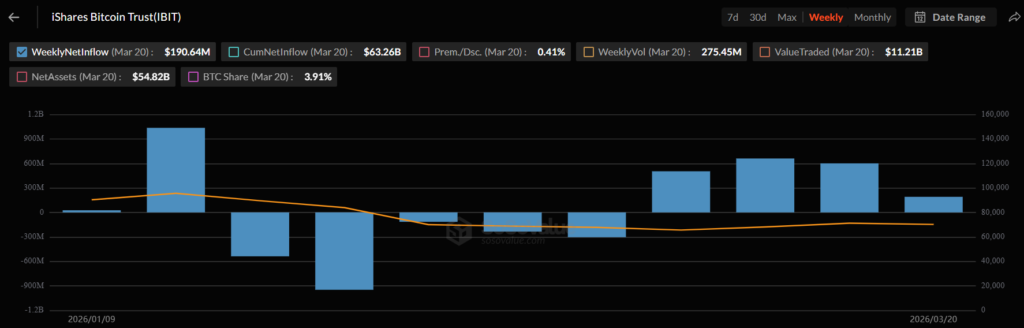
The platform observes the same dynamic of net inflows. However, the pace of accumulation remains lower than previous cycles. Current entries remain below the strongest phases. This period nevertheless marks a change in trend. It constitutes the most extensive sequence since August-September 2025.
At that time, more than 3.8 billion dollars had been injected. The current pace therefore remains more moderate in comparison. ETFs simplify market access for large institutions. They reduce the technical constraints linked to direct holding.
A progressive dynamic and still measured prospects
However, some analysts urge caution. The current dynamic does not guarantee a rapid increase. The Ecoinometrics platform qualifies this trend via a post on X:
The direction is now unequivocal, but we are still far from a full recovery, and even in optimistic scenarios this demand involves a slow rebuild.
Given this, the company evokes a more measured scenario. A target of $80,000 over 30 days seems more plausible. Thus, a gradual progression is preferred. A rapid crossing of $100,000 seems less likely. However, structural change is beginning to emerge. ETF demand is gradually moving from a drag to a market support. This shift marks a significant turning point for Bitcoin. It suggests the entry into a new cyclical phase.
A sustained price, but dependent on ETF flows
Despite macroeconomic tensions, the price of bitcoin remains stable and hovers around $70,000. ETF flows directly support this price level. Thus, regular entries create constant buying pressure.
This mechanism brings Bitcoin closer to traditional financial assets. Flows become a key trend indicator. Institutions regularly adjust their allocations. These decisions directly influence price dynamics. However, this stability depends on the continuity of inputs. A slowdown could quickly weaken the market.
Towards a new phase of the Bitcoin cycle
Since their launch in 2024, ETFs have profoundly transformed the market. More than $56 billion has been pumped into these products. This dynamic is gradually anchoring Bitcoin in global finance. Institutional flows become a structural pillar of the market. In the short term, progress should remain gradual.
Analysts favor moderate scenarios around $80,000. However, an acceleration will depend on a more massive influx of capital. Without this, the increase could remain contained. In the longer term, a change in cycle seems to be underway. ETFs could permanently redefine the trajectory of Bitcoin. Thus, the market is entering a more mature phase. Institutional capital now becomes the main driver.
Maximize your Tremplin.io experience with our 'Read to Earn' program! For every article you read, earn points and access exclusive rewards. Sign up now and start earning benefits.