
The Cold War climate is not fading. The reduction in Saudi oil production and the reunion of the BRICS point furiously to a new world order.
OPEC at the bedside of Russia?
As expected, Sunday’s OPEC meeting in Vienna ended with a drop in oil production. “Saudi Arabia will cut its production by one million barrels a day from July”To declared Saudi Energy Minister Abdulaziz Bin Salman.
The production of the kingdom will therefore increase from 10 to 9 million barrels per day. The prince also warns that this million was ” stretch “. The other members of OPEC will maintain their production at the current level.
Asked if OPEC could trust Russia, Mr. Abdulaziz replied: ” Absolutely. But I always liked President Reagan’s phrase. Trust, but verify”.
Indeed, the public oil giant Rosneft forecasts a 45% increase in its net profit in the first quarter of 2023. And this even as Russia had pledged to reduce its daily production by 500,000 barrels per day.
The Saudis know this. The maneuvers of the Saudis are barely veiled support for Russia, which is leading the revolt against Uncle Sam. Thus, after dealing a hard blow to the petrodollar at the start of the year, Riyadh is multiplying the pledges of goodwill.
How to validate your entry ticket within the BRICS? In any case, the Russian and Saudi foreign ministers seemed to get along well this weekend in Cape Town:
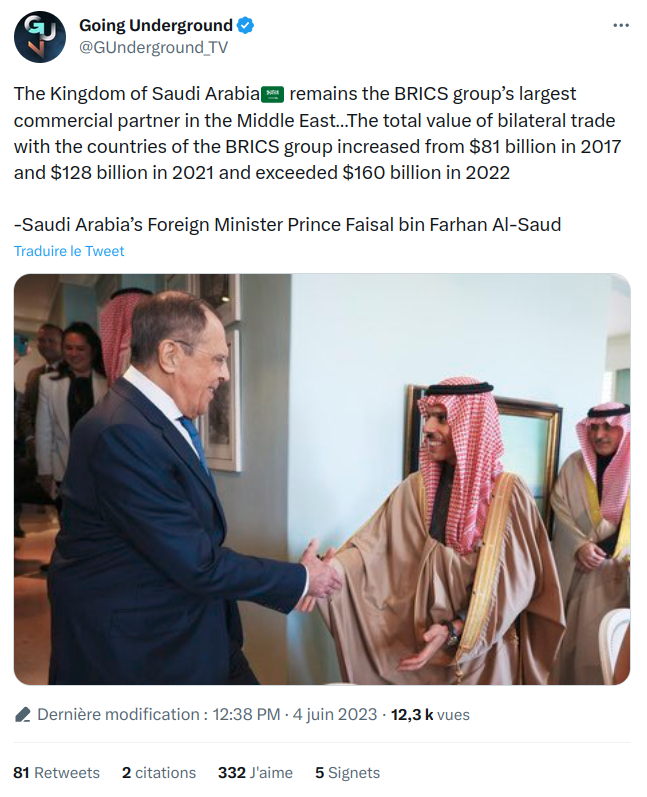
https://twitter.com/GUnderground_TV/status/1665307061398151173
China raises its voice
Speaking of world order, Defense Minister Li Shangfu had a message for his American counterpart present in Singapore for the summit of theIISS (International Institute for Strategic Studies):
“China firmly supports the international system centered on the United Nations. […] Some countries, however, take a selective approach to international law. What they call “rules-based international order” never says what the rules are and who makes them. The rules are exceptionalism and double standards for the benefit of a small number of countries. »
The Chinese general didn’t mince words to Defense Secretary Lloyd James Austin:
“A country deliberately meddles in the internal affairs of other countries, frequently resorting to unilateral sanctions as well as force. He encouraged color revolutions and proxy wars in different regions leaving chaos behind. We must never allow such things to happen again in the Asia-Pacific region. »
“Cold War mentality resurfaces […]. The real purpose of military alliances like NATO in the Asia-Pacific region is to hold countries hostage and play on conflicts and confrontations that will only drag the region into a whirlwind of division and conflict. »
Last caveat:
“We must never forget the catastrophes inflicted by the two world wars and the Cold War. And we must never allow such tragedies to happen again. »
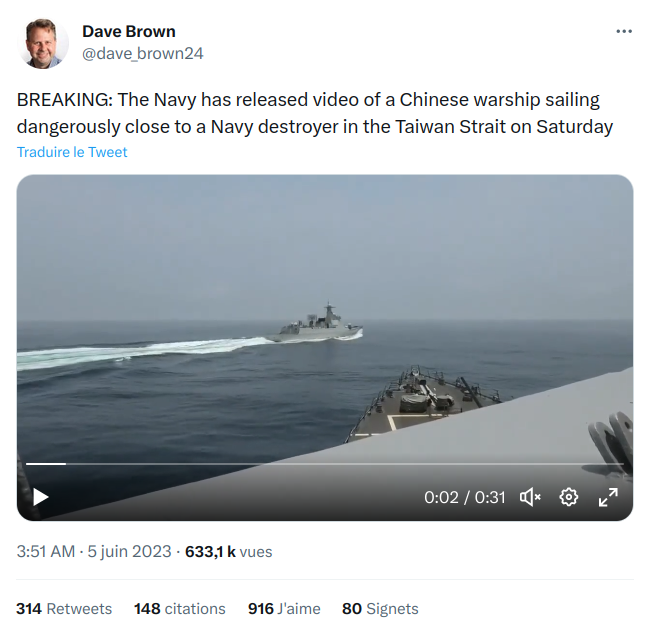
The day after this speech, the Chinese navy went to greet an American frigate patrolling 8,000 km from its coast, in the Taiwan Strait:
The BRICS meeting
BRICS foreign ministers also met this weekend in South Africa. Also invited were ministers from Saudi Arabia, Iran, United Arab Emirates, Nigeria, Argentina, Egypt, Indonesia and Kazakhstan.
These new alliances are not trivial. The BRICS clearly find themselves around the idea of doing without the dollar and rebuilding the international order.
Led by Iran, members of the Asian Clearing Union (ACU), for example, have just launched a new cross-border financial messaging system.
The BRICS for their part have announced that they have instructed the New Development Bank to think about a possible common currency. The subject remains tricky. It is not so easy to get rid of the dollar.
Indeed, Russia will not forever accept rupees in exchange for its oil. If India has no tangible goods to exchange for these rupees, the Russians will eventually turn off the tap.
A new international reserve currency will therefore be needed very quickly. Gold is the eternal candidate, but the fact is that it cannot be used to oil the millions of daily international transactions.
Some BRICS members are tossing around the idea of a gold-backed stablecoin. But who will keep the gold? China ? Who can guarantee that China will not do the same thing as Nixon in twenty years?
Bitcoin as an international reserve currency
The Gold Standard is ultimately based on trust that will always be sacrificed on the altars of geopolitics and debt. It is doomed to failure and 1971 was the proof.
A good international reserve currency must allow instantaneous transactions. It must be a two-in-one payment network at the same time. This is exactly what bitcoin is.
A reserve currency must also be decentralized. For what ? To avoid any devaluation. Indeed, who can guarantee that a gold-backed stablecoin will not one day be devalued by its creators? Or that some countries see themselves disconnected from it, as with the SWIFT network?
The question does not arise for bitcoin. Those who participate in the network are naturally encouraged not to modify the protocol (21 M), under penalty of devaluing their savings.
Conversely, States generally do not have savings, but rather debts. They are encouraged to create money ex nihilo or to default.
And while gold deposits are concentrated in a few countries, bitcoin has the advantage of being able to be mined absolutely everywhere. All you have to do is dedicate part of your electricity production to it.
Finally, there is little chance that a currency entirely controlled by the BRICS will be accepted by the West. The world needs a stateless currency (decentralized) and that all nations play on equal terms.
The United States, which already controls 50% of the hashrate, cannot say that it is leaving with a handicap. Bitcoin is poised to become the last international reserve currency.
Receive a digest of news in the world of cryptocurrencies by subscribing to our new service of daily and weekly so you don’t miss any of the essential Tremplin.io!