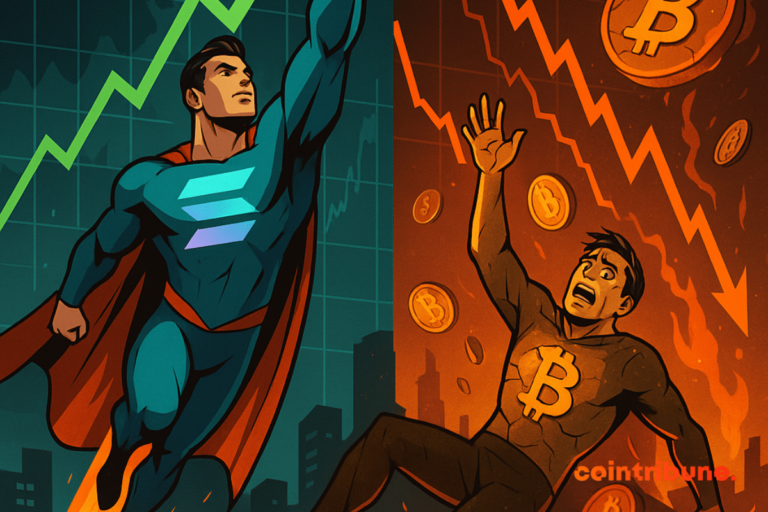
In the midst of the economic tumult of the last decade, bitcoin emerges as an epic modern-day hero. From his quiet beginnings to his spectacular rise, he embodies resilience and adaptability. In this ever-changing landscape, why has crypto grown so big and what impact could it have on the retirement of future generations?
The awakening of a digital age: the genesis of Bitcoin
While Russia is now considering crypto as an alternative to the SWIFT system, let’s take a look back at the origins of Bitcoin.
Indeed, it is fascinating to note that, in the shadow of the 2008 financial crisis, an innovative solution has emerged.
In January 2009, Satoshi Nakamoto introduced Bitcoin, a decentralized digital asset. Initially it was seen as a simple technological toy, without intrinsic value.
At the end of 2010, bitcoin was trading at $0.29. This testified toa growing recognition of its potential.
This progression, however, was not linear. In 2011, after breaking through the dollar mark, bitcoin experienced dizzying highs, peaking at $31, before falling sharply.
This was the first test of its volatility, a reminder that any market, even digital, is subject to fluctuations.
The period from 2012 to 2016 witnessed economic turbulencenotably the eurozone crisis and the strengthening of the American dollar.
Despite these upheavals, bitcoin gradually gained ground, closing 2016 at $998. Crypto’s ability to adapt and grow in an uncertain economic environment has boosted its legitimacy.
2017 was the banner year for bitcoin, with a valuation approaching $20,000. However, this euphoria was followed bya severe correction in 2018.
But, like the phoenix rising from the ashes, bitcoin continued its rise, supported by institutional adoption in 2020 and global economic challenges, such as trade wars and inflation.
A shield against uncertainty?
The pandemic of COVID-19 shook the world. Faced with this crisis, central banks have opted for flexible monetary policies, leading to a depreciation of fiat currencies.
In this context, Bitcoin, with its decentralized nature, has emerged as an attractive alternative, sometimes positioning itself as “digital gold”.
In May 2021, bitcoin reached its all-time high around $69,000. But as the market fluctuated, its price fell in 2022 until closing around $16,500.
The year 2023 shows us bitcoin in full recovery, oscillating between 25,000 and 30,000 dollars. With the emergence of central bank digital currencies and the growing popularity of cryptocurrencies, we are heading towards a profoundly transformed monetary landscape.
Faced with the depreciation of fiat currencies, bitcoin offers an attractive alternative. Satoshi’s invention demonstrated a remarkable ability to adapt and thrive in diverse economic contexts.
As a result, it positions itself as a serious candidate to guarantee the financial future of younger generations.
While bitcoin’s journey has seen many challenges, its perseverance points to a prominent place in the future monetary revolution. Are we at the dawn of an era where cryptocurrencies, with bitcoin leading the way, will become essential to retirement plans? Elon Musk, with his characteristic frankness, goes so far as to call fiat currencies a fraud.
Receive a summary of the news in the world of cryptocurrencies by subscribing to our new service daily and weekly so you don’t miss anything of the Tremplin.io essentials!