
Bitcoin extended its decline after October's market shock, while traditional safe-haven assets continued to advance. Data from on-chain analysis, combined with price developments, suggests that investors are gradually withdrawing funds from cryptocurrencies to reposition themselves on assets deemed more stable in times of uncertainty. Furthermore, the contraction in the supply of stablecoins is fueling concerns about a broader market recovery, which could take longer to materialize.

In brief
- Bitcoin has fallen almost 30% since its October highs, as investors shift their capital from cryptos to traditional safe-haven assets.
- A $2.24 billion drop in stablecoin market capitalization suggests liquidity is leaving the crypto ecosystem, rather than standing by to buy on dips.
- Gold and silver are hitting all-time highs as risk appetite weakens as uncertainty pushes investors toward tangible assets.
- Bitcoin is holding around $88,000, but remains below key technical levels, as traders await monetary policy signals from the Federal Reserve.
Bitcoin loses speed, decline in stablecoins signals capital outflow
Bitcoin has now fallen almost 30% from levels seen before the October crash. At the same time, gold and silver reached all-time highs, illustrating a marked shift in investor behavior. According to crypto analytics firm Santiment, this rotation reflects increased caution in global markets.
Over the past ten days, the total capitalization of stablecoins has decreased by $2.24 billion. Santiment explains that this decline indicates that capital is leaving the crypto ecosystem, rather than remaining available for purchases during market downturns. A significant part of these flows appears to be redirected towards gold and silver, two assets widely considered safe havens in times of economic stress.
“A falling stablecoin market cap shows that many investors are converting to fiat, instead of positioning themselves to buy on dips”said Santiment. The firm adds that growing demand for precious metals reflects a increased preference for securityas uncertainty continues to intensify.
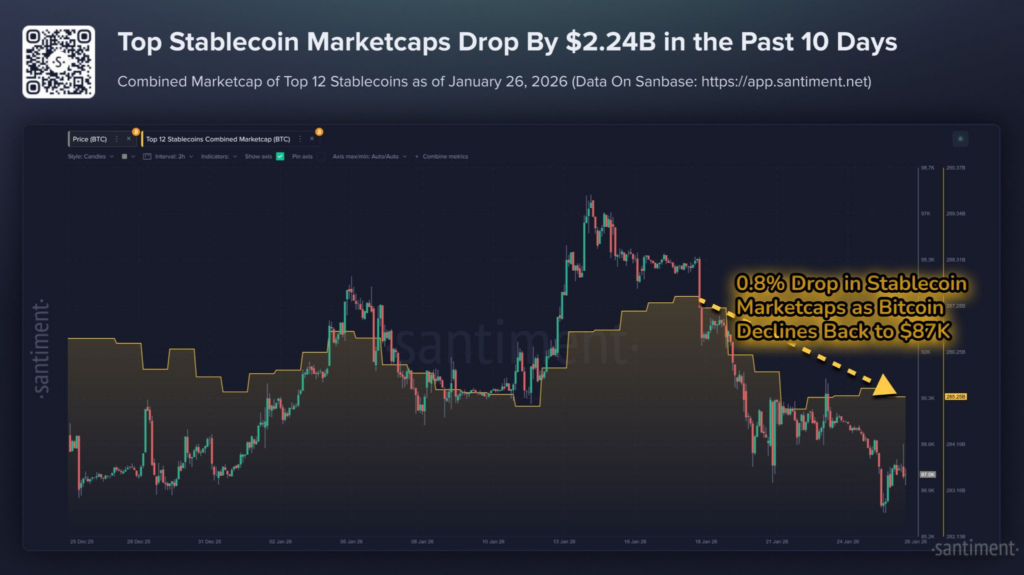
Bitcoin had performed strongly for much of 2025, before the situation suddenly deteriorated on October 10. That day, more than $19 billion in leveraged crypto positions were liquidated, causing bitcoin to fall sharply — from around $121,500 to below $103,000 — in just a few hours. Since this episode, losses have deepened, with bitcoin recently trading around $88,000.
Conversely, gold and silver have moved in the opposite direction. Gold prices have risen more than 20% since October, crossing the $5,000 threshold, while silver has more than doubled in market value.
Altcoins in danger as capital flows out and liquidity tightens
Demand for tangible assets also comes from within the crypto industry itself. The stablecoin issuer Tether thus acquired 27 metric tons of gold, for an estimated value of $4.4 billion, during the fourth quarter of 2025, reinforcing this trend towards physical assets.
Current market conditions highlight several key dynamics:
- The supply of stablecoins is decreasing, signaling a tightening of liquidity in crypto markets.
- Capital rotation favors gold and silver over digital assets.
- Bitcoin shows weaker momentum compared to previous cycles.
- Altcoins are under increased pressure due to declining risk appetite.
- Investors' attention is now focused on macroeconomic factors and monetary policy signals.
According to Santiment, analysis of past market cycles shows that sustainable recoveries in the crypto universe generally begin when the capitalization of stablecoins stops decreasing and starts increasing again. A rising supply of stablecoins is often interpreted as a sign of an influx of new capital and renewed investor confidence. Until this movement occurs, riskier assets tend to underperform.
Bitcoin holds near $88,000 as traders await Fed decision
Historically, bitcoin has held up better than altcoins during periods of stress, but reduced liquidity is now limiting the rebound potential of the entire market. Smaller-cap tokens typically experience steeper declines when capital withdraws, while bitcoin tends to move sideways rather than rebound quickly.
On Tuesday, bitcoin rose slightly, while remaining below the $90,000 threshold. Price action remained near one-month lows as traders adopted a cautious stance ahead of the US central bank's monetary policy decision.
At the time of writing, the leading cryptocurrency is trading at $88,497, up 0.56% over the last 24 hours. Market sentiment remains bearish, with the Fear and Greed Index at 29, signaling a climate of fear. The price is also moving below its 200-day simple moving average, with only 13 positive sessions recorded over the past month.
Since the start of 2026, bitcoin has seen a gain limited to 1%, underperforming other major asset classes despite a weaker US dollar. Market attention now turns squarely to the upcoming Federal Reserve meeting, at which interest rates are expected to remain unchanged, maintaining moderate risk appetite in the near term.
Maximize your Tremplin.io experience with our 'Read to Earn' program! For every article you read, earn points and access exclusive rewards. Sign up now and start earning benefits.