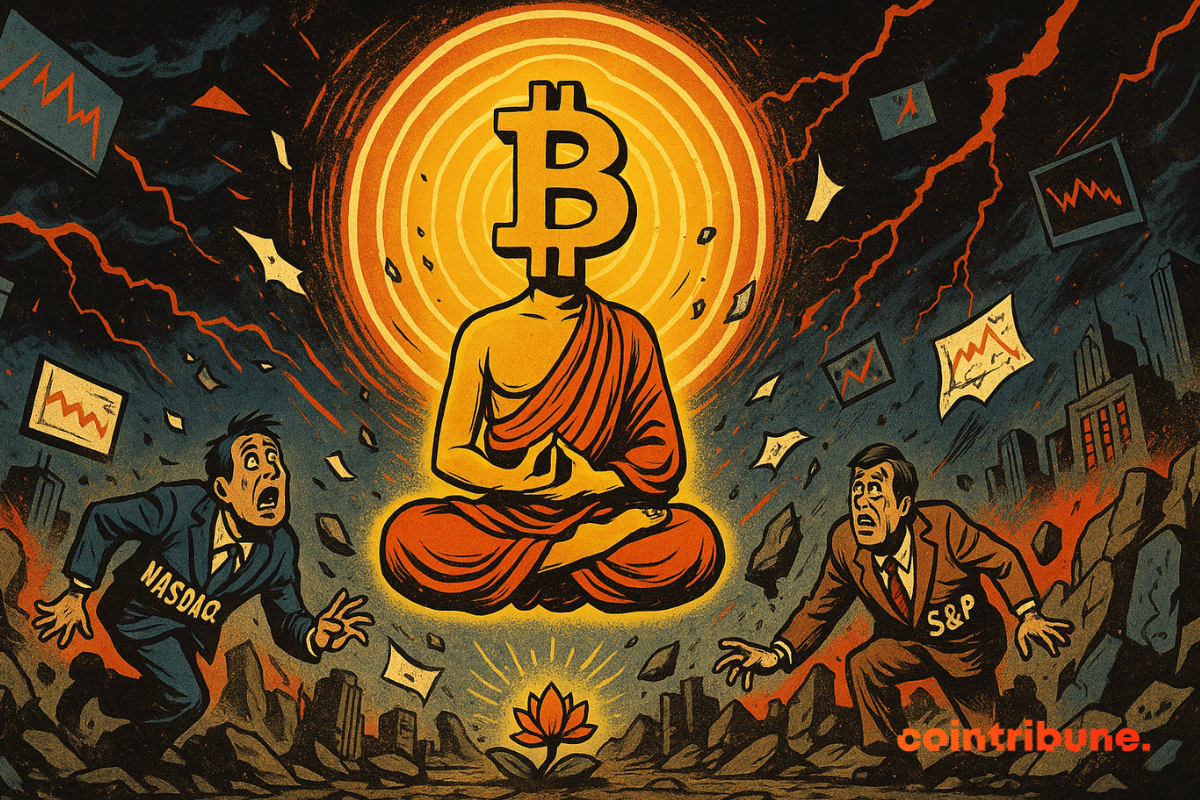
In a crypto market where volatility is the norm, Bitcoin has just crossed an unexpected CAP. It is now less unstable than the S&P 500 and the Nasdaq. This discreet but significant shift, revealed by Galaxy Digital, calls into question a decade of perception of an active deemed too risky for traditional wallets. More than just a technical indicator, this signal could mark a change in lasting status for the first crypto.
In short
- Bitcoin now displays a volatility lower than that of the S&P 500 and the Nasdaq, according to Galaxy Digital, an unprecedented situation for an active as a long deemed unstable.
- Key indicators such as the Bloomberg Dollar Index and gold have experienced strong variations, strengthening Bitcoin's perception as a counteractive in the face of crises.
- The influx of institutional capital, in particular via the ETFs, contributes to this stabilization, supported by a prudent risk management on the crypto markets.
- With 95 % of the Bitcoin offer already in circulation, rarity strengthens its image of digital refuge value, comparable to that of gold in a world in monetary recomposition.
Volatility increasingly comparable to traditional assets
On May 12, Galaxy Digital revealed that the volatility carried out over ten days from Bitcoin had dropped to 43.86, a level now lower than that of S&P 500 (47.29) and Nasdaq 100 (51.26). This is a situation deemed exceptional for an asset deemed unstable.
Analysts specify In their note:
An unusual position for an crypto historically known for its disproportionate volatility.
This tilting comes as traditional markets show signs of feverishness, especially since the surprise announcement of April 2 by Donald Trump concerning the “Pricaire Liberation Day”which amplified international economic tensions.
In this context, Bitcoin has not only stabilized. It increased by 11 % over the period, clearly contrasting with the sluggishness of stock market indices. Several major economic indicators have in parallel with increased volatility:
- The Nasdaq Composite remained almost stable despite the turbulence;
- The Bloomberg Dollar Index dropped by almost 4 %;
- Gold briefly crossed the symbolic threshold of 3,500 dollars per ounce, before falling back by 5.75 %.
Galaxy Digital compares this situation to that observed in 2018–2019 during trade tensions between the United States and China, a period during which Bitcoin had already asserted itself as an active refuge.
This parallel highlights an emerging dynamic. In the systemic crisis phases, Bitcoin tends to behave like a macroeconomic counteractive, a posture hitherto reserved for raw materials like gold.
The growing influence of institutional actors in the stabilization of bitcoin
Beyond recent fluctuations, Galaxy Digital identifies a deeper trend: the drop in Bitcoin beta vis-à-vis the large clues, despite correlations still high over 30 days with the S&P (0.62) and the NASDAQ (0.64).
This change of risk profile indicates that “Investors are starting to consider Bitcoin less as a high -risk asset and more as a long -term allowance”comments Chris Rhine, head of liquid strategies at Galaxy.
In other words, Bitcoin would be out of the field of speculative assets to integrate that of sustainable wallet components.
This evolution is also supported by the rise of institutional liquidity. Hank Huang, CEO of Kronos Research, observes that continuous influx to ETFs and recurring strategic purchases of Bitcoin “Contribute to transforming it into a digital version of gold, less correlated with actions”.
This stabilization is made possible, according to Galaxy, by a market “Tactically cautious, but structurally constructive”characterized by a disciplined use of the lever and low pressure on the coverage strategies. With 95 % of the total bitcoin offer already undermined, the mechanical scarcity of assets strengthens this dynamic of maturity.
This transfer could ultimately redraw the landscape of international reserves. On April 25, Jay Jacobs, responsible for themed ETF at Blackrock, noted that states gradually reduce their dependence on the dollar to turn to alternative assets like gold … and now Bitcoin. “Geopolitical fragmentation feeds demand for non -correlated assets”he explained, explicitly mentioning the growing role of Bitcoin as a refuge value alongside the precious metal.
Maximize your Cointribne experience with our 'Read to Earn' program! For each article you read, earn points and access exclusive rewards. Sign up now and start accumulating advantages.