The circus of inscriptions (ordinals, stamps, runes, etc.) is fading, but the damage is already significant. Return to this nuisance which is ruining the decentralization of bitcoin.
Catch-up course on registrations
Registrations are data (a .jpeg file for example) that resides inside bitcoin transactions.
For example, there are inscriptions linked to what we call an ordinal. An ordinal is a “unique satoshi” serving as a title deed. The term ordinal comes from the expression “ordinal theory” which refers to a virtual numbering allowing these satoshis to be followed from one transaction to another.
This tracking is done via software that is completely foreign to the bitcoin protocol. It's all about the ordinal explorer. In other words, the data (jpeg/registration) is not at all transferred from one transaction to another as one might imagine. The registration remains linked to the same original transaction (txid) located in the same block. It is claimed that the inscription changes ownership via the ordinal theory.
How does it work technically?
Two things need to be explained first:
First, carrying out a bitcoin transaction means creating a “utxo”. This is a piece of code (a script) that mathematically links an amount of bitcoins to a bitcoin address (public key).
Second, the mechanics of transactions rely on a computer execution language called “scripting”. It is a very simple language that has a limited number of instructions.
These instructions are called opcodes. Think of them as little digital cogs. The most basic is OP_CHECKSIG. This opcode verifies that the signature provided in the transaction corresponds to the bitcoin address in question.
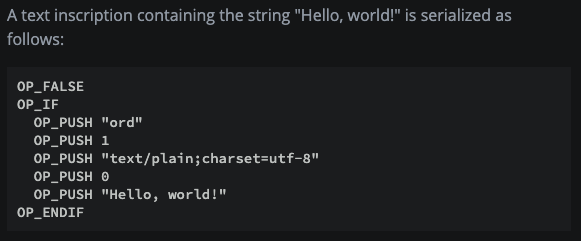
The inscriptions (txt, jpeg files, etc.) are inserted into utxos of type P2TR and P2WPKH. They use to do a trick involving 3 opcodes: OP_FALSE, OP_IF and OP_PUSH.
This combination of opcodes causes nothing to actually execute at transaction time. However, the data contained in OP_IF is kept on the blockchain forever.
And There you go.
What's the problem for bitcoin?
When you think about it, registrations turn transactions into casino chips. It is then enough to attract the crypto addicts to the pump & dump and let the ponzienne mayonnaise take hold for this attack to finance itself.
This is very serious since the financial incentive is now against bitcoin. For what ? Because pools and miners inherit the lucrative transaction fees that come with registrations.
One of the problems is that these tens of millions of registrations weigh down the blockchain. Some will argue that this is a false problem since the ordinals can be pruned. The reason being that they live in the “witness” section of transactions that lightweight nodes do not need to validate blocks.
Certainly, but full nodes are obliged to keep them in memory. And the fact is that we will have unpleasant surprises if the number of full nodes decreases too much compared to light nodes (pruned nodes).
Here is the explanation for English speakers:
Another even more serious problem is linked to the stamp registration protocol.
Bitcoin STAMPS
If ordinals can be pruned via a process called “pruning”, this is not the case for inscriptions made with the stamps protocol. The data this time pretends to be public keys inside several multisig utxos.
[Un utxo « multisig » signifie que plusieurs clés publiques sont utilisées pour le construire.]
This type of extremely toxic registration has caused a phenomenal explosion in the total number of utxos. They have more than doubled in just one year. There are now more than 230 million.
The unintended consequence is a huge increase in the time needed to install a node. The latest tests carried out by the founder of the Ocean pool are clear:
“In 2022, I could install a node in less than 48 hours with a simple Raspberry Pi 4. I now use a Raspberry Pi 5 whose processor is twice as powerful. And despite this, the process took over 100 hours instead of 48 hours! “.
“The situation is much worse than before. That's a difference of several orders of magnitude. This is not FUD. The more we close our eyes [sur les inscriptions] and the more we accelerate the centralization of the bitcoin network. »
At this rate, it will take 24 days to install your node in just a decade….
The “right” way to do things
Many people believe that no arbitrary data should be found in the blockchain, period.
Registrations are, however, tolerated if done intelligently. That is to say without negative impact on the decentralization of bitcoin. These inscriptions use an opcode specially dedicated for this purpose: OP_RETURN.
OP_RETURN was created in 2014 to provide an alternative to more harmful arbitrary data insertion techniques. And by the way, stamps is just a carbon copy of the counterparty protocol which led to the creation of OP_RETURN.
OP_RETURN offers a limited space of 83 bytes per transaction, that is to say enough to insert a SHA-256 hash (32 bytes) as well as an identification tag. This type of utxo is special in that it is “non-spendable” (the bitcoins linked to this utxo are lost). Light knots can therefore prune them entirely.
All this to say that schemers are doing things in the worst way on purpose, which says a lot about their dark intentions. Doubling the time required to install a node in less than a year should provoke an outcry.
Faced with the troubling inaction of Bitcoin Core, yours truly strongly recommends that you use the client BitcoinKnots. This implementation of the Bitcoin client stands out with a series of bug fixes via stricter filters.
If you are a miner, direct your hash harvest to @ocean_mining. This pool founded by Luke Dash and Jack Dorsey mines blocks with almost no registrations.
Don’t miss our latest article on Bitcoin Core’s inaction: Bitcoin Core comes out of silence.
Maximize your Tremplin.io experience with our 'Read to Earn' program! For every article you read, earn points and access exclusive rewards. Sign up now and start earning benefits.
Click here to join 'Read to Earn' and turn your passion for crypto into rewards!