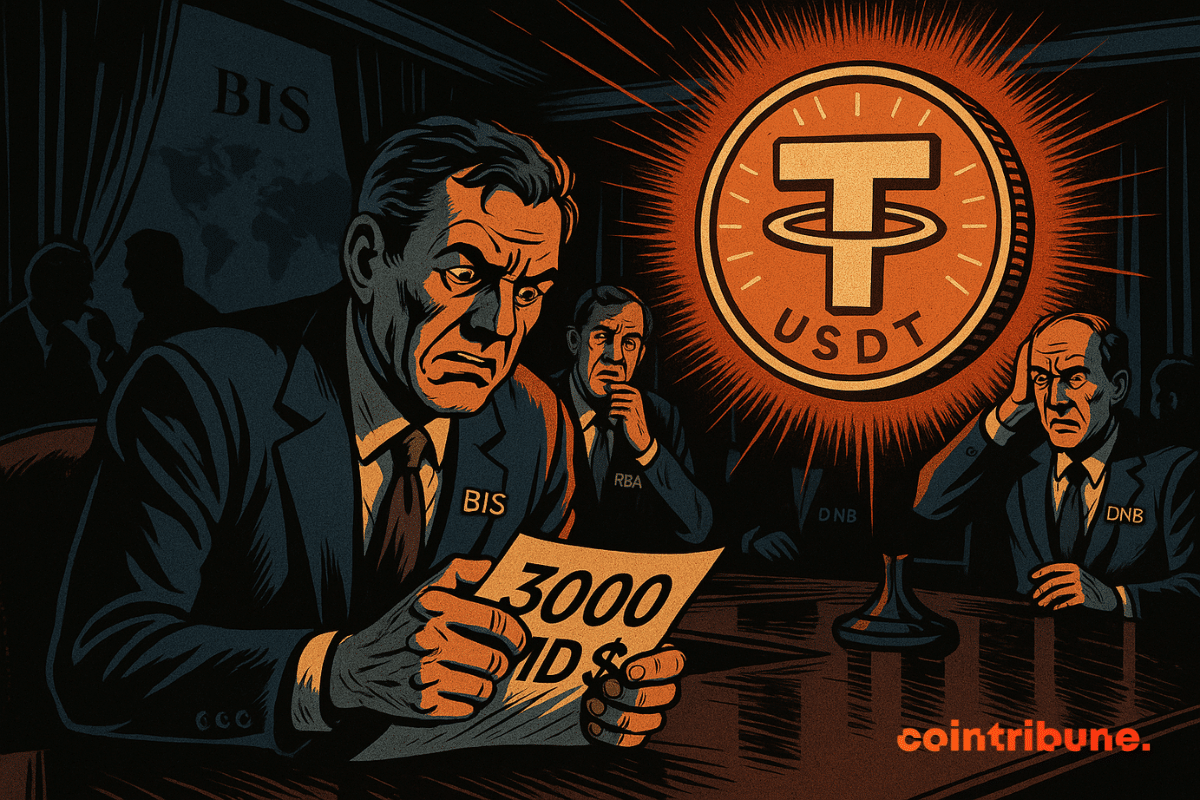
In the world's top financial circles, there has never been any question of shortchanging crypto. Even less to its decentralized avatars. We observe them, we supervise them, we suspect them. Even stablecoins, although designed to reassure with their anchoring to the dollar, raise questions. In a global atmosphere tense by geopolitical risks, they are now the ones that some see as the possible fuse of a future bond fire.
In brief
- A run on stablecoins could trigger a sell-off in US Treasuries.
- The GENIUS Act imposes a 1:1 reserve for regulated stablecoins issued in the United States.
- Some experts claim that stablecoins are more secure than traditional banks.
- The stablecoin market could exceed $3 trillion by 2030 according to BIS.
Stablecoins at the crossroads of liquidity and panic
The historical parallel is chilling: the Bank for International Settlements (BIS) evokes a risk similar to the Lehman Brothers debacle of 2008. This time, the trigger could well be a “run” on stablecoins, these inefficient and dangerous assets for the global economy. Clearly, if a loss of confidence occurs, holders could all want to cash in their tokens, forcing issuers to urgently liquidate their US Treasury bonds.
This is not a science fiction scenario. During the USDC depeg in March 2023, after the collapse of Silicon Valley Bank, the crypto lost almost $20 billion in one day. And this, without war, without global crisis, just a faltering bank.
Olaf Sleijpen, governor of the Dutch Central Bank, warns :
If stablecoins are not that stable, we could find ourselves in a situation where the underlying assets need to be sold quickly.
Faced with this specter, the Bank of Australia and the BIS share the same concern: a massive liquidity shock could unbalance not only crypto markets, but also the heart of the global financial system.
GENIUS Act: regulatory shield or sweet illusion?
Faced with doubts, the American regulatory response has a name: the GENIUS Act. It imposes a simple rule: each regulated stablecoin must be backed by 1:1 reserves, composed exclusively of liquid assets such as short-term Treasury bills. A model without leverage, without return, without risk? This is what Coinbase stands for.
Faryar Shirzad, Chief Policy Officer at Coinbase, does not mince his words:
First, banks make long-term, often risky loans to individuals and businesses, exposing them to credit and liquidity risks. In contrast, stablecoin issuers typically hold short-term government bonds that are virtually risk-free and highly liquid.
He goes even further, arguing that this stable architecture opens the way to a new programmable dollar, equivalent in value to the classic greenback. The argument is that unlike the “free banking” era of the 19th century, GENIUS stablecoins would be standardized, supervised and interoperable. Exit the jungle, make way for unity.
But not everyone sees this law so favorably. For the most skeptical, if mass adoption occurs without global coordination, even perfect infrastructure could be overtaken.
Crypto, explosive growth and global tension: is the cocktail sustainable?
This debate over stablecoins cannot be isolated from the entire crypto ecosystem. Since 2022, volumes in the stablecoin market have continued to grow. The BIS mentions a potential capitalization of 2,000 to 3,000 billion dollars by 2030. The slightest stress could trigger a “domino effect”: asset sales, massive withdrawals, tension on rates.
It is no coincidence that the RBA report (October 2025) warns of the fragility of this system in the event of a fall in confidence. And during this time, other cryptos follow their course, also exposed to the dynamics of stablecoins. If these crack, the whole building could falter.
For Shirzad, these fears are unfounded. According to him, the report misses a crucial point: stablecoins offer much greater traceability than the banking system. This would limit financial crimes, streamline automated processes and strengthen the effectiveness of public security systems.
But for regulators, caution trumps tech-savvy enthusiasm.
Figures & signals not to ignore
- In March 2023, USDC fell to $0.88 after the SVB bankruptcy;
- The stablecoin sector could be worth $4 trillion by 2035;
- More than 80% of the market is now controlled by Tether and Circle;
- In one day, $20 billion was wiped from the crypto market after Trump's tariff threats in October 2025;
- According to the BIS, even a moderate shock could rival the tensions of March 2020 on Treasuries.
In recent days, a new actor has come to support the BIS's concerns: the Banque de France. She published a note calling for increased vigilance on the issue of stablecoins, highlighting their systemic potential. In France too, the lines are moving. Distrust is no longer an ideological posture, but a precautionary measure in the face of a rapidly changing crypto industry.
Maximize your Tremplin.io experience with our 'Read to Earn' program! For every article you read, earn points and access exclusive rewards. Sign up now and start earning benefits.