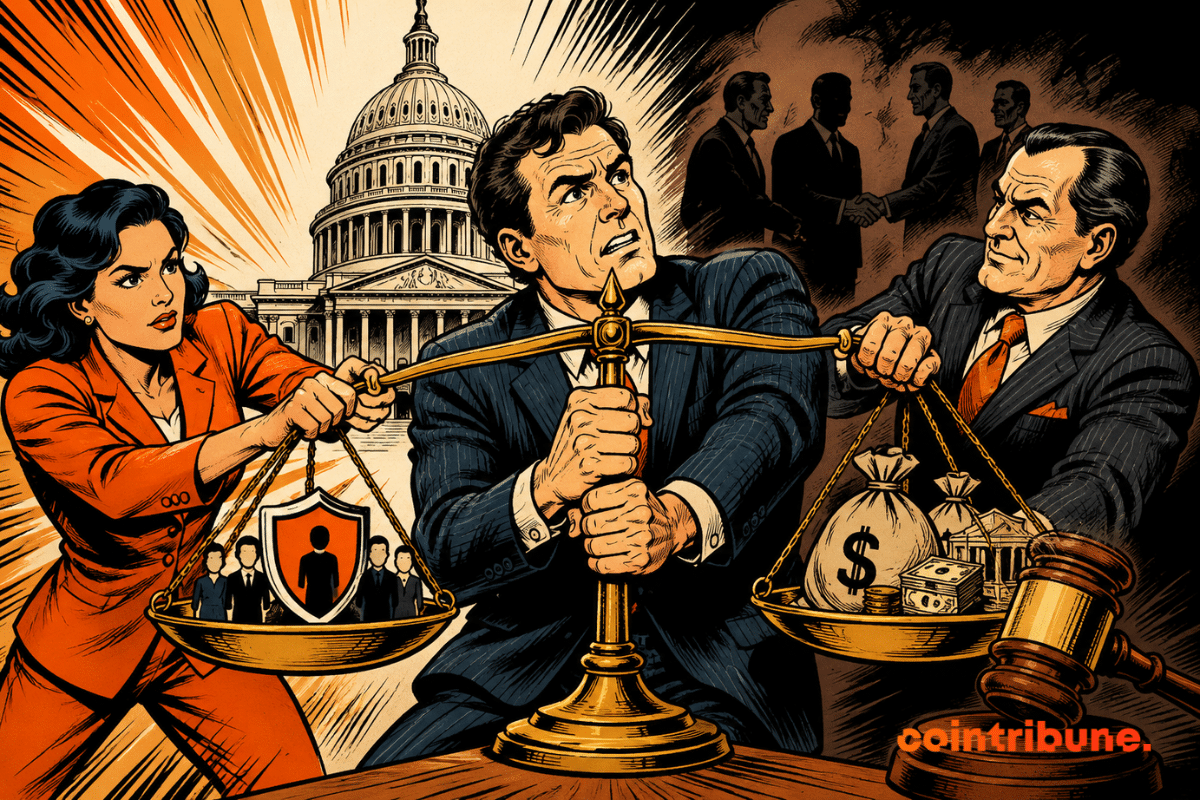
The debate around the digital asset market is once again intensifying in the US Senate. While elected officials continue discussions on the CLARITY Act, the negotiations remain marked by several sensitive points, notably investor protection and ethical questions. Behind this text, considered one of the most important legislative projects for the cryptocurrency industry, Democrats and Republicans are still trying to find common ground. The latest discussions behind closed doors, however, illustrate divergences which could still influence its adoption.
In brief
- Democrats added new consumer protection measures to the CLARITY Act during negotiations in the Senate.
- The ethics-related provisions remain a sticking point for several Democratic senators.
- Coinbase now supports the bill after expressing reservations about a previous version.
- The text is still awaiting a final version and a vote date in plenary session in the Senate.
The CLARITY Act evolves around consumer protection
Final negotiations continue in the U.S. Senate ahead of an expected vote on the bill. In a interview granted to CNBC on Monday, Ryan VanGrack, vice president of Coinbase, declared that the elected Democrats obtained the addition of new provisions intended to strengthen consumer protection. These modifications aim to give more weight to the text without calling into question its main objective.
The current system does not have this infrastructure, nor these protections, and Democrats have wisely used this opportunity to ensure that consumers are at the heart of this bill. Ultimately, it is about their protection.
Ryan VanGrack, vice president of Coinbase. Source: CNBC.
According to his statements, the discussions placed users at the center of concerns. He believes that the current regulatory environment does not provide sufficient infrastructure to effectively protect consumers. In this logic, the new measures integrated into the CLARITY Act respond to a request made by several Democrats during the last negotiations.
On the other hand, Ryan VanGrack did not indicate whether provisions relating to ethics had been added to the project. However, several elected Democrats consider these guarantees essential before granting their support. This question therefore remains one of the main topics of discussion around the text.
Coinbase now supports the project despite a turbulent journey
Coinbase’s role in the discussions has also evolved over the past few months. In January, CEO Brian Armstrong announced that the platform could not support a previous version of the text. This position would have contributed to the postponement of its examination by the Senate banking committee.
Since then, several company executives have shown greater support for the project. Ryan VanGrack spoke publicly about the progress of the negotiations, while Legal Director Paul Grewal also defended the Senate’s passage of the CLARITY Act. He wrote in a post on X:
Are you indifferent or rather neutral towards cryptocurrencies? Vote for the CLARITY Act to show that Congress can still take concrete action with the power given to it by the American people. It’s time.
Paul Grewal, Chief Legal Officer of Coinbase. Source: X / @iampaulgrewal.
This development comes as the platform seeks to closely monitor regulatory discussions surrounding digital assets. The context nevertheless remains marked by the previous dispute between Coinbase and the Securities and Exchange Commission.
Under the Biden administration, theAmerican authority had initiated proceedings against the companyaccusing him of carrying out unregistered activities as a stock exchange, broker and clearing house. The case was finally closed after Donald Trump took office and then the appointment of Mark Uyeda as interim chairman of the SEC.
Ethical questions further complicate the vote on the text
The CLARITY Act benefits from the stated support of Donald Trump, but several senators continue to express their reservations. After the death of Senator Lindsey Graham, the American president called on members of the Senate to adopt the text in tribute to this elected official, whom he presented as a fervent supporter of this reform.
At the same time, Republican elected officials reportedly met with Donald Trump to discuss the future of the bill. For their part, several Democrats are questioning the president’s ties to the cryptocurrency sector. At the end of June, Donald Trump declared having received $1.4 billion in income from his Official Trump token (TRUMP), World Liberty Financial and other investments linked to digital assets. These elements fuel the debates around the CLARITY Act and possible conflicts of interest.
Discussions are also continuing within the Democratic camp. Senators met behind closed doors to consider their positions before the vote. At this stage, the final text of the CLARITY Act has still not been made public and no date for a plenary vote has yet been announced. The outcome of the latest negotiations will now determine whether the project manages to gather a sufficient majority while meeting the expectations expressed on consumer protection, ethical requirements and the future of crypto regulation in the United States.
Maximize your Tremplin.io experience with our ‘Read to Earn’ program! For every article you read, earn points and access exclusive rewards. Sign up now and start earning benefits.