
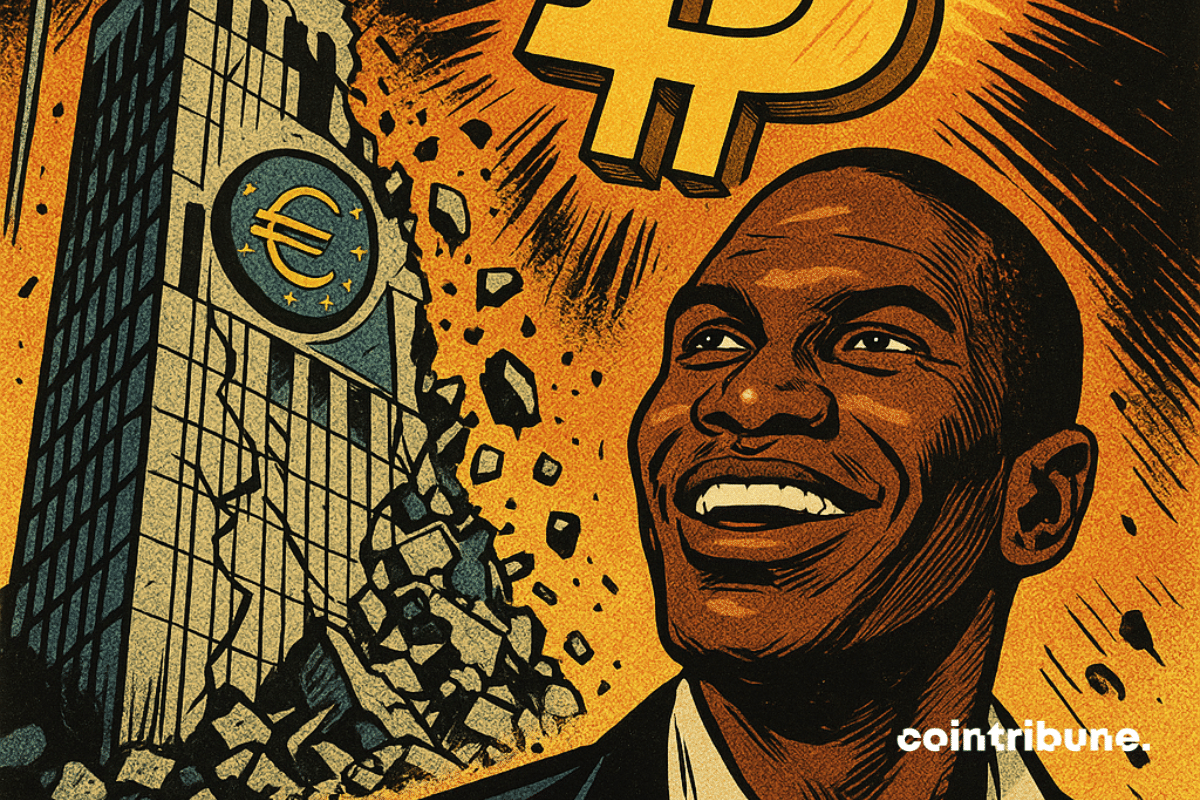
Arthur Hayes puts a part in the machine. This time, his target is not the Fed, but the euro zone. And its message is clear: if the ECBFS, Bitcoin takes advantage of it.
In short
- Arthur Hayes believes that financial instability in Europe is strengthening the attraction of Bitcoin as a rare active.
- The French debt and the BCE dilemmas could accelerate the dilution of the euro.
- For Hayes, these tensions create a structural catalyst in favor of Bitcoin, beyond conventional market cycles.
Why could monetary policy become an unexpected catalyst
Hayes advances a simple mechanism. When a central bank faces a crisis of confidence, it buys time with the ticket plank. Not for pleasure. Out of necessity. In this context, the euro is diluted. Rare asset gains mechanically in attractiveness.
This reasoning is not theoretical. The episodes of monetary stress create arbitrations. Investors sell what depreciates in real terms. They take refuge towards limited offer assets. Gold has been playing this role for decades. Bitcoin endorses it more and more often during liquidity shocks.
Above all, the transmission is rapid. Unconventional policies, asset purchases, promises of support “whatever it costs”: all of this feeds the rarity bonus. With each monetary screw, the narrative “active hard vs currency” is strengthened. Hayes only explodes this dynamic in the European case.
France, debt and systemic risk
The stumbling block, according to Hayes, is France. Key economy, heavy debt, permanent financing needs. An increase in risk premiums on French debt would put the ECB in front of a dilemma. Let the market do, or monetize. In both cases, confidence in the euro would be tested.
If the ECB chooses the impression, the euro depreciates. If it refuses, the risk of fragmentation reappears. Capitals are protected. For him, the outcome is identical. The balance sheets swell. The currency dilutes. Bitcoin draws a structural advantage.
This debate goes beyond France. It affects the architecture of the euro zone: a single currency, multiple budgets, a central bank with a delicate mandate. At each peripheral crisis, the ECB is summoned to arbitrate between financial stability and orthodoxy. This institutional vagueness is, in itself, latent volatility and narrative fuel for Bitcoin.
What it involves for Bitcoin and the market
In the shock phase, Bitcoin can fall with risky assets. But if the political response is softening, the trajectory is often overturned. Liquidity returns. The preference for rare assets leaves. It is this second breath that aims Hayes' analysis.
Monetary cycles do not change in a weekend. They announce themselves, dispute, then impose themselves. For a crypto investor, this implies patient management: clear thesis, measured size, cash ready to be deployed when the macro narration rocks. The staggered entries are, here, a discipline more than an opinion.
A hypothesis is not a fact. The ECB may surprise. French fiscal policy can rotate. The markets can reassess the risk without panic. In this scenario, the BTC progresses less by “crisis” than by “adoption”: infrastructure, regulated products, institutional flows. One does not exclude the other. But confusing catalyst and certainty remains the best way to burn yourself.
Maximize your Cointribne experience with our 'Read to Earn' program! For each article you read, earn points and access exclusive rewards. Sign up now and start accumulating advantages.


