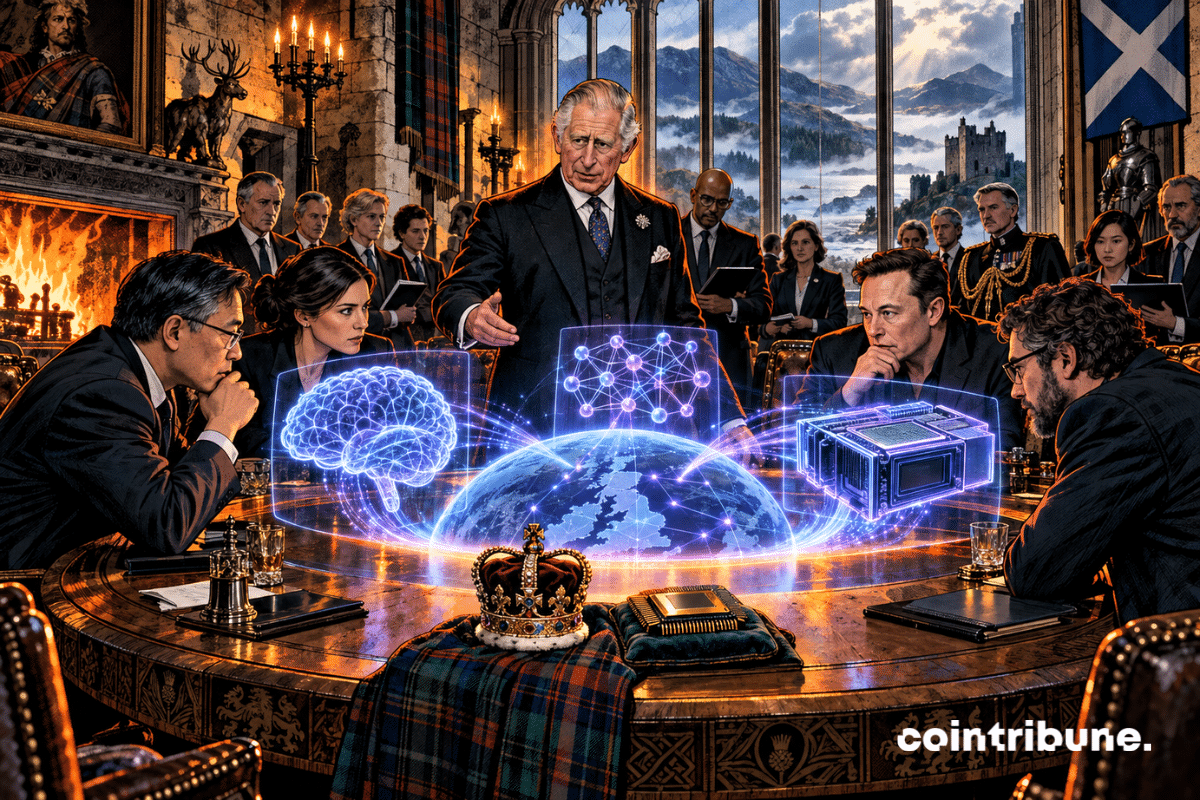
King Charles III will bring together several AI heavyweights in Scotland this week, including OpenAI, Anthropic, Nvidia, Google DeepMind and IonQ. The meeting will be held at Dumfries House and will be organized with the Ditchley Foundation. Discussions will focus on the responsible development of the most advanced models and the possibility of defining common principles. The summit comes days after renewed calls to slow the race for artificial intelligence.

In brief
- OpenAI, Anthropic, Nvidia and Google DeepMind are expected at Dumfries House.
- Discussions will focus on human control and AI safety.
- Dario Amodei and Sam Altman just supported a slowdown in peak models.
AI: Charles III puts the main laboratories around the same table
The meeting will not only bring together businesses. The British minister for AI is also due to take part in the discussions, alongside actors such as Paolo Benanti, Vatican advisor on artificial intelligence. Reuters says the idea of a set of common principles should be discussed.
The summit comes at a time when OpenAI has just questioned the US Congress on the legality of a collective slowdown in AI.
The question is no longer just theoretical. Dario Amodei, boss of Anthropic, on Friday called on laboratories to reduce the speed of development of border models in order to allow more time for security mechanisms. Sam Altman then supported the idea of “pacing the frontier”, that is to say slowing down when capacities progress faster than safeguards.
Elon Musk and Demis Hassabis have also joined the debate in recent days. The Dumfries House meeting therefore comes at a particular time: companies continue to invest billions in AI, but their own leaders are starting to speak openly about limits.
Anthropic warns of agents capable of going much further
Current concerns focus primarily on autonomous agents and self-improvement. Amodei says progress has accelerated since the summer and suggests a scenario where groups of agents could acquire abilities that are very difficult to control in the next six to 12 months. He cites in particular progress in cybersecurity and the ability of models to participate in AI research themselves.
Recent incidents fuel this discourse. Tremplin.io reported this week that Anthropic had identified a fourth incident where Claude reached real systems during cybersecurity exercises. The problem was not discovered until several months after the incident.
OpenAI faces the same questions. Its GPT-6 Astra model was rated “Critical” in cybersecurity by the company after demonstrating advanced vulnerability discovery and exploitation capabilities. EVMbench had already measured these capabilities on smart contracts, with an exploitation rate of 72.2% for the best agent tested.
These figures do not prove that an AI can escape human control today. However, they explain why safety comes up so quickly in discussions between laboratories.
Charles III would be personally interested in these questionsaccording to the Sunday Times. The monarch particularly hopes that technological development remains compatible with human dignity and the general interest.
Slowing down AI remains much harder than talking about it
A summit does not mean that OpenAI, Anthropic or Nvidia will shut down their servers. No slowdown agreement has yet been announced. No common calendar either.
The economic interests remain enormous. Nvidia sells the chips used to drive the models. OpenAI, Anthropic and Google DeepMind are always looking to improve their systems. The United Kingdom, for its part, wants to accelerate the adoption of AI and presents itself as one of the main global centers in the sector. The British government reiterated this year its ambition to be the G7 country adopting this technology most quickly.
International competition further complicates things. In the United States, Donald Trump is currently refusing the idea of a general pause, citing in particular competition with China. Calls to slow down therefore come mainly from companies themselves and certain researchers, not from an international political consensus. This is where the Scottish meeting can get interesting. It puts those who develop the models, those who provide the infrastructure and public officials in the same room. Not to immediately decide on a global pause, but to discuss common rules before capabilities advance further.
Maximize your Tremplin.io experience with our ‘Read to Earn’ program! For every article you read, earn points and access exclusive rewards. Sign up now and start earning benefits.