
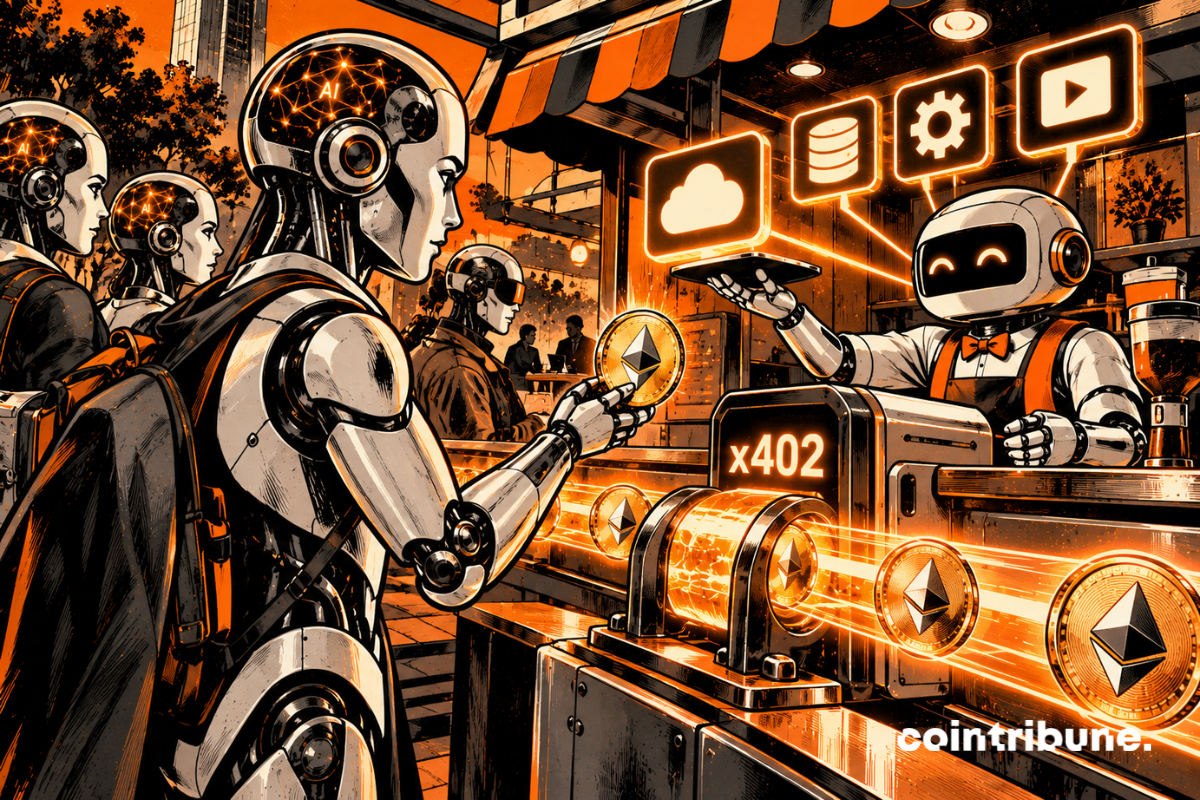
AI agents have made more than 138 million payments via the x402 protocol on Base, according to a Chainalysis study published on October 14. However, this figure measures a number of transactions, and not $138 million: more than 87% of the transactions analyzed are worth less than ten cents.
In brief
- More than 138 million payments have been made via the x402 protocol on Base, according to Chainalysis.
- More than 87% of transactions involve amounts less than ten cents, illustrating the rise of micropayments between AI agents.
- The United States dominates payments linked to AI models, while China stands out in security and code analysis services.
- Stablecoins facilitate automated transactions, but the high number of transactions is not enough to demonstrate mass adoption of AI agents.
Tiny payouts, but a fast-growing business
The x402 protocol allows standalone software to directly pay for a service online without requiring human validation for each expense. Initially developed by Coinbase, it relies in particular on stablecoins to pay amounts that are too small for traditional bank card networks.
THE main figures of the study allow us to measure the growth of this still experimental economy:
- More than 138 million x402 transactions have been recorded on Base since the protocol’s launch;
- More than 87% of payments were between 0.01 cents and 10 cents;
- The most common range was between 1 and 10 cents;
- The median time between funding a wallet and its first payment fell from 73 days to 18 minutes;
- The share of portfolios replenished within 30 days increased from 70.6% to 89.3%.
These operations are used to purchase data, query a programming interface, access an AI model or have code reviewed. An agent responsible for a mission can thus acquire alone the digital resources necessary for its execution.
Stablecoins present an economic advantage here. A transaction of just a few cents would typically be absorbed by the fees of a card payment. On an inexpensive blockchain like Base, it can remain viable.
Circle summarizes this distribution of uses with a formula:
Cards for consumer-triggered agent payments, stablecoins for machine-to-machine settlements too small for card economics.
US dominates purchases of AI models
Wallets linked to the United States represent 30% of location-based payments made between agents and services on x402. Their domination appears even clearer in a specific category: they account for 88.1% of regulations intended to use artificial intelligence models.
The share of portfolios linked to China only reaches 0.1% in this category. Chain Analysis advance a possible explanation: Chinese developers can rely more on open national models, such as DeepSeek or Qwen, while the main American models are often billed on a per-use basis.
However, the situation is reversed for certain specialized services. Chinese wallets are responsible for nine out of ten payments dedicated to security and code analysis. Most of this activity has been directed toward AgentLISA, a tool that uses a language model to audit Solidity smart contracts.
On-chain data therefore does not describe the entire global market. They only cover x402 transactions that Chainalysis was able to identify and geolocate. The high US share does not mean that the US makes 88% of all payments between AI agents.
The number of transactions is not enough to prove adoption
The growth of payments and the more frequent replenishment of wallets suggest that some projects are moving from simple tests to recurring uses. Hoolie Tejwani, head of Coinbase Ventures, believes that “AI agents become economic actors, each agent effectively constituting a new user of the blockchain”.
This conclusion must nevertheless remain cautious. A transaction recorded as coming from an agent does not necessarily prove that an AI system made a real economic decision on its own. Classic scripts, automated tests or operations between wallets controlled by the same actor can also inflate the statistics.
The cumulative amount transferred would also constitute a more telling indicator than just the number of operations. With a majority of payments below ten cents, 138 million transactions do not necessarily represent a considerable financial volume.
Rather, the most significant change lies in the ability to monetize each query. Data, research or a few seconds of calculation can be sold individually without subscription and without heavy banking infrastructure. Will Su, head of digital assets research at BlackRock, believes that agents could thus create significant demand for frequent, low-value, constantly executed payments.
The next step will be to determine whether these flows correspond to useful and sustainable services. For now, x402 above all demonstrates that a blockchain can provide autonomous software with a means of payment suitable for tiny expenses.
Maximize your Tremplin.io experience with our ‘Read to Earn’ program! For every article you read, earn points and access exclusive rewards. Sign up now and start earning benefits.


