
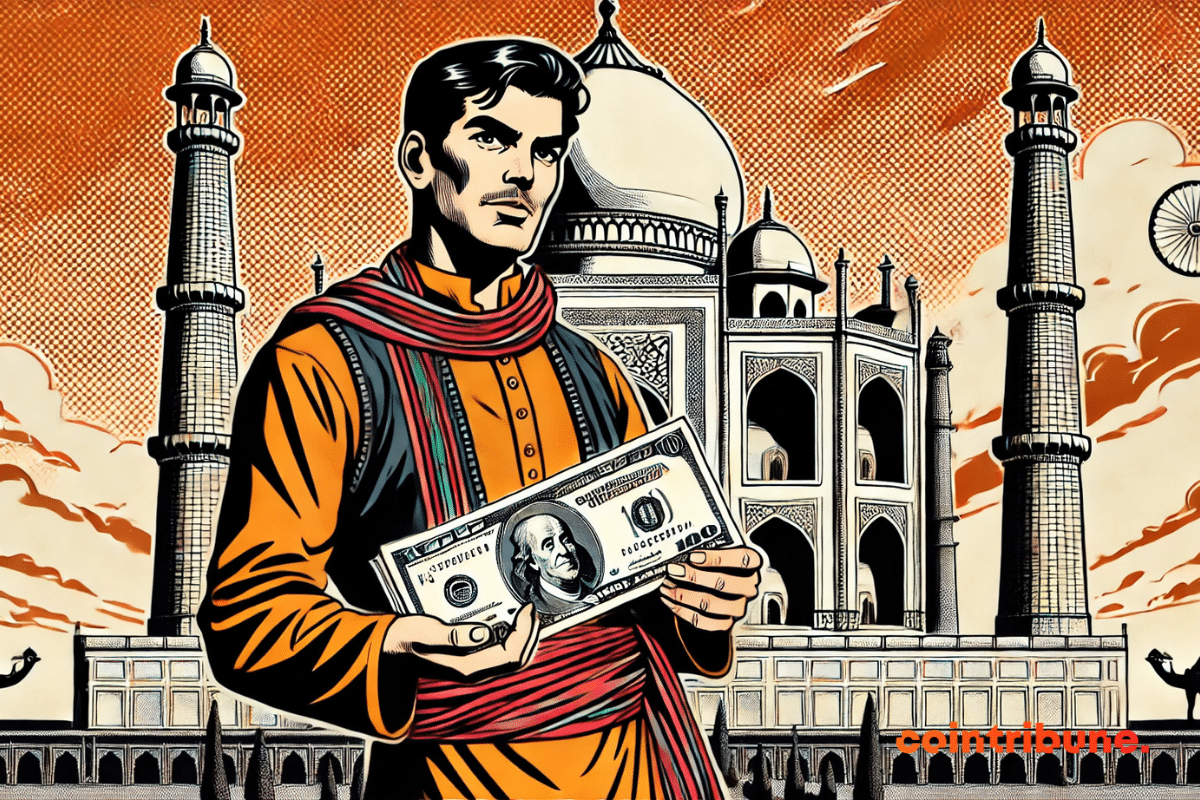
The question of dedollarization agitates the major economic powers. While the BRICS are looking for alternatives to the US dollar for their international exchanges, India takes a different path. The Minister of Foreign Affairs, Subrahmanyam Jaishankar, clarified the country's position during a visit to the United Kingdom: “India does not plan to replace the dollar as a reference currency”. A statement that contrasts with the global trend and which causes questions about the strategic motivations of New Delhi.
Support affirmed to the dollar despite the tendency to diversification
During his recent intervention, Subrahmanyam Jaishankar wanted to dispel any ambiguity on India's position against the dollar: “There is no policy on our part which aims to replace the dollar. At the end of the day, the dollar as a reserve currency is a source of international economic stability ”.
This is a clear position at a time when several major economies seek to reduce their dependence on the American currency.
Despite its membership of the BRICS, India does not follow the last line of some of its partners on the monetary issue.
Contrary to the perception of a united front within the organization, the Minister has clarified “That there is no unified position of the BRICS against the dollar”. Thus, each country pursues clean interests, and New Delhi favors an approach that promotes financial stability and foreign investments, rather than an economic confrontation with the United States.
Maintaining the dollar as a reference currency is explained by several reasons:
- International financial stability: the dollar remains the main reserve currency and its maintenance avoids economic shocks;
- Trade flows and major investments in dollars: a large part of Indian foreign trade is denominated in dollar, which makes any substitution risky;
- The weight of strategic relations with the United States: thanks to the strengthening of its economic ties with Washington, India secures trade agreements and international funding;
- A distrust of an alternative Brics still uncertain: unlike certain expectations, the BRICS have not adopted a coordinated position on dedollarization, which gives way to individual strategies.
Far from engaging in a sudden break with the dollar, India is therefore seeking to preserve its economic interests and to continue the diversification of its monetary tools.
A dual strategy: internationalize the rupee without challenging the dollar
If India does not call into question the hegemony of the dollar, it is making efforts to internationalize its own currency. Jaishankar underlined this ambition:
We clearly promote the internationalization of the roupie because we actively globalize India.
This will involves the development of trade agreements which allow rupees regulations, in particular with countries with difficulty in access to strong currencies.
Such a dynamic is reflected in the implementation of direct payment mechanisms in rupees with several economic partners. The goal is twofold: to reduce the dependence on the dollar fluctuations and strengthen the country's monetary sovereignty.
However, this approach remains complementary, and not opposed, for the use of the dollar in international exchanges.
In parallel, India remains pragmatic in the face of world monetary tensions. US threats to economic sanctions against countries engaged in a dedollarization policy have led certain states to a more prudent posture.
Donald Trump, for example, has already mentioned customs prices of up to 150 % on nations seeking to move away from the dollar. Rather than confrontation, India adopts a strategic approach which aims to preserve its economic interests and to consolidate its links with Washington.
This choice of a hybrid strategy reflects a desire to adapt to developments in the global financial system. By consolidating the Place de la Roupie on the international scene and by the conservation of the dollar as a pivot of its monetary policy, India seeks to position itself as a central actor in a multipolar world. This pragmatism allows it to avoid economic turbulence linked to a too steep turnaround in order to prepare its economy for future transformations. With this posture, India is not content to follow a guideline dictated by the BRICS or the United States. It shapes its own economic and monetary trajectory.
Maximize your Cointribne experience with our 'Read to Earn' program! For each article you read, earn points and access exclusive rewards. Sign up now and start accumulating advantages.


