
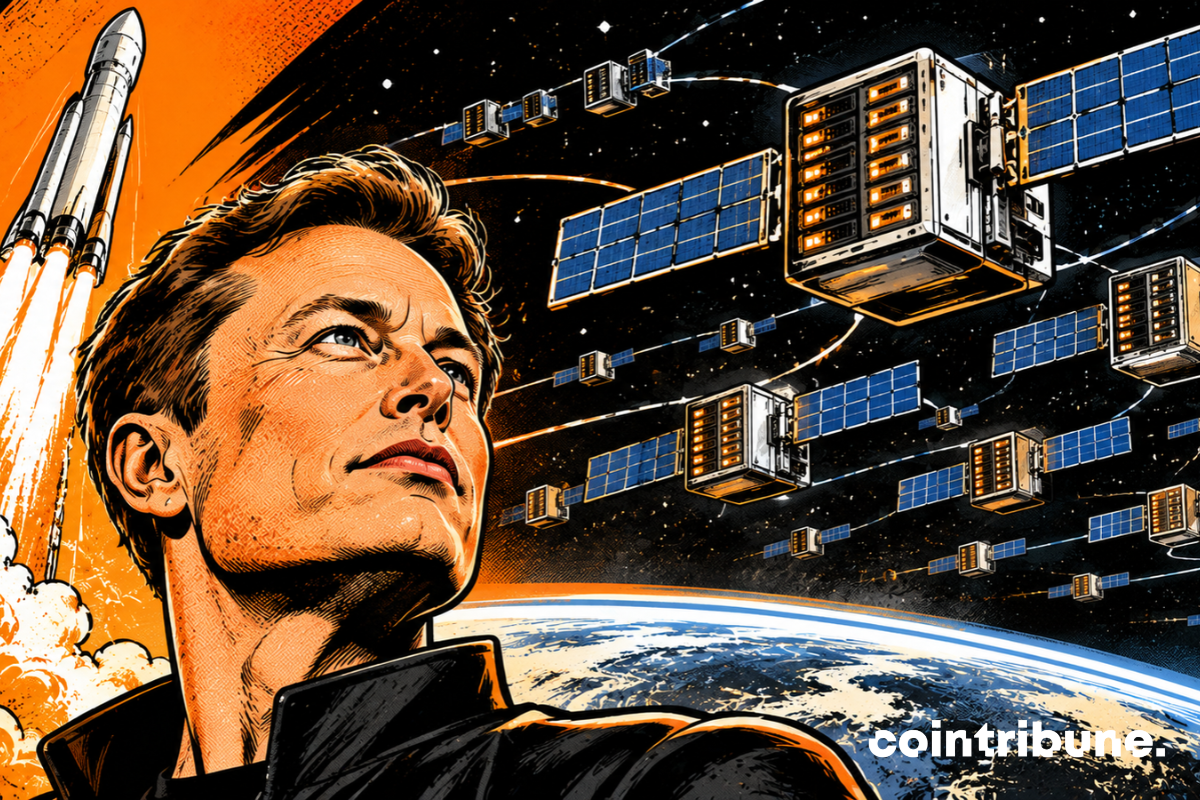
The authorization granted to SpaceX to deploy up to one million satellites dedicated to artificial intelligence calculation marks a turning point in the race for digital infrastructure. However, behind this regulatory victory for Elon Musk lies a less spectacular reality. Obtaining the right to occupy the orbit does not mean having all the necessary authorizations to operate data centers there. The real challenge for SpaceX could therefore be as much legal and industrial as technological.
In brief
- SpaceX obtains the green light from the FCC for its Starmind project, which plans up to one million satellites dedicated to artificial intelligence.
- The American authorization imposes a precise timetable and does not yet cover all the planned operations.
- Orbit is becoming a new field of competition between SpaceX, Google and Blue Origin to develop AI infrastructures.
- The management of space debris, the risks of congestion and regulatory constraints could slow down Elon Musk’s project.
Starmind, a million satellites and an authorization that doesn’t solve everything for SpaceX
On November 25, 2026, the Federal Communications Commission (FCC) gave the green light to SpaceX’s Starmind project. This constellation could have up to a million satellites in low orbit, designed to carry out artificial intelligence calculations and transmit their results to Earth.
This decision constitutes a major step forward for Elon Musk, but its scope deserves to be clarified. The FCC has not given a blank check to all of the operations planned by SpaceX. Its authorization concerns in particular emergency radio communications and satellite telemetry, tracking and control functions.
Several elements remain decisive:
- The deployment schedule: SpaceX must place its first operational satellite in orbit before November 2033;
- The ramp-up: half of the constellation must be deployed before November 2038, and the whole before November 2040;
- Communications: exchanges must mainly be based on laser links, with authorized radio frequencies serving as a backup solution;
- Debris management: certain end-of-life conditions for satellites, particularly above 600 kilometers in altitude, remain subject to additional authorizations.
Nuance is essential. SpaceX has obtained strategic authorization, but must still demonstrate its ability to meet the technical and regulatory requirements associated with an orbital infrastructure of unprecedented scale.
Orbit becomes a new territory of industrial competition
Until now, the battle for artificial intelligence has been fought mainly around processors, models and access to electricity. With Starmind, SpaceX intends to move part of this competition to space. The objective is to circumvent certain physical limits of terrestrial infrastructures, notably the availability of energy and the constraints of electrical networks.
The satellites must operate using solar energy and communicate with each other via optical links. Elon Musk’s company is banking in particular on its ability to reduce launch costs thanks to Starship, its reusable heavy launcher. The company plans to begin the first deployments in 2027, before gradually ramping up production.
However, this strategy opens a new industrial question: who will control the orbital infrastructures essential to the artificial intelligence of tomorrow?
SpaceX is not alone in this field. Google is developing Project Suncatcher, while Blue Origin is also working on on-orbit computing infrastructure. American authorization could thus accelerate a competition in which launch capabilities, access to electronic components and mastery of space communications will become decisive advantages.
The real risk is building an infrastructure without legal precedent
Starmind’s ambition goes far beyond the usual difficulties of a satellite project. A constellation of a million devices would profoundly modify the orbital environment and raise new questions of responsibility.
Amazon Leo, Viasat and the American Astronomical Society have notably expressed reservations regarding the risks of space congestion, interference and the consequences for astronomical observations. The FCC rejected appeals filed against the project, finding in particular that certain environmental and scientific concerns did not fall directly within the scope of its radio authorization.
The question of the end of life of satellites particularly illustrates this difficulty. SpaceX particularly wants to be able to send certain devices into heliocentric orbits rather than systematically having them re-enter the atmosphere. The FCC, however, postponed its decision on this possibility due to lack of sufficient information.
This point could become a significant obstacle to Starmind’s expansion. Because unlike a terrestrial data center, an orbiting IT infrastructure cannot be dismantled or repaired as easily. Each failure, collision or replacement operation involves additional constraints.
Ultimately, the green light from the FCC does not yet mark the birth of a new generation of data centers. Rather, it opens a decisive phase: one where SpaceX, which is aiming for a valuation of $1000,000 billion, will have to prove that an IT infrastructure of such magnitude can operate sustainably without compromising other space activities. For Elon Musk, the next frontier of AI will therefore not only be technological. It will also be regulatory.
Maximize your Tremplin.io experience with our ‘Read to Earn’ program! For every article you read, earn points and access exclusive rewards. Sign up now and start earning benefits.


