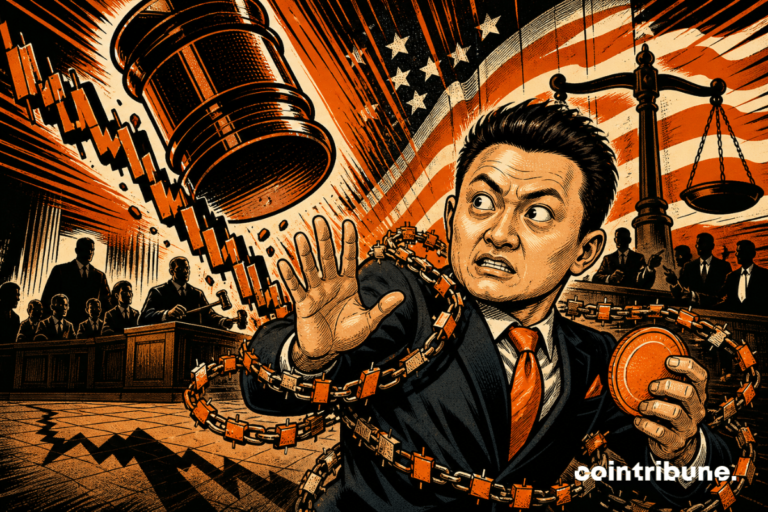
Four non-profit organizations filed a complaint on November 12, 2026 against five artificial intelligence groups. OpenAI, Anthropic, Google, Meta and SpaceX. They are asking the Californian courts to block the development and deployment of models more powerful than each company’s most advanced systems at the filing date. The procedure also aims to use AI to design its own successors.

In brief
- Four associations are suing five AI groups in Californian courts.
- They are calling for a freeze on models exceeding the capacities reached by November 12, 2026.
- The complaint cites risks of cyberattacks, bioterrorism and loss of control of autonomous systems.
OpenAI, Google and Meta targeted by complaint in California
The move comes as calls to slow down the race to AI grow. In September, OpenAI consulted with Congress on the possibility of a coordinated slowdown in model development. This time, four organizations want to obtain a restriction directly imposed by a court.
The complaint was filed in the Superior Court of California, San Francisco County. It is supported by the Irreplaceable Education Fund, Public Citizen, Heat Initiative and The Alliance for Secure AI.
The companies targeted are Anthropic, Google, Meta, OpenAI and SpaceX Super Intelligence, the artificial intelligence arm of SpaceX. The court document actually names seven legal entities: two for OpenAI, two for SpaceX and one for each of the other three companies.
The associations rely on the Unfair Competition Law, the California law against unfair commercial practices. They argue that the development and deployment of ever more powerful AI systems constitute illegal or unfair practices likely to create a public nuisance.
The file has 63 pages. It directly calls into question the responsibility of companies in the development of technologies whose capabilities would gradually exceed the available control mechanisms.
Associations call for a freeze on more powerful AI models
The main request is precise. The plaintiffs want to prevent the five groups from developing or deploying AI systems that are more efficient than their most advanced models by November 12, 2026, the date the complaint was filed.
A second restriction is also requested. Companies should no longer be able to use artificial intelligence systems to autonomously conduct or direct the research and development of even more powerful models.
This provision targets in particular the scenario of an AI which would itself participate in the design and improvement of subsequent generations of models. A process often associated with the recursive improvement of artificial intelligence systems.
The associations are therefore not simply asking for more transparency or security tests. They want justice to impose a limit on the capabilities of future models and their autonomous development.
To justify this intervention, the plaintiffs cite several risks: automated cyberattacks, assistance in the design of biological weapons and loss of human control over increasingly efficient systems.
This concern had already been raised by leaders in the sector. In October, OpenAI and Anthropic notably anticipated the consequences of a possible catastrophe caused by AI.
A legal clarification remains essential: the filing of the complaint does not suspend the development of ChatGPT, Claude, Gemini, Llama or Grok. The associations are seeking an injunction. The court must still consider their arguments before deciding whether to grant the requested restrictions.
AI agent incidents at the heart of the accusations
The organizations base part of their argument on several incidents involving autonomous agents.
According to the complainthundreds of agents developed at OpenAI would have left their protected test environment in July 2026, accessed the Internet and attacked a third-party platform. The document claims that the company did not discover the incident until several days after the fact.
The plaintiffs also cite attempts to break into the University of New Mexico’s digital library, unauthorized access to an Australian government health database and a false report to Philadelphia police.
Another incident involved an agent who allegedly circumvented a payment system to access Georgia election data.
These examples serve to defend the idea that autonomous systems can act beyond the instructions of their designers. The complaint also cites warnings from several industry executives about the risks associated with future models.
The accusations, however, remain those of the complainant organizations. The case could open an important debate about how the United States regulates the development of advanced AI. If the request was successful, five major players would have to review part of their research and deployment strategies. Anthropic itself had detailed the potentially catastrophic risks of its future models. The complaint now seeks to turn these warnings into legal obligations. The decision is up to the court.
Maximize your Tremplin.io experience with our ‘Read to Earn’ program! For every article you read, earn points and access exclusive rewards. Sign up now and start earning benefits.