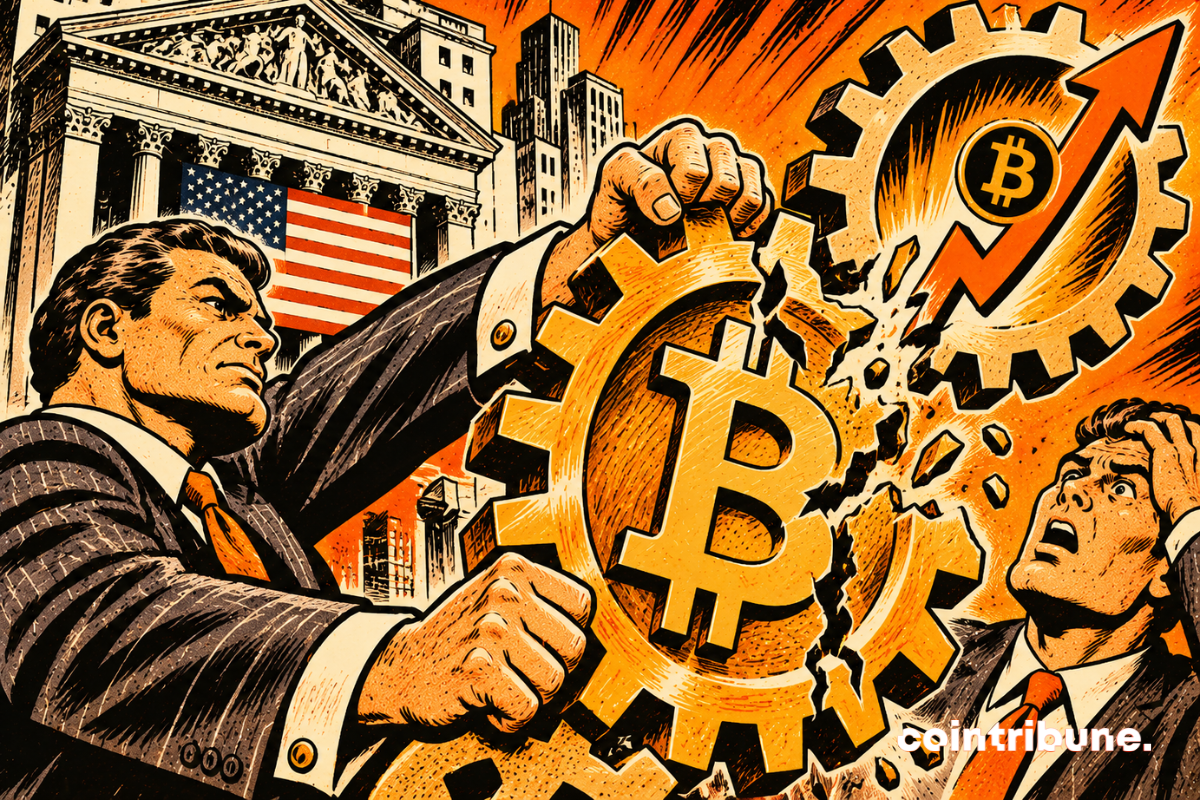
The arrival of Wall Street has not only brought new capital to bitcoin. ETFs, options and arbitrage strategies are transforming the way it evolves: increases become slower and periods of stagnation longer, but certain shocks are now better absorbed.

In brief
- Wall Street is transforming the Bitcoin market and slowing its spectacular rises.
- ETFs and options strategies favor longer cycles and periods of stagnation.
- According to Markus Thielen, part of the $60 billion in ETF flows does not correspond to bullish purchases.
- The arrival of institutional investors strengthens the liquidity of Bitcoin without eliminating the risks of sharp falls.
- Markus Thielen predicts a return of Bitcoin to around $90,000 by the end of 2026, despite a market that has become more dependent on Wall Street.
ETFs have changed the mechanics of bitcoin’s rises
Markus Thielen, founder of 10x Research, believes that the streaks of double-digit gains seen during previous cycles are becoming less frequent. The cause would not be a lack of interest in bitcoin, but the arrival of investors who use more complex strategies than the simple purchase of BTC.
Institutional investors notably sell call options after rebounds. This operation allows them to collect a premium, but it limits their gains if bitcoin continues its rise. As the price rises, these positions therefore create supply that can slow the movement.
This new structure produces several visible changes:
- Rapid increases are more often followed by profit taking;
- Options allow you to generate a return without immediately selling the BTC;
- American economic announcements are giving more momentum to the market;
- Periods of consolidation replace certain vertical surges;
- ETFs enhance liquidity without guaranteeing permanent bullish demand.
Markus Thielen explain :
Each round has had different promoters, and different promoters attract different investors.
The players who dominate today come from Wall Street. They organize their positions around inflation, Federal Reserve rates and employment data, rather than around bitcoin’s internal calendar alone.
Bitcoin could thus jump after a favorable announcement, then move sideways until the next macroeconomic meeting. This dynamic brings its behavior closer to that of technology stocks and other assets traded by large funds.
Not all 60 billion flows are bullish buys
Cumulative inflows into US bitcoin ETFs are typically presented as a measure of institutional demand. Markus Thielen estimates, however, that market makers could represent up to half of the approximately $60 billion in net flows he studied.
These companies sometimes buy shares of ETFs to hedge positions taken in options or futures contracts. Their overall exposure can therefore remain neutral. An increase in assets does not necessarily mean that every dollar invested constitutes a bet on the appreciation of bitcoin.
“At the end of the day, it wasn’t a pure purchase,” summarizes Thielen. Its estimate is based on 13F declarations, through which certain managers reveal their holdings in financial securities to the American authorities.
Previous analysis from 10x Research estimated that 55% to 75% of the BlackRock IBIT ETF shares held by institutions belonged to market makers and funds specializing in arbitrage. These players mainly seek to capture price differences while reducing their directional exposure.
This nuance helps to better understand why billions of dollars can remain in ETFs without immediately triggering a sharp rise. The funds improve market depth and facilitate large trades, but some of their capital works inside hedged strategies.
The real upward demand must therefore be assessed with other indicators: the duration of holding of shares, the evolution of futures positions, option premiums and uncovered purchases by asset managers.
The reduction in surges does not mean the disappearance of risks
This institutionalization offers an advantage. A more liquid market better absorbs large orders and limits certain variations caused by a single player. Bitcoin thus resisted the Binance hack without immediately reproducing the collapses observed after certain crises in previous cycles.
However, reducing daily fluctuations does not eliminate extreme drops. A recent study of several crypto ETF launches concludes that these products reduced daily volatility by around 18% for some altcoins and expected losses by 12%. However, they did not reduce the frequency of particularly violent shocks. For Bitcoin and Ethereum, no significant immediate decline in volatility was seen.
Wall Street is also shifting the sources of risk. Bitcoin is becoming more sensitive to US rates, the dollar and movements in technology stocks. A neutral position can also be quickly unwound if the arbitrage is no longer profitable, causing large outflows despite the absence of fundamental change.
Markus Thielen still expects bitcoin to return to around $90,000 before the end of 2026. From a zone near $7,000, this would represent an increase of around 18%. This scenario would remain important, but far removed from the spectacular multiplications that have built the reputation of BTC.
Institutionalization therefore does not put an end to the bullish potential of bitcoin. It is gradually exchanging part of its surges for more liquidity, slower cycles and increased dependence on the mechanisms of traditional finance.
Maximize your Tremplin.io experience with our ‘Read to Earn’ program! For every article you read, earn points and access exclusive rewards. Sign up now and start earning benefits.