
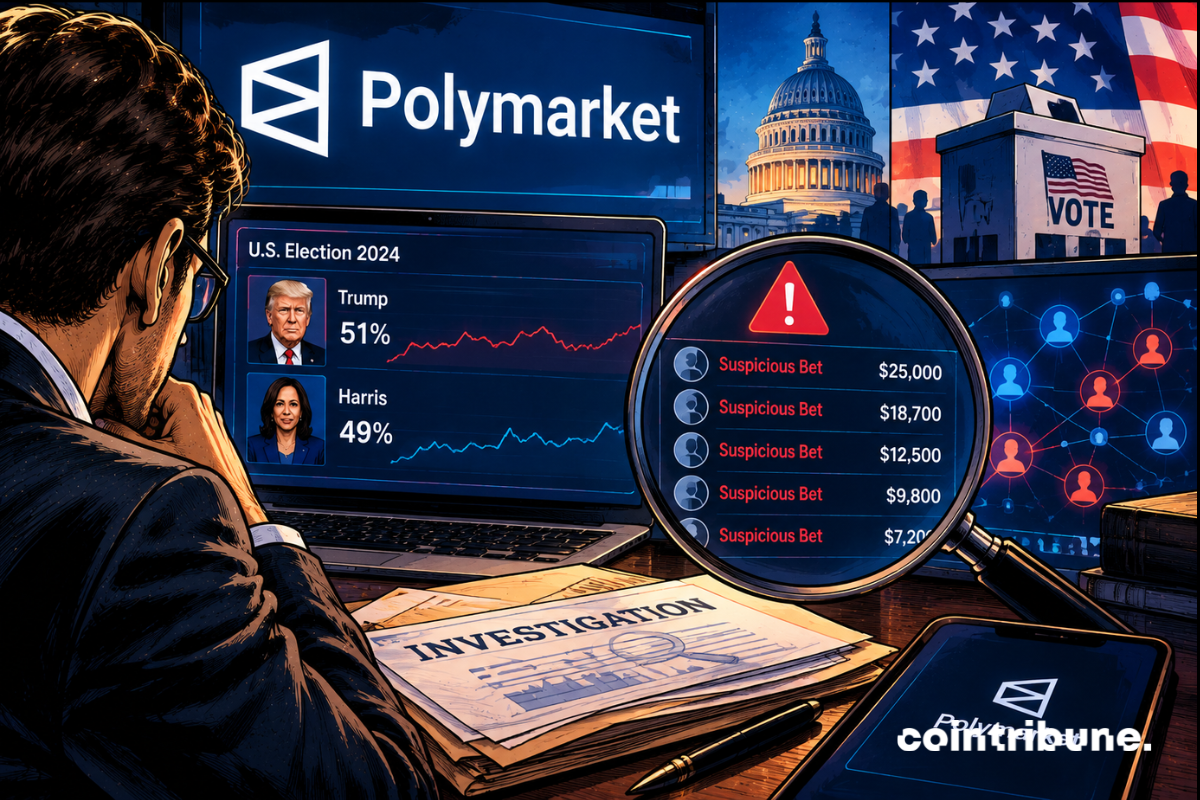
As the US midterm elections approach, prediction markets are drawing attention to the risks associated with confidential information. Polymarket has opened dozens of investigations into suspicious bets, including suspicions of insider trading and manipulation. According to NPR, its monitoring team receives hundreds of alerts every day. At least two files have been transmitted to the American authorities, while the platform strengthens its controls before the November 3 vote.
In brief
- Polymarket is investigating dozens of suspicious bets linked to the US midterm elections.
- At least two files were sent to the CFTC for suspicion of manipulation or insider trading.
- The platform’s monitoring system generates hundreds of alerts every day.
- A team of 16 people analyzes transactions and cross-references several data sources to identify suspicious activities.
- Polymarket strengthens its control tools, while prediction markets face risks linked to confidential information.
Polymarket strengthens monitoring of election betting
Polymarket is reviewing dozens of bets linked to the US midterm elections, according to statements by Shana Bautista reported by NPR. Global head of intelligence and investigations, she leads a team of 16 people responsible for spotting suspicious activities. In particular, the company seeks to identify users who could exploit non-public information to make money. These investigations take place before the election scheduled for November 3.
Bautista joined Polymarket in June, after working at the FBI and in cryptocurrency analysis. Since her arrival, she has overseen controls relating to electoral markets. His team uses a new monitoring system to spot unusual behavior and examine the risks of manipulation. According to NPR, at least two files resulting from these investigations were transmitted to the Commodity Futures Trading Commission (CFTC), the American authority responsible in particular for monitoring certain financial markets.
The manager also recalled that the use of confidential information contravenes the conditions of use of the two platforms operated by the company. She points out that these practices can also break the law. His team therefore intends to identify users who seek to benefit from information to which the public does not have access. However, the company has not communicated the details of the cases examined or the possible follow-up given to each file.
A system that generates hundreds of alerts per day
To identify suspicious transactions, Polymarket brings together several categories of data. Its system analyzes in particular publications on social networks, declarations from the Federal Election Commission (FEC), information from cryptocurrency companies and data from its banking partners. It also uses statistical models to spot behaviors that merit further investigation. When several internal indicators converge, the system triggers an alert to Bautista.
This method generates hundreds of reports every day, according to the head of investigations. However, an alert does not automatically mean that a user has committed an offense. Rather, it allows the team to spot activity that requires additional verification. Bautista refuses to reveal the precise criteria used by the system, in order to preserve its effectiveness and to prevent users from being able to circumvent the controls.
Monitoring covers two distinct environments. The American platform requires identity verification, while Polymarket International allows cryptocurrency transactions without systematic public identification of users. This difference potentially complicates the monitoring of operations, but Bautista believes that anonymity remains limited in the files examined by his team. She says investigators have always been able to identify, at least potentially, the people involved in the cases they work on.
Electoral markets exposed to the risk of manipulation
Betting on elections presents particular risks, as the information available can influence participants’ expectations. Rajiv Sethi, an economics professor at Barnard College, tells NPR that these markets can produce self-fulfilling effects. Indeed, the perception of a dynamic favorable to a candidate can modify the behavior and expectations of participants. Price movements then risk reinforcing an already perceived trend, without necessarily reflecting only the real chances of a candidate.
Suspicions of insider trading on these markets do not date from this investigation. In May, several campaign team members told NPR having won thousands of dollars through bets on their own candidates. They allegedly used confidential information regarding polls that had not yet been published. A former CFTC attorney explained that such operations could violate the law, depending on the circumstances.
This situation also concerns Kalshi, Polymarket’s main competitor. In May, the company launched a system based on FEC rules to prevent campaign members from betting on elections. In June, she added employment declaration obligations for certain high-risk markets and a risk assessment system. Kalshi then indicated that he had opened more than 150 investigations since the start of the year and transmitted more than 20 files to law enforcement. However, a member of a campaign team told NPR that they found a way around the restrictions.
Cooperation with authorities at the heart of controls
In April, Polymarket has partnered with Chainalysisa company specializing in blockchain analysis, to develop tools to strengthen the integrity of markets. This collaboration followed a few days after the indictment of an American soldier on active duty. He allegedly used classified information about an operation to capture Nicolás Maduro to place bets on the platform. According to reports, he pledged more than $33,000 and won nearly $410,000.
The soldier pleaded not guilty. Polymarket said it detected the suspicious transactions and alerted authorities before his arrest. This case highlighted the risks associated with using sensitive information in prediction markets. It also illustrates the importance of blockchain analysis tools for examining the movement of funds and finding the people behind certain transactions.
The role of the authorities, however, remains an important issue. According to NPR, the CFTC has done little so far to police prediction markets, leaving much of the oversight to the traders themselves. In September, agency employees nevertheless warned that contracts relating to the mention of specific words or the participation of a person in an event could facilitate manipulation. The warning came three weeks after a fine against a teleprompter operator who had bet on speeches he had already read.
The coming weeks will allow us to measure Polymarket’s ability to spot suspicious transactions during the election period. The number of alerts, ongoing investigations and possible reports to the authorities will give indications on the effectiveness of its controls. As the November 3 vote approaches, the challenge will be to limit the exploitation of confidential information while preserving the reliability of prediction markets.
Maximize your Tremplin.io experience with our ‘Read to Earn’ program! For every article you read, earn points and access exclusive rewards. Sign up now and start earning benefits.


