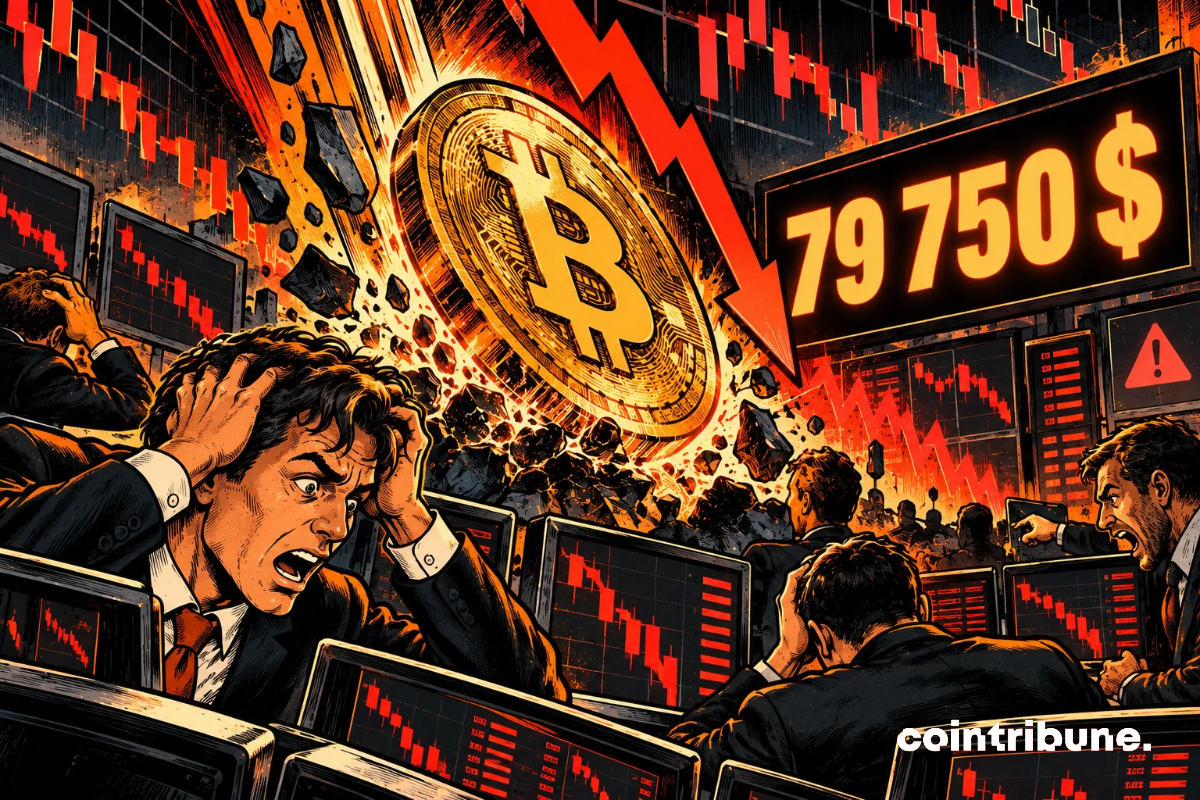
Bitcoin fell below $80,000 this Saturday, dragging the rest of the crypto market into its decline. Geopolitical concerns in the Middle East accelerated a movement already fueled by liquidations, the withdrawal of institutional investors and weak liquidity over the weekend.
In brief
- Bitcoin falls below $80,000 and leads the main cryptos in its decline.
- Tensions in the Middle East are heightening investor concerns and increasing pressure on the market.
- Nearly $670 million in crypto positions were liquidated in 24 hours, amplifying the decline.
- Low weekend liquidity and outflows from Bitcoin ETFs further weaken the market.
- The return of bitcoin above $80,000 remains decisive for considering a lasting rebound.
The crypto market erases its rebound of the week
Bitcoin touched around $79,750, its lowest level in nine days. However, it had approached $85,000 on Wednesday, before losing more than $5,000 in a few sessions. This new drop below 80,000 dollars is the second observed in ten days.
Major altcoins followed suit. Ether fell below $2,350, while XRP extended its decline below $1.30. Solana fell below $100 for the first time since the beginning of September.
Data available at the time of the drop make it possible to measure the extent of the movement:
- Bitcoin bottomed near $79,750;
- Approximately $670 million in positions were liquidated in 24 hours;
- More than 213,000 traders suffered forced closure of their positions;
- Some $220 million in long positions disappeared in a matter of hours;
- The largest individual liquidation reached almost $12 million on Binance.
Less capitalized assets recorded even steeper losses. Notably, NEAR dropped more than 10%, while Zcash fell around 7.5%. This difference illustrates a common mechanism: when investors reduce their exposure to risk, altcoins generally suffer more than bitcoin.
Tensions in the Middle East weigh on risky assets
The decline deepened after the announcement of new American security measures in the Middle East. The State Department ordered the employees to leave non-essential government workers and their families in Saudi Arabia. Several other embassies in the region have also reduced their staff, without receiving a general evacuation order.
This decision comes after an increase in attacks carried out by the Houthis, supported by Iran, against Saudi civil and energy infrastructure. American officials also spoke of Iranian plans targeting United States nationals, which have reportedly reached an advanced stage.
State Department spokesman Tommy Pigott said the Houthis had increased attacks on civilian airports and critical infrastructure. American authorities now fear an extension of the conflict, likely to further disrupt maritime transport and energy supplies.
The price of Brent thus reached around 117 dollars on Friday. A lasting rise in oil prices could fuel inflation and reduce the Federal Reserve’s room for maneuver. This scenario penalizes cryptocurrencies, because high rates make bonds and interest-bearing investments more attractive compared to assets without guaranteed returns.
However, geopolitics alone does not explain the fall of bitcoin below 80,000 dollars. The market was already experiencing rising bond yields, a strong dollar and outflows from US Bitcoin ETFs. The weekend’s announcements above all served as a catalyst for an already fragile structure.
Liquidations amplify bitcoin’s fall
Leverage turned this decline into a sharper move. A liquidation occurs when a platform automatically closes the position of a trader whose guarantees no longer cover losses. In the case of a long position, this closure leads to additional selling in a market already trending downward.
Nearly $670 million in crypto positions were liquidated within 24 hours. More than 200 million disappeared during the fastest phase of the decline, with a clear majority of bullish bets.
The weekend period accentuates this risk. Volumes are often lower than during the week and traditional financial markets are closed. A large sell order can then cause a disproportionate variation, reach several liquidation thresholds and trigger a chain reaction.
The $80,000 level now constitutes the first zone to reconquer. A sustained return above this threshold would reduce immediate pressure, but the area between $84,000 and $85,000 remains important resistance. Conversely, a further acceleration below $79,000 would expose the market to long positions still concentrated around $78,500.
The evolution of oil, American decisions in the Middle East and ETF flows will provide the next indications. As long as these three factors remain unfavorable, a rebound in bitcoin may remain fragile.
Maximize your Tremplin.io experience with our ‘Read to Earn’ program! For every article you read, earn points and access exclusive rewards. Sign up now and start earning benefits.