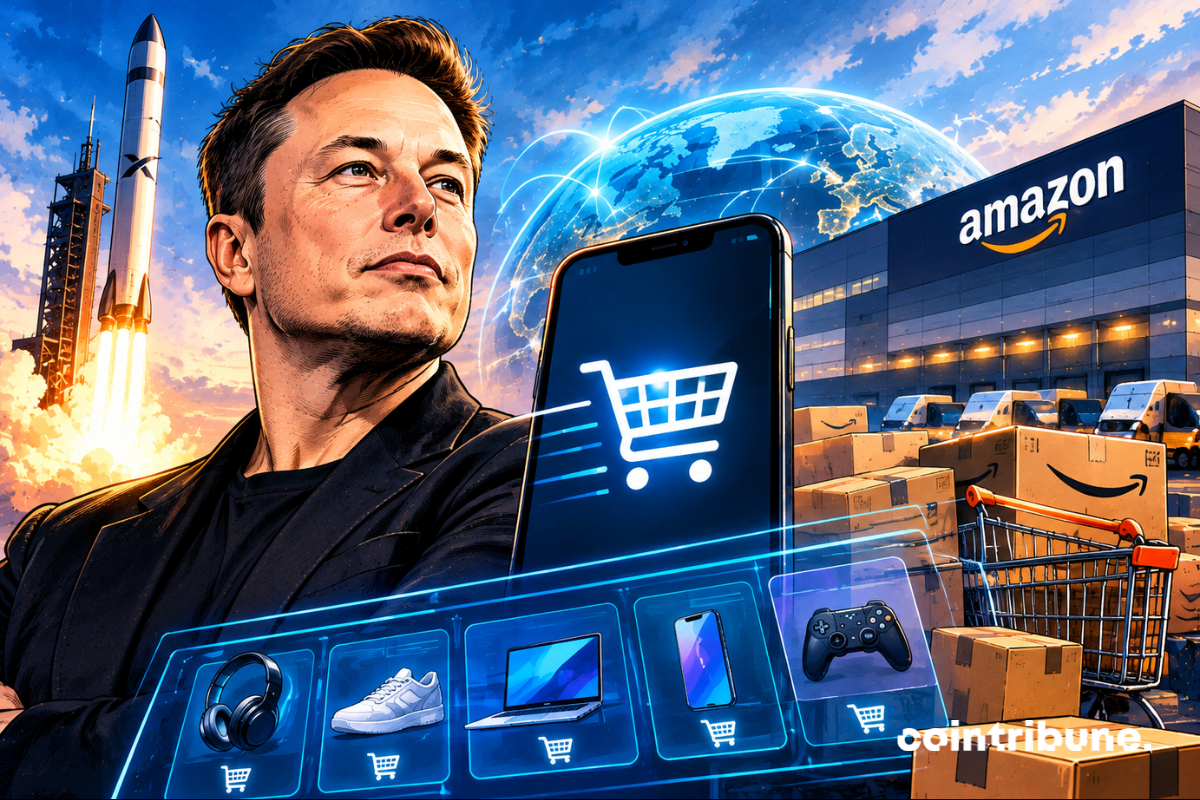
Artificial intelligence could soon change online shopping habits. Elon Musk is reportedly considering launching an Amazon competitor after accusations from users that the platform blocked purchases made by Grok bots. This situation raises a central question: who will control purchasing decisions in the era of AI agents? As Amazon dominates online commerce, new players are seeking to simplify shopping with autonomous assistants.
In brief
- Elon Musk is reportedly considering competing with Amazon after reports of Grok bots being blocked.
- Amazon had already blocked Meta’s Muse sales agent in September, citing transparency and security issues.
- Shopify opens its catalog of more than a billion products to third-party artificial intelligence agents.
- AI agents could transform online shopping by comparing prices and helping customers choose products.
Elon Musk faces Amazon’s control over online shopping
Elon Musk could seek to compete with Amazon amid tensions around sales agents. Of the users claim that the e-commerce giant blocked Grok bots from making certain purchases. This situation illustrates the limitations that AI assistants may encounter when trying to interact with large platforms.
Amazon had already blocked MuseMeta’s sales agent, in September. The company then cited concerns related to transparency and security. This decision shows that platforms do not necessarily want to let third-party agents freely access their services. For Elon Musk, this context could open up reflection on another way of organizing online commerce.
Today, Amazon controls several key stages of the customer journey. Its interface organizes search results, advertisements, recommendations and payment. This model encourages consumers to browse its catalog before choosing a product. However, AI agents could modify this relationship by taking over part of this research.
AI agents could transform online shopping
With an assistant like Grok, a user could request a pair of running shoes for less than $150. The agent would then compare the available prices, examine the options and propose a choice before validation. This method would limit manual searches and reduce the need to navigate between multiple pages. Elon Musk could thus target a specific stage of commerce: the purchasing decision.
At the same time, Shopify is opening its catalog of more than a billion products to third-party AI agents. This strategy contrasts with the restrictions observed at Amazon and highlights two different approaches. On the one hand, a platform maintains control of its commercial environment. On the other hand, it allows external assistants to access products more directly.
Amazon nevertheless retains important assets, notably its catalog, its logistics and its delivery capabilities. A competitor focused on AI agents would not necessarily need to replicate all of this infrastructure. Elon Musk could instead seek to control the stage where the consumer chooses what to buy. The next evolution of commerce will therefore depend on the place given to these assistants and the rules for access to catalogs.
Maximize your Tremplin.io experience with our ‘Read to Earn’ program! For every article you read, earn points and access exclusive rewards. Sign up now and start earning benefits.