
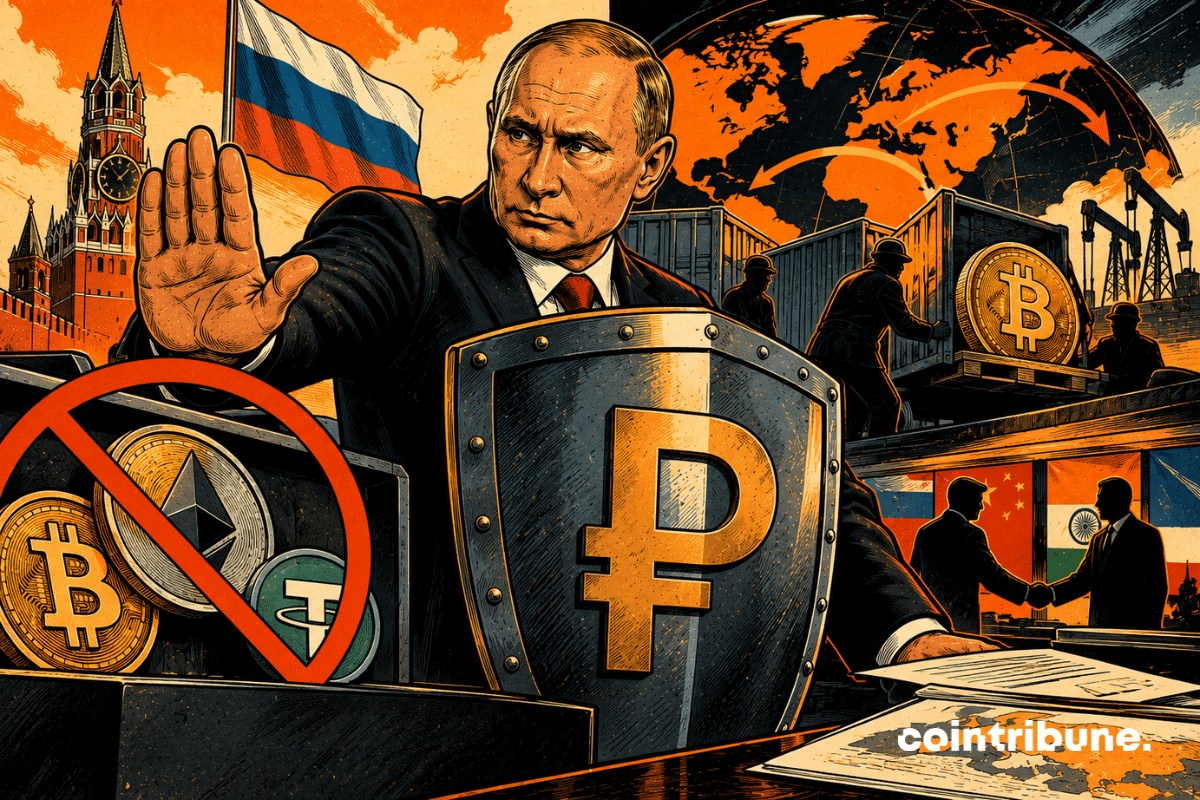
Russia is not closing the door on crypto. Rather, she chooses who can open it, how far, and above all for what. After a new round of European sanctions this summer, Moscow has accelerated its regulatory work. Putin signed the law, investors now have a regulated market and the digital ruble has just changed scale. Behind this closely monitored opening appears a fairly clear line: protect the Russian currency at home, find more financial freedom elsewhere.
In brief
- Russia authorizes certain international settlements in digital assets, while maintaining a ban on payments in cryptocurrencies for purchases made on its territory.
- Russia authorizes certain international settlements in digital assets, while maintaining a ban on payments in cryptocurrencies for purchases made on its territory.
- The digital ruble recorded 87,000 accounts opened and more than 50,000 operations during its first ten days of large-scale deployment.
- The Bank of Russia fears that stablecoins will compete with the ruble and simultaneously strengthens tax identification, transaction monitoring and control of regulated platforms.
Under sanctions, Moscow opens a door to bitcoin
The calendar helps to understand the movement. On July 23, the European Union adopted its 21st package of sanctions. This includes 94 banks and large financial institutions, 33 additional Russian establishments subject to a transaction ban and 14 crypto-related exchanges established in third countries. The A7 cross-border network is also in the European sights.
Moscow was already looking for other tips. Russian companies can use digital assets for certain international settlements under an experimental regime overseen by the Bank of Russia. MP Kaplan Panesh bluntly described the benefit of the system: allowing Russian companies to pay foreign partners by circumventing sanctions-related restrictions.
Bitcoin finds a use here that Moscow still does not grant it in Russian businesses. It can circulate in certain foreign exchanges, without becoming a daily currency inside the country.
This big gap has nothing to do with an ideological conversion. Russia is seeking additional rails at a time when several traditional rails are becoming more difficult to access. Putin doesn’t have to like cryptocurrencies to find plumbing interesting.
Can the digital ruble keep the Russian currency at the center of the game?
On September 1, another piece arrived on the chessboard: the digital ruble. This time, no decentralized network or private transmitter. The new currency circulates on the platform of the Bank of Russia and constitutes a third form of the ruble, alongside cash and bank money.
The start attracted curious people. In ten days, 87,000 accounts were opened and more than 50,000 transactions carried out. Elvira Nabiullina herself admits that some users are still testing the service:
Many people just test to see how it works. We hope they will appreciate the convenience and free services.
Large banks have had to offer this infrastructure since September. Affected large merchants must also accept these payments.
The project thus offers Putin and the authorities a domestic counterweight to private stablecoins. Crypto may enter the landscape; the ruble intends to keep the boss’s chair.
Why is the Bank of Russia so protective of the ruble?
Thirteen days after the massive launch of its CBDC, the Bank of Russia has cooled the mood. On September 14, its document devoted to the development of the financial market for 2027-2029 ranks digital currencies among the risks to monitor.
The angry word isn’t really bitcoin. It is especially stablecoins that are worrying. If the Russians start using them as substitutes for the ruble, monetary sovereignty may crumble. The regulator also mentions the possibility of a total loss for investors and the difficulties posed by assets circulating beyond national legal borders.
Regulated crypto will therefore have a short leash. Non-qualified investors can purchase up to 300,000 rubles per year through intermediaries. Bitcoin, Ether and USDT are among the assets retained for regulated exchanges. Domestic payments in cryptocurrencies remain prohibited.
Rosfinmonitoring is also gaining visibility. Opening an account with a Russian digital custodian now requires an INN tax number.
The law signed by Putin therefore opens the market without offering him the keys to the house. At home, the ruble still does not share its throne.
Internationally, can Moscow loosen the financial stranglehold?
This is the most pragmatic side of the strategy. Russia monitors crypto at home, while allowing certain uses for foreign trade. This compartmentalization responds to a fairly mundane reality: an economy under sanctions continues to import, export and seek partners ready to settle their affairs.
The European Union understands this perfectly. Her July package does not only target Russian banks. It also affects digital asset providers based in Georgia, Panama, the United Arab Emirates, the Marshall Islands, Kyrgyzstan and Belarus. Brussels can now further target foreign suppliers used to circumvent its restrictions.
The battle therefore goes well beyond Putin, Moscow and a few exchanges. It concerns the payment infrastructures themselves: who controls them, who can use them and under what rules?
Russia has a few commercial partners and is necessarily looking for circuits less dependent on Western banks. Digital assets can provide a piece of the puzzle, not a magic wand.
This is perhaps the Russian subtlety: crypto becomes acceptable when it helps to cross a border, much less when it threatens to break down that of the ruble.
Some figures that better explain the Russian shift
- Since September, non-qualified individuals can purchase up to 300,000 rubles of digital assets per year through intermediaries.
- The massive launch of the digital ruble generated 87,000 new accounts and more than 50,000 transactions in ten days.
- The European package of July 23 targets in particular 94 banks and large financial institutions as well as 14 platforms linked to digital assets.
- Bitcoin, Ether and USDT are among the three assets proposed by the Bank of Russia for the new regulated market.
- Since September, affected merchants with more than 120 million rubles in annual revenue must accept the digital ruble.
Putin thus seems to have found his balance: letting crypto breathe when it serves foreign trade, while strengthening the digital ruble at home. Europe is observing the same chessboard from the other side. France is pushing the Twenty-Seven to develop stablecoins in euros, alongside the digital euro, in the face of the weight of tokens backed by the dollar. Behind Moscow, like Brussels, an old question returns in new clothes: who will control the currency that will circulate tomorrow?
Maximize your Tremplin.io experience with our ‘Read to Earn’ program! For every article you read, earn points and access exclusive rewards. Sign up now and start earning benefits.


