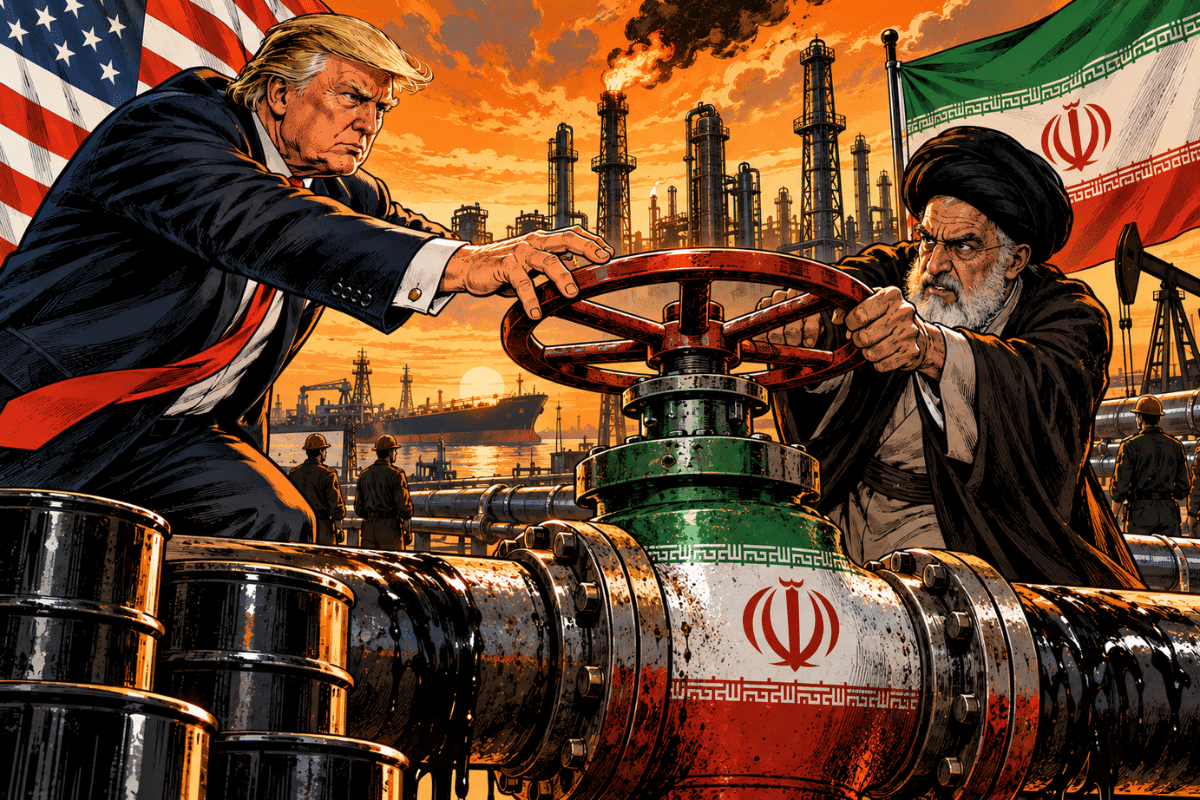
According to a new statement from Donald Trump, Iranian oil would become a lasting objective of the American presence. The president mentions maintaining the United States in Iran on the model of Venezuela, without presenting an agreement or a precise timetable.
In brief
- Donald Trump plans to maintain an American presence in Iran to maintain access to the country’s oil.
- The president compares this scenario to the Venezuelan model, the modalities of which still remain uncertain.
- Tensions in the Middle East push Brent and WTI above $100 per barrel.
- The shutdown of the Saudi East-West oil pipeline and disruptions in the Strait of Hormuz are increasing tensions on global supply.
- No agreement defines at this stage the conditions for a prolonged American presence in Iran.
Trump conditions US withdrawal on Iranian oil
This September 13, Donald Trump addressed this possibility during a trip to Ireland. Asked about the conflict in Iran, he suggested that Washington would extend its commitment to maintain access to the country’s oil resources.
The American president therefore noted : “we will eventually leave Iran, unless we decide to stay and keep the oil like in Venezuela”. However, this statement represents a political hypothesis. The White House has not released any mechanism likely to allow Uncle Sam’s country to control or exploit Iranian oil.
The main elements relating to this intervention make it possible to measure its scope, but also its limits:
- Trump considers American departure from Iran, barring decision to stay for oil;
- He compares this scenario to the announced energy agreement with Venezuela;
- He thinks the war would end in 2026, perhaps after the November midterm elections;
- He projects a sharp drop in gasoline prices once the conflict ends.
The American president also indicates that Iran regularly requests peace negotiations. Similar claims had already been disputed by Tehran. Trump emphasizes that he could exclusively accept the “good agreement”without providing details on the conditions necessary for its conclusion.
The Venezuelan model remains surrounded by uncertainties
The comparison with Venezuela refers to an agreement communicated by Trump at the end of August. Indeed, Washington seeks to guarantee American companies lasting access to part of the country’s countless oil reserves.
The project could involve more than 65 billion barrels, or nearly a fifth of Venezuela’s official reserves, according to information published. American companies would obtain rights to certain fields through private partnerships, concessions or calls for tender.
However, the full terms of such an arrangement are not public. According to Venezuelan law, the State has a capital role in oil exploitation, which would complicate its implementation.
Trump maintains that revenues from Venezuela have already “paid for the war many times over”. No figures to verify this claim were provided. The precedent invoked for Iran therefore remains incomplete on financial, operational and legal levels.
Crisis pushes oil back above $100
These comments come as tensions in the Middle East are severely disrupting energy markets. Brent rose by more than 3% to around $108.04 per barrel, while American WTI stands at around $103.54.
The shutdown of the East-West oil pipeline in Saudi Arabia consolidates fears. This infrastructure can transport nearly four million barrels per day to the port of Yanbu, bypassing the Strait of Hormuz. Its unavailability threatens around 4% of the world’s oil supply and repairs would take up to six weeks.
Trade flows passing through the Strait of Hormuz have also declined significantly. A meeting between Iaran and other Gulf countries dedicated to the reopening of this strategic route was postponed for lack of consensus.
Trump says gasoline prices “will fall like a stone” after the war. Such a decline could depend on the restoration of exports, maritime security, refining capacities and the duration of Saudi reparations.
No agreement yet allows Washington to stay
Trump’s statements in no way define the conditions for a prolonged American presence. They do not emphasize the fields concerned, nor the private companies, nor the distribution of possible income. Iran, a BRICS member, has also not validated a system comparable to that invoked in Venezuela.
Numerous indicators will make it possible to assess the veracity of this scenario. An official proposal from Washington, a public response from Tehran and an agreement on the Strait of Hormuz would represent the first tangible steps.
In the meantime, the remarks mainly serve to link American strategy in Iran to energy security. Without a detailed plan, the possibility of “keep the oil” remains a political intention, and not an enforceable decision.
Maximize your Tremplin.io experience with our ‘Read to Earn’ program! For every article you read, earn points and access exclusive rewards. Sign up now and start earning benefits.