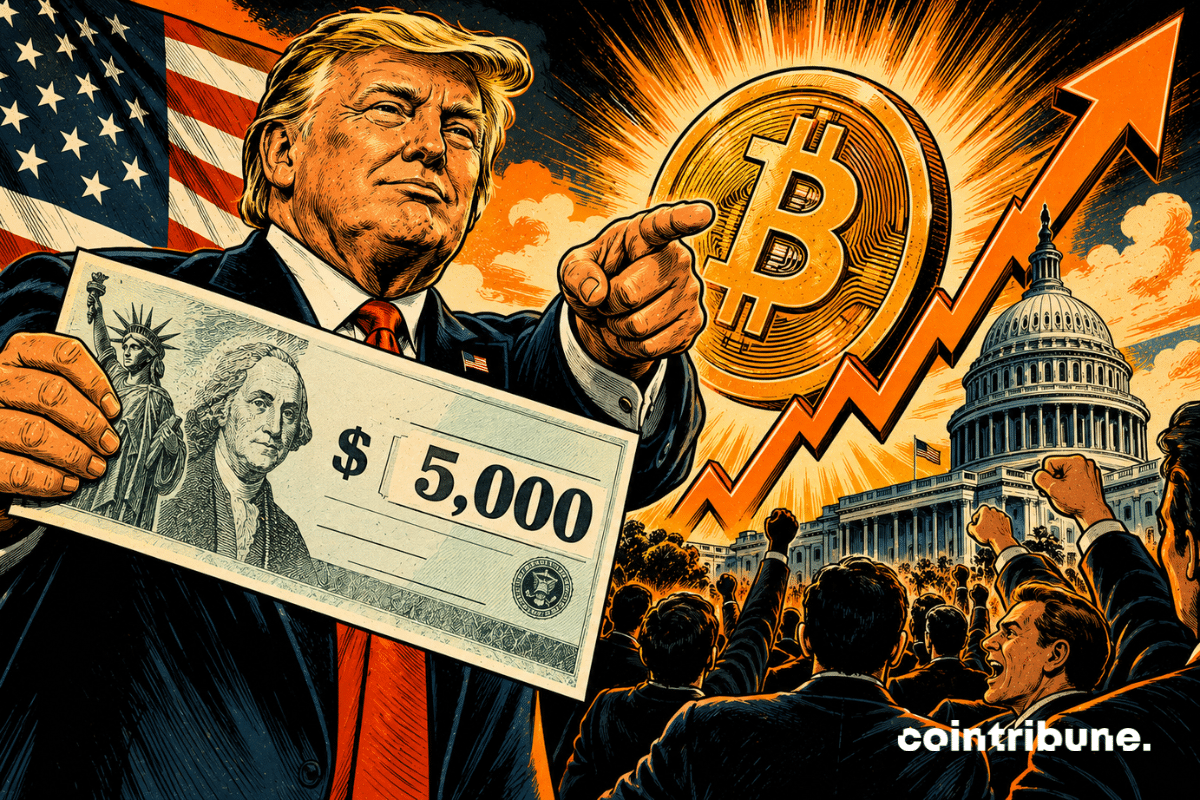
Donald Trump promises $5,000 to every American adult if Republicans win the House and Senate in the midterm elections. Anthony Pompliano already sees fuel for bitcoin, gold and earth. The market hardly applauded: BTC reacted little after the announcement. Behind this very political promise lies above all an addition of more than 1,200 billion dollars, with a much less spectacular question: who will pay?
In brief
- Trump promises $5,000 to every American adult if Republicans win both houses of Congress in the midterm elections.
- A universal payment would cost more than $1.2 trillion, while estimated net tariff revenues for 2027 reach just $125 billion.
- Pompliano believes that more money distributed could push bitcoin, gold and the earth higher, but BTC saw little initial reaction in the markets.
- Tax Foundation warns that deficit financing could increase inflationary pressures and push U.S. interest rates even higher in the coming months.
5,000 dollars after the midterms: the promise even shakes the Republicans
In Dallas, Trump, president enriched by cryptos, did not just promise a check. He set a condition: the Republicans must retain control of both houses of Congress. The White House then named the operation “Trump Dividend”, comparing the mechanism to a company which redistributes part of its results to its shareholders.
The parallel quickly found its limits in public debate. Republican Rep. Chip Roy asked how Washington would finance the measure. Bob Good, former chairman of the Freedom Caucus, called it a socialist vote-buying device. Joe Lonsdale, a Republican donor and co-founder of Palantir, also opposed the idea.
Legal questions also accompany the promise since the announced payment explicitly depends on the election result. CNBC reminds that federal law prohibits offering money to induce someone to vote or to vote for a candidate.
For the moment, no check is ready to go. The project would require congressional authorization and its criteria remain unclear. JD Vance notably mentioned payments intended for the middle class, while Trump had spoken of every American adult.
A check for 1,200 billion against a debt of 40,000 billion
At a rate of $5,000 for about 245 million American adults, the bill would exceed $1.2 trillion. A slightly broader estimate from the Tax Foundation, based on 250 million beneficiaries, puts the bill at 1.25 trillion.
This is a big chunk for federal finances already under pressure. The US debt has exceeded $40 trillion and budget projections show high deficits. Financing the dividend with new borrowing would further increase the government’s financing needs.
Inflation complicates the story. Injecting money does not mean that every dollar will be immediately spent: some households could save, repay debts or invest. Only a portion would quickly return to the economy.
The Tax Foundation, however, warns that a deficit-financed program could push interest rates and inflationary pressures higher.
A deficit-financed dividend payment of this magnitude would signal to markets that the United States is not serious about restoring its public finances. It could further increase interest rates and increase inflationary pressures.
For bitcoin, this discussion matters: Pompliano precisely builds his scenario around a more abundant currency in the face of assets whose supply remains constrained.
Tariffs must pay the bill… except it’s missing almost 90%.
JD Vance puts forward one avenue: customs duties. The new tariffs bring in more money for Washington and the Trump administration wants to present these revenues as a possible source of the dividend.
The problem lies in two numbers: 125 billion versus around 1,250 billion.
The Tax Foundation estimates that the new tariffs could produce some $125 billion in net revenue in 2027 if the policies remain in place. That would cover about a tenth of a universal payment of $5,000. At this rate, almost ten years of revenue would be needed to finance a single distribution.
The mechanics have another subtlety. Tariffs are levied on imports. Their cost can then be found, totally or partially, in the prices borne by businesses and consumers. Increasing rights to finance a check can therefore indirectly take back part of the purchasing power that this same check seeks to provide.
Nor do the revenues constitute an immobile jackpot. The Tax Foundation recalls that they recently decreased, even falling into negative territory in certain months, when the government reimbursed customs duties invalidated by the Supreme Court.
The word “dividend” sounds pleasant. Arithmetic still requires a few lines of calculation.
Bonds, gold, bitcoin: where could the dividend money go?
Now let’s imagine that Congress gives the green light. The check arrives. What becomes of him?
Part could be used to consume, another to save or reduce debt. Financial markets could also recover a fraction of this windfall. This is where bitcoin really comes into the story.
The experience of payments distributed during the pandemic fuels this hypothesis without proving it. In April 2020, Brian Armstrong showed an increase in deposits of $1,200 on Coinbase, the same amount as the first stimulus check. Binance US had observed a comparable phenomenon. However, it is impossible to establish that all these deposits came directly from aid or that they were then used to buy cryptos.
The bond market would rather look at the other side of the balance sheet. If the program increases government borrowing, more debt would have to be absorbed by investors, with the risk of further pressure on yields.
Gold would have its own argument: concerns about deficits, inflation and purchasing power can increase interest in reserve assets. Bitcoin plays partly on this same rope, with a much more generous volatility.
Thus, the same check could support consumption, worry about bonds and fuel interest in rare assets. However, nothing obliges these movements to occur simultaneously.
Pompliano bets on scarcity while the market waits
Anthony Pompliano doesn’t bother with a multi-story model. For the boss of Procap Financial, more money distributed simply means more potential for certain assets.
Trump announced yesterday that he would be handing out $5,000 stimulus checks. The more money he distributes, the higher bitcoin, gold and earth will rise.
Anthony Pompliano,
The formula travels well on social networks. For the moment, the market is giving him a duller response. After the announcement, bitcoin was still trading around $78,000, without any immediate surge.
Pompliano reasons mainly about what could happen if the payments became a reality. Between Trump’s speech and the arrival of $5,000 in American bank accounts, several doors remained closed: Republican victory, Congressional vote, definition of beneficiaries and above all financing.
The investor also makes a bet on where the money will ultimately end up. There is no guarantee that beneficiaries would purchase assets. Even less that they would massively choose bitcoin.
The promise therefore creates a favorable narrative for scarce assets. It does not yet create the flows that would allow this to be verified.
The numbers to remember
- BTC price: $76,770 at the time of writing.
- $5,000 promised to every American adult.
- More than 1,200 billion to finance a universal payment.
- 125 billion in net tariff revenue estimated for 2027.
- More than 40 trillion in US federal debt.
Pompliano sees a possible accelerator for bitcoin in a massive distribution of money. CryptoQuant looks at another thermometer: price. His scenario calls for a close above $81,700, the 365-day moving average level, to confirm a new bull market. Between Trump’s monetary narrative and this technical validation, BTC still has to gain several thousand dollars. The check can fuel the story; the graph demands proof.
Maximize your Tremplin.io experience with our ‘Read to Earn’ program! For every article you read, earn points and access exclusive rewards. Sign up now and start earning benefits.