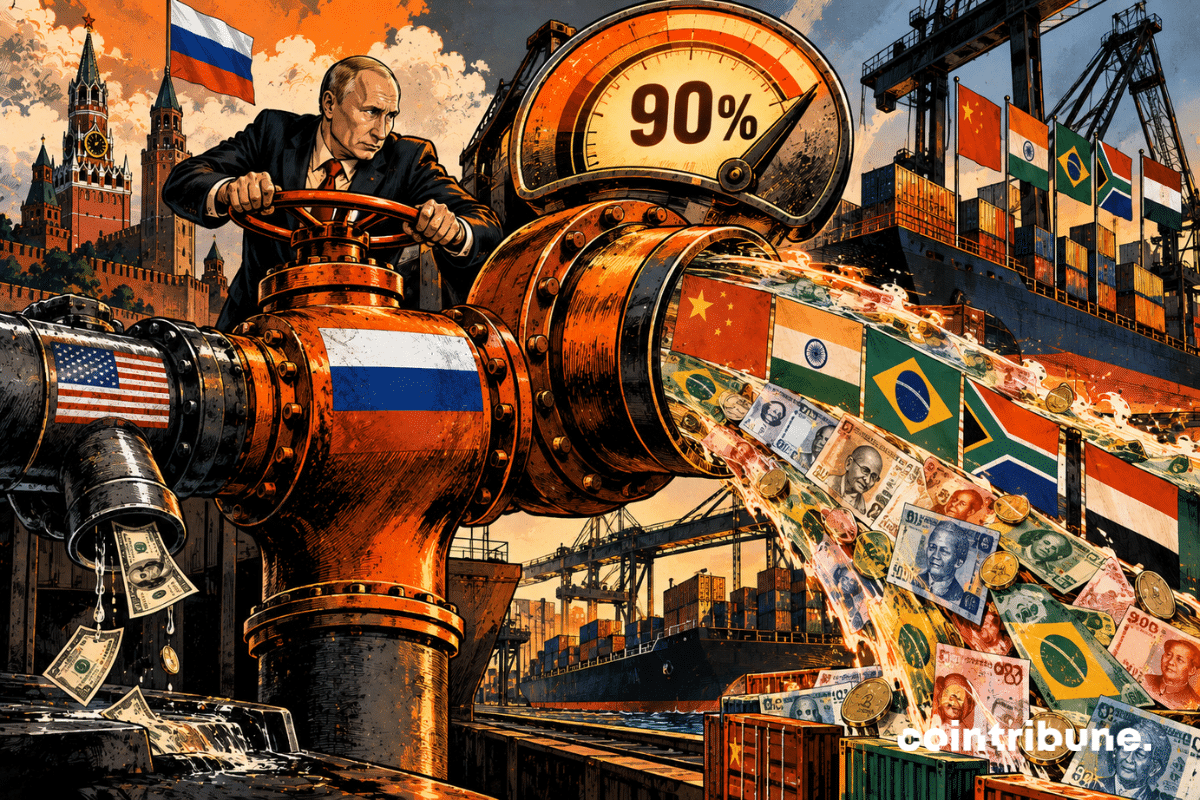
BRICS local currencies already enable 90% of Russia’s transactions with its alliance partners to be settled, according to the Kremlin. However, this figure represents neither a collective objective nor a promise of abandonment of the dollar by all member countries.
In brief
- Russia already settles 90% of its transactions with BRICS in local currencies.
- This threshold concerns Russia and does not constitute a common objective of the BRICS.
- The Kremlin refuses to present this development as a dedollarization policy.
- Settlements in national currencies respond to Western sanctions and financial restrictions.
- The BRICS do not have a single currency and maintain their own monetary policies.
Russia already reaches the 90% threshold
From now on, Russia carries out 90% of its financial transactions with its BRICS partners in national currencies. Dmitri Peskov, Kremlin spokesperson, disclosed this figure to Indian journalists before the summit in New Delhi.
One such part concerns Russia’s trade with other members, including India. However, it does not describe the situation of the entire bloc. This is also a level already achieved, but not a target to be included in the future joint declaration.
Four important pieces of information therefore allow us to correctly explain this threshold:
- The 90% concerns only Russia’s transactions with its BRICS partners;
- The figure describes a current situation and not a future target;
- Payments use several national currencies, with no common currency;
- No collective commitment to abandon the dollar has been announced.
Dmitry Peskov noted :
The use of national currencies is not a dedollarization policy. We are simply doing what best serves our national interests.
The Kremlin spokesperson attributes this progression to pressure from Western countries. Thus, sanctions and financial restrictions have led Moscow to increase payments in rubles, yuan, rupees and the currencies of its other partners.
The Kremlin refuses to talk about dedollarization
For the Russian Federation, the use of local currencies is primarily a response to a practical necessity. Therefore, Peskov summarized this posture by indicating that Moscow uses its own currencies if certain countries prevent it from using theirs.
An increase in bilateral settlements effectively decreases immediate dependence on the dollar. However, it does not mean that the American currency disappears from the entire transaction. The price of goods can still be determined in dollars before conversion into a national currency.
Companies must also manage fluctuations in exchange rates, limited liquidity of certain currencies and trade imbalances. A state that accumulates currency that is difficult to reuse may encounter obstacles when repatriating or converting its revenues.
It is also worth pointing out that the BRICS also do not have a single currency comparable to the euro. Each member of the alliance maintains its monetary policy and economic priorities. The bloc is mainly exploring payment systems likely to link national currencies and reduce the use of Western financial infrastructures.
Thus, Peskov’s remarks mark a Russian advance in bilateral exchanges. It does not represent proof that the eleven members already apply the same policy or want to adopt a common timetable for dedollarization.
A joint declaration remains uncertain in New Delhi
Russia hopes that the summit on September 12 and 13 will result in a joint declaration. Thus, discussions must cover security, finance, the economy and new technologies. Moscow also wants to consolidate the image of BRICS as a pillar of a multipolar world order.
The adoption of the text nevertheless requires consensus. Also, Iran and the United Arab Emirates defend divergent positions on the crisis in the Middle East. These disagreements had already prevented the group’s foreign ministers from issuing a joint statement in May.
The existence of these tensions was recognized by Peskov. He offers Russia’s help in facilitating normalization. Moreover, he believes that Indian diplomats can find a formulation compatible with the interests of both countries.
The alliance now brings together eleven economies after the arrival of Egypt, Ethiopia, Iran, the United Arab Emirates, Saudi Arabia and Indonesia. This enlargement consolidates its weight, but also makes compromises more difficult.
The final declaration could make it possible to measure the degree of agreement on the local currencies of the BRICS. In the absence of a common numerical target, the 90% threshold will remain a result specific to Russian trade.
Maximize your Tremplin.io experience with our ‘Read to Earn’ program! For every article you read, earn points and access exclusive rewards. Sign up now and start earning benefits.