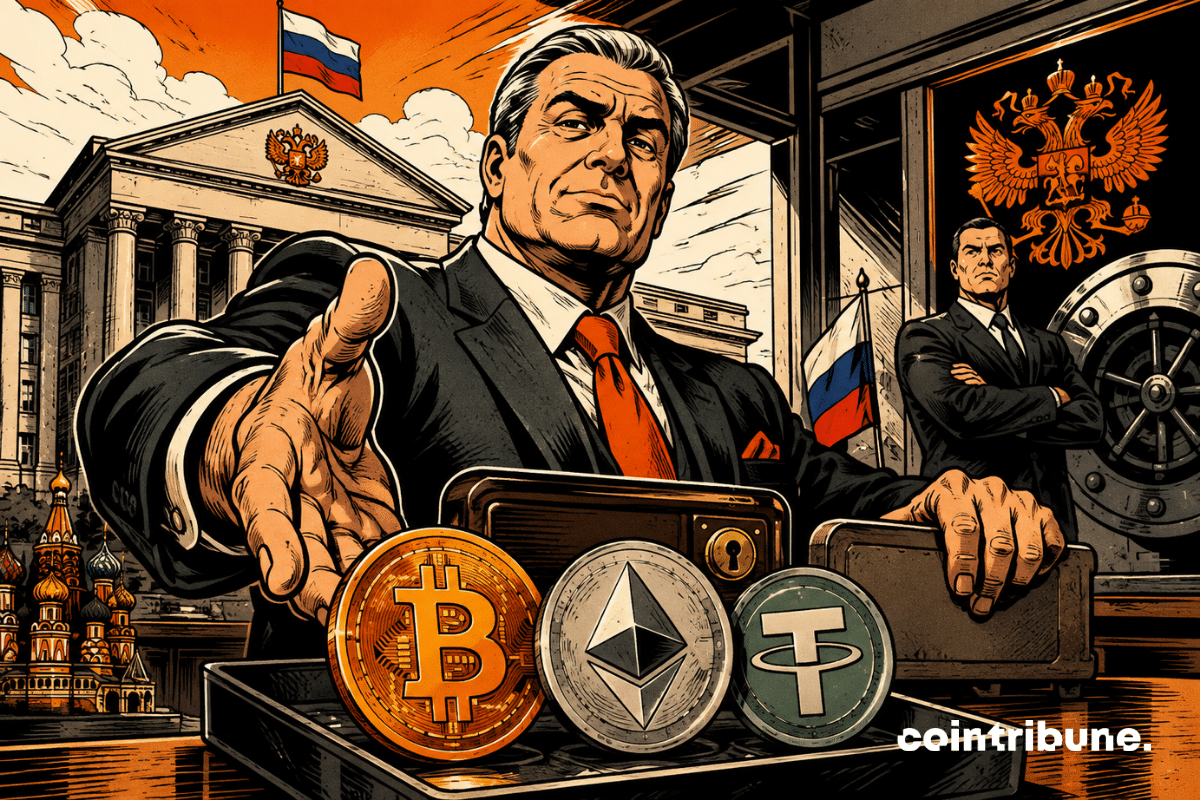
The largest Russian bank Sber is preparing a new stage in its crypto services. The establishment wants to accept three assets as loan guarantees, while Russia prepares the entry of a regulated framework. Bitcoin, Ether and USDT must join existing collateral. This development depends on authorization from the central bank for their listing. At the same time, Sber sees limited demand for the digital ruble, ahead of its wider deployment as part of this transformation of the current national financial sector.
In brief
- Sber wants to accept Bitcoin, Ether and USDT as collateral for its cryptocurrency-backed loans.
- The bank is awaiting authorization from the Bank of Russia to include these three assets in its offering.
- Russia is establishing a regulated crypto market whose main rules will come into force on September 1.
- Sber sees limited demand for the digital ruble, despite its wider deployment.
Sber prepares three crypto guarantees
Sber wants to adapt its existing loans to accept USDT and Ether in addition to Bitcoin. Anatoly Popov, vice-president, indicates that the bank will expand this offer according to a report from the TASS agency published Friday. Russia is thus supporting an evolution of its financial services around assets.
The integration, however, depends on the public listing authorized by the central bank. Sber will add these assets after this authorization. The calendar remains linked to the rules.
The three assets are already included in the bank’s proposal. Bitcoin, Ether and USDT meet several criteria. Russia takes into account in particular the capitalization, the volume of exchanges and five years of price history.
Russia regulates the crypto market
These projects follow the signing, on August 4, of a new law on cryptocurrencies. Its main provisions will come into force on September 1. Russia is thus establishing a regulated market for crypto trading.
The central bank determines the assets tradable on the platforms. On August 11, it offered Bitcoin, Ether and USDT. In Russia, this selection is based on their capitalization and their price history.
For Sber, this framework can facilitate the adaptation of loans backed by cryptocurrencies. The bank must wait for authorizations. The country is thus moving towards a more formal organization.
The digital ruble remains in less demand
At the same time, Sber is adopting a more cautious stance on the digital ruble. This central bank digital currency is due to be deployed more widely from September 1. Taras Skvortsov, CFO of Sber, observes limited demand. According to him, no obvious interest beyond the central bank. Individuals, businesses and financial institutions do not request this instrument.
This situation contrasts with Sber’s projects around crypto guarantees. The addition of USDT and Ether will first depend on their authorized quotation. Russia will then have to measure the real demand for these new banking services.
Sber is thus entering a phase linked to expected regulatory decisions. If the authorizations progress as planned, the bank will be able to expand its guarantees to three assets. Russia will then have to follow the adoption of the digital ruble and the use of crypto loans.
Maximize your Tremplin.io experience with our ‘Read to Earn’ program! For every article you read, earn points and access exclusive rewards. Sign up now and start earning benefits.