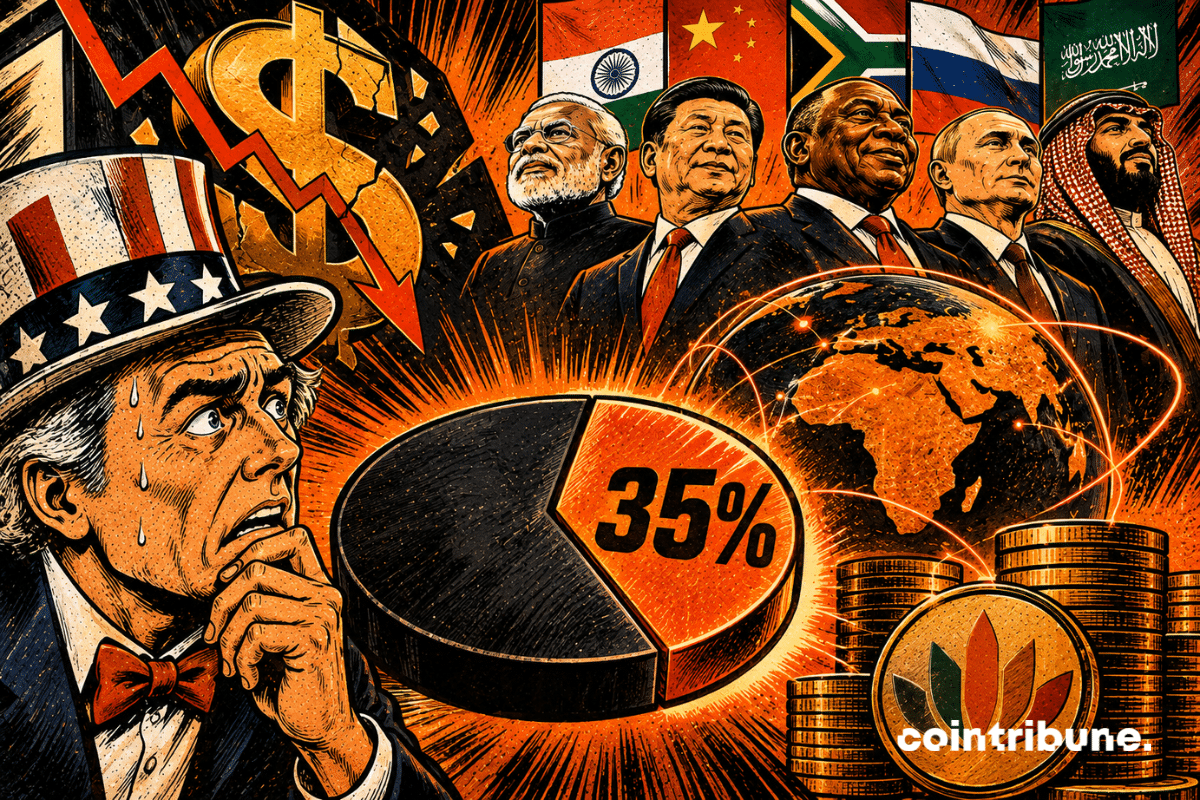
The greenback is losing more and more ground in the BRICS alliance. Indeed, the use of local currencies in various commercial exchanges is now intensifying in the member states of the bloc. Reducing their dependence on the dollar as well as the costs relating to cross-border payments are the objectives thus set. This revolution then constitutes a new phase in the fight for monetary sovereignty, while the American administration tries to safeguard the international power of its currency. The BRICS are gradually reconfiguring the global financial balance of power, between dedollarization, sovereign digital currencies, and the American response.
In brief
- Only 35% of trade within BRICS remains denominated in US dollars.
- A share of 65% now dominated by bilateral settlements in national currencies.
- An acceleration driven by the Saudi petro-yuan and the diversified use of the rupee, ruble and dirham.
- Threats of 100% customs tariffs formulated by Donald Trump to slow down dedollarization.
- Future automation of cross-border payments discussed at BRICS summit.
The assessment of BRICS trade flows: the historic breakthrough of local currencies
The dedollarization schedule resolutely undertaken by the BRICS alliance since 2022 has just reached an important milestone in terms of international payments. In a report published by Pradip Dhir, director of Pranan Consulting, the data reveal that the bloc only used the dollar for 35% of its entire internal cross-border trade.
At the same time, the rest of the trade was carried out entirely in national currencies, which constitutes a notable decline of the American dollar in the balance of payments of the members of the alliance. This change is backed by an increase in bilateral agreements, like trade flows between China and Russia, now settled in yuan and rubles. Also, the use of the Chinese yuan has accelerated in Iran given American financial sanctions.
This modification of the model is based on the creation of tailor-made exchange circuits. Since 2024, the Chinese government has been implementing contractual systems specially suited to the use of local currencies with the aim of promoting the transactions of its partners.
Conversely, Saudi Arabia took a decisive step economically by choosing the yuan for the settlement of oil contracts. The multiplication of these bilateral agreements has contributed to bringing the use of national currencies to this threshold of 65%, which brings the American dollar back into a minority position in commercial exchanges in the alliance.
Numerous statistical data and bilateral agreements demonstrate actually this restructuring of flows:
- Dollar settlement: it is reduced to only 35% for cross-border transactions within the bloc;
- Local currencies: a 65% share occupied by the national currencies of the alliance;
- Indian diversification: India settles part of its trade within the BRICS in rupees, rubles and dirhams;
- The Saudi petro-yuan: Saudi Arabia validates the use of the yuan for the settlement of oil transactions.
Tariff threats and crisis diplomacy: Washington’s response
The deliberate exposure of this dollar exclusion approach was nevertheless met with a firm response from the Trump administration. Following the targeting of the greenback on the global financial scene by the members of the alliance, the return of Donald Trump at the head of the United States constituted a brake on the trajectory of the BRICS bloc.
The American president hastened to intimidate by imposing punitive surcharges capable of reaching 100% the member countries which would continue to execute their dedollarization agenda. Given the firmness of these warnings, the bloc has temporarily moderated official statements on this subject.
The existence of commercial exchanges already carried out in national currencies was not shaken by this strategic respite on the political level. It simply allows us to review the short-term priorities of BRICS. Cautious compromise now replaces direct confrontation. Thus, each member country assesses the effect of customs tariffs on its personal exports to the United States.
The horizon of MNBC: towards a digitalized monetary infrastructure
Apart from diplomatic conflicts and the use of traditional fiat currencies, the perpetuation of these parallel channels of exchange is now taking place thanks to technological innovations. This is why Indian authorities have indicated their willingness to raise the issue of settlements through central bank digital currencies (CBNC) during the BRICS summit scheduled for September. Connecting these sovereign digital currencies could provide the prospect of automating cross-border payments that can bypass conventional correspondent banking systems.
In the long term, this shift towards digital payment networks would stabilize the ratio of non-dollar exchanges, despite external political pressures. According to observers from the financial and crypto world, this overhaul of monetary infrastructures by central banks would contribute to the exploration of new technological alternatives for securing the sovereignty of international payments.
Maximize your Tremplin.io experience with our ‘Read to Earn’ program! For every article you read, earn points and access exclusive rewards. Sign up now and start earning benefits.