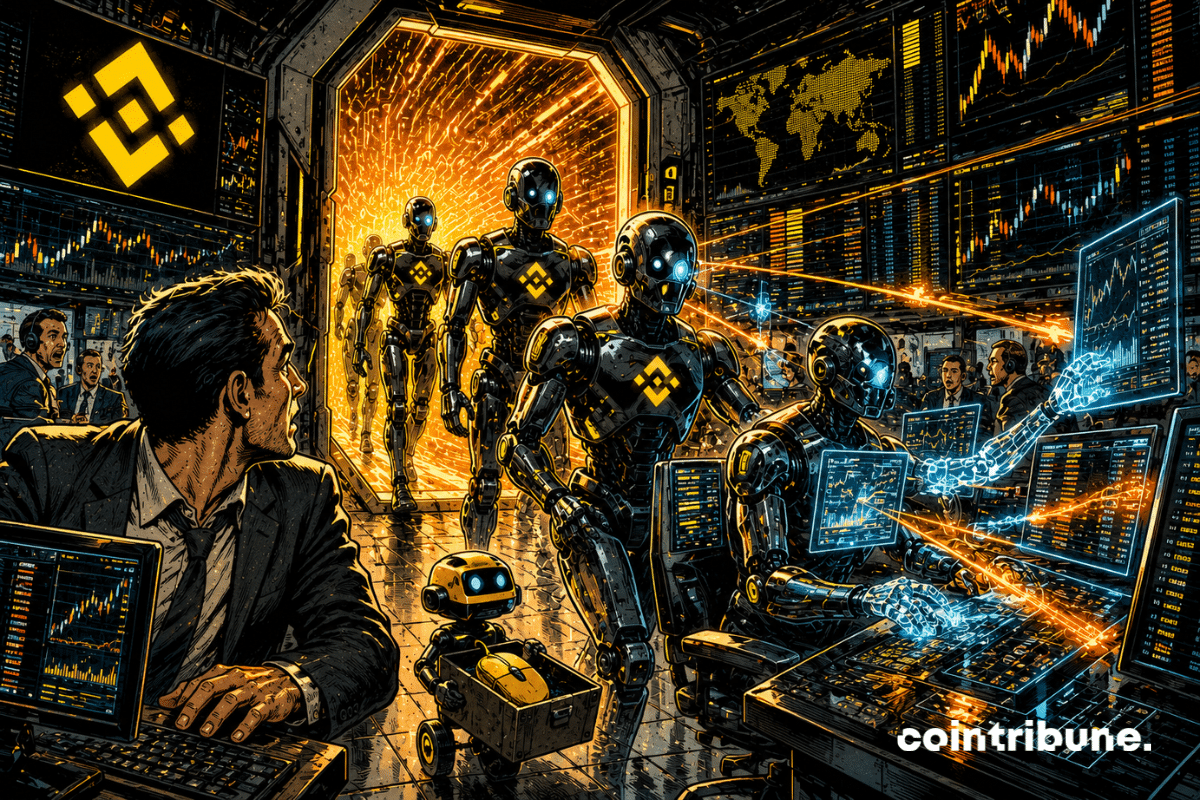
Binance is now directly opening its infrastructure to AI agents. With Agent OS, tools like ChatGPT, Claude Code, Codex or Cursor can view market data, follow an account and execute crypto trades. The user retains control over permissions and can cut access at any time.
In brief
- Binance launches Agent OS to connect AI agents to its crypto services.
- Agents can view an account, trade and make certain payments.
- Users choose permissions and can isolate funds into a subaccount.
Binance lets AI agents place orders
Binance was already preparing this ground. In January, its wallet launched several AI tools to analyze the crypto market. Agent OS goes further. AI no longer just reads data or summarizes a token. She may receive authorization to view certain account information and place orders.
ChatGPT, Claude Code, Codex and Cursor are among the compatible tools mentioned at launch. The user decides what the agent can do. In particular, Binance allows you to assign a sub-account separate from the main account. It then becomes possible to place only funds intended for automated trading there.
Permissions can also be limited. An agent can therefore receive the right to read certain data or carry out operations without obtaining general access to the account. The authorization remains revocable. Binance can see transactions executed via Agent OS. However, the exchange does not see the external information used by the AI or how it arrives at its decision. This part remains in the tool chosen by the user.
Crypto becomes a field for agents
Agent OS doesn’t stop at trading. Agents can also access Binance payment tools and interact with certain on-chain services. A user could therefore entrust several steps to the same AI: monitor the market, verify the account then execute an operation within the limits already set.
The developers have been working in this direction for several months. Until recently, we identified the main crypto APIs used by trading bots and AI agents.
Binance does not arrive alone. Coinbase launched Coinbase for Agents in June. The service already allows models like ChatGPT and Claude to connect to accounts and execute certain strategies.
Kraken took a more cautious route. Its AI assistant can monitor the market and suggest trades according to the user’s goals. The order still requires human validation before execution.
OKX, for its part, is experimenting with a marketplace where AI agents can work, make stablecoin payments and even recruit other agents. Exchanges are therefore starting to test different levels of autonomy. Binance has just chosen its own.
CZ was already waiting for this step
Changpeng Zhao has been talking for several months about the rapprochement between artificial intelligence and blockchain. For him, cryptos correspond well to the functioning of autonomous agents. A machine does not need to open a traditional bank account to send a digital asset or interact with a smart contract.
In May, CZ already presented AI agents as a possible new driver of the crypto market. Agent OS is now giving concrete form to this idea at Binance. Change remains regulated. The agent does not automatically receive the master account keys. The user chooses their permissions, can limit the available capital and withdraw access when they wish. This does not eliminate the risk.
An AI can misinterpret information, follow the wrong source or make a different decision than expected. Binance also specifies that it does not see the external reasoning that led to the order. The trade happens on the exchange. After the assistants capable of explaining the market, Binance therefore moves to the next step. The AI can now click instead of the trader.
Maximize your Tremplin.io experience with our ‘Read to Earn’ program! For every article you read, earn points and access exclusive rewards. Sign up now and start earning benefits.