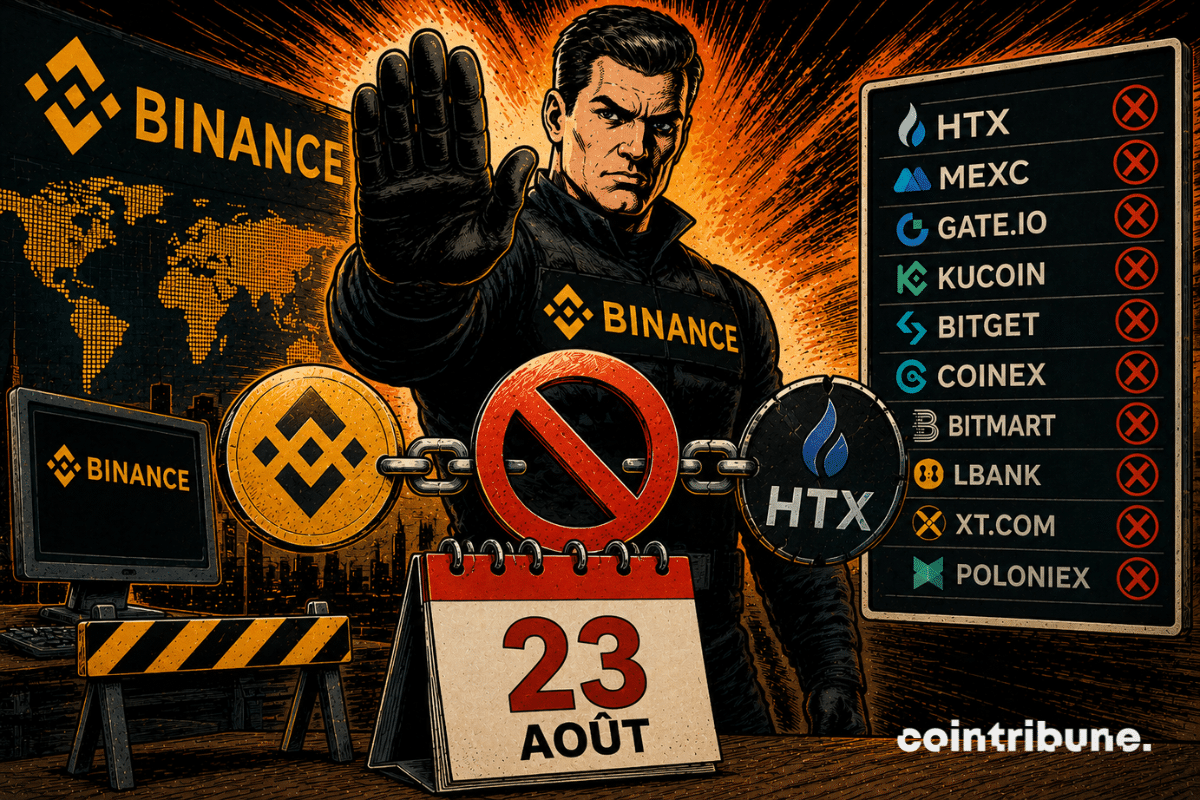
Binance cuts ties with 16 crypto players. Since August 14, 2026, the giant has no longer processed their transactions in order to respond to international sanctions linked to the war in Ukraine and anti-money laundering requirements. Among the platforms targeted is HTX (formerly Huobi), a global heavyweight in the sector. Under European and American regulatory pressure, Binance is now prioritizing compliance over interconnection between exchanges. The move reveals how sanctions and regulation are beginning to reshape relationships between major crypto platforms.
In brief
- Binance is halting transfers with a group of crypto exchanges, including giant HTX, on a schedule from August 7 to 23, 2026.
- Any transfers to or from these entities after the deadline will trigger a compliance check which may result in the freezing of wallets.
- These restrictions stem from EU and US sanctions targeting Russian sanctions evasion and money laundering.
- Justin Sun qualifies the impact by targeting only European and British residents, while confirming ongoing negotiations with regulators.
Binance: a strict execution schedule and progressive blacklisting
Two distinct execution stages have been decided by Binance in its operational schedule. This choice constitutes a gradual, but also irreversible, break with the various targeted entities. The first stage began immediately during the first half of August. From August 7, the exchange platform cut off access to the various financial flows coming from and destined for Shelbit and Aban Tether Exchange.
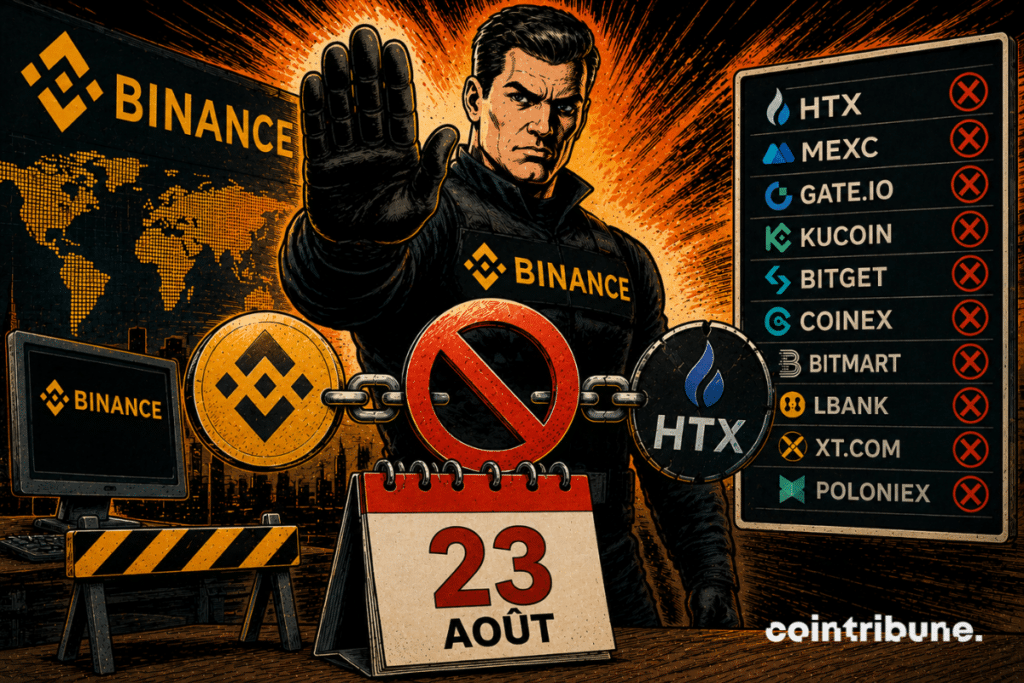
On August 13, this promptly followed measure led to the exclusion of three other companies. These are A7 Nigeria, A7 Africa and PilotFinance Ltd. Indeed, it should be emphasized that this restriction device must achieve its full effect during the second stage, the date of which is set for August 23. From this date, the list of all platforms will expand to include Rapira, Aifory Pro, ABCeX, WhiteBird, NoOnecrypto, Tradex, Monease, BitPapa, Exnode/Exnode Pay, EXMO Ltd., as well as the company Huobi Global SA, operating under the HTX brand.
In practice, the consequences of such an operational ultimatum for Binance users are direct and unambiguous. Thus, the exchange asks its clients to strictly refrain from issuing or receiving funds linked to these 16 structures at the end of their respective cessation dates. For the platform, the date of August 23 is considered a point of no return for all the actors on this list.
Therefore, Binance has warned that any attempted transaction relating to one of these services beyond this allotted time frame will automatically trigger a compliance review by its internal teams. Such a reinforced control procedure will therefore lead to direct restrictive standards or the temporary freezing of the wallets of all the users concerned, which illustrates the severity of the control put in place to seal the group’s financial circuit.
In order to provide clear and complete clarity on the various players excluded from its ecosystem, here is the detailed summary of the 16 entities covered by the Binance restriction schedule:
- Structures blocked as of August 7, 2026: Shelbit and Aban Tether Exchange;
- Entities blocked as of August 13, 2026: A7 Nigeria, A7 Africa and PilotFinance Ltd.
- Companies blocked as of August 23, 2026: HTX (Huobi Global SA), Rapira, Aifory Pro, ABCeX, WhiteBird, NoOnecrypto, Tradex, Monease, BitPapa, Exnode/Exnode Pay and EXMO Ltd.
Accusations of sanctions evasion at the heart of the decision
The decision of the world’s leading exchange platform, beyond the technical organization of this blockage, would result from numerous accusations made by the authorities of the European Union as well as the United States Department of the Treasury. During the month of July, the EU formally took sanctions against HTX as well as all other targeted structures besides Shelbit and Aban.
European regulators reportedly accuse these platforms of actively hindering the various financial restrictions imposed on Moscow in the context of the invasion of Ukraine. For them, HTX would notably provide financial services to the company A7 Limited Liability Company, a Russian structure specializing in cross-border payments and linked to the subsidiaries A7 Nigeria and A7 Africa.
At the same time, United States authorities have issued sanctions against Shelbit and Aban Tether Exchange. Indeed, they suspect this entity of money laundering and evasion in the context of sanctions relating to Iran. As for the United Kingdom, it also sanctioned HTX at the beginning of the year in connection with its links with Russia and the publication of illegal financial promotions.
This analysis by the specialized firm TRM Labs revealed in this regard that the exchange platform had rotated its hot wallets (hot wallets) and its funding addresses in an attempt to evade British financial restrictions, thus speeding up decision-making by Western regulators.
HTX’s counter-offensive and the irreversible fracture of the global market
Faced with the media and regulatory storm caused by Binance’s announcement, the reaction of the management of HTX, a platform bought in 2022 by the founder of TRON, Justin Sun, via an investment vehicle, was not long in coming. In a public statement broadcast on the social network “This matter only concerns Binance users in the UK and EU. HTX does not operate in the UK or EU, and settlement negotiations with UK and EU regulators are already underway.”
This strategy of minimization does not, however, mask the reality of a sector now split in two. By confirming the existence of settlement negotiations with the European and British authorities, HTX implicitly admits the seriousness of the complaints against it. The argument according to which the platform’s activities remain outside territories under Western jurisdiction underlines the emergence of an imposed imperviousness: crypto exchanges can no longer evolve indifferently between regulated markets and gray areas without suffering a direct breakdown in interoperability on the part of the giants of the ecosystem.
Ultimately, this episode marks an irreversible tipping point for the structure of the crypto market. The geographic segmentation of the sector is accelerating, forcing centralized platforms to choose in a binary manner between strict compliance with Western sanctions and maintaining business relationships with embargoed jurisdictions.
While Binance chooses absolute compliance to preserve its licenses and access to strategic European and British markets, the isolation of platforms like HTX risks creating a lasting divide between two increasingly less porous crypto ecosystems. For investors, this new reality requires constant vigilance regarding the origin and destination of their flows, otherwise they risk seeing their crypto assets stuck in the machinery of international compliance.
Maximize your Tremplin.io experience with our ‘Read to Earn’ program! For every article you read, earn points and access exclusive rewards. Sign up now and start earning benefits.