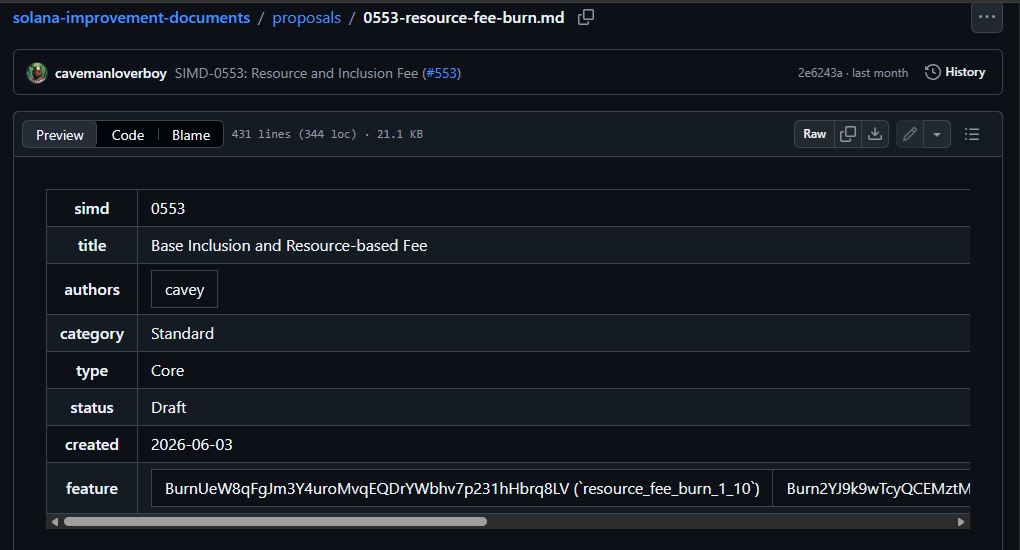
Crypto blockchain Solana is preparing a major overhaul of its fee structure via proposal SIMD-0553. The model would move from a flat fee to pricing based on the resources requested, with part burned. The daily burn of SOL could therefore be multiplied by 12 to 14. Concretely, it would go from 650 to 9,000 SOL. Accompanied by SIMD-0550 which accelerates disinflation, this crypto reform could bring Solana closer to a deflationary economy. The governance vote is ongoing until August 18, 2026.

In brief
- SIMD-0553 proposes to bill each transaction according to five categories of requested resources.
- The deployment would follow three levels: 0.1, 0.25 then 0.5 lamport per cost unit.
- Some no-priority fee swaps could see an increase of up to 3,150%.
- Light transactions could, however, pay less than the current 5,000 lamports.
- The mechanism would burn up to 9,000 SOL per day, compared to around 648 SOL currently.
Solana: why does the crypto blockchain want to charge the “big eaters” of resources?
On July 20, 2026, the Solana Improvement Document 0553 has been merged into the official foundation repository. Proposed by Cavey, researcher at Temporal and engineer at Helius, this text calls into question a dogma several years old: the flat fee. Today, each transaction on Solana costs 5,000 lamports, whether it consumes 10,000 or 200 million CPU cycles. Tomorrow it will be different.
During an interview given to Cointelegraph MagazineCavey said:
If I submit a transaction that does nothing versus a transaction that burns 200 million CPU cycles, I pay the same amount.
On the surface, the mechanism seems simple. The flat fee of 5,000 lamports disappears. It will be replaced by two components:
- an inclusion fee of 2,500 lamports paid to the validator who produces the block;
- a resource fee calculated on the compute units requested by the transaction.
This second part will not be paid to the validators in any way. It will be burned, that is to say permanently withdrawn from circulation.
The figures are particularly interesting
Currently, Solana burns around 650 SOL per day. That’s about $47,000 at the current price of $75. If SIMD-0553 reaches its terminal rate, this daily crypto burn could climb to 7,500 SOL (or even 9,000 SOL). Which equates to a jump of 12 to 14 times. In dollars, we’re talking about $650,000 of SOL incinerated every day.
According to Cavey:
The main goal is to align core developers, application developers and users to make Solana faster.
However, there remains a side effect that makes holders of the crypto SOL : deflation.
Today, Solana issues around 60,000 SOL per day. Inflation is around 3.8%. Even with 9,000 SOL burned daily, the token would remain inflationary. Fortunately, the SIMD-0553 doesn’t travel alone. It comes with SIMD-0550, a companion proposal that would double the annual disinflation rate. The latter would then increase from 15% to 30%.
Result : the inflation floor of 1.5% would be reached in 2029 instead of 2032. Over six years, 18.9 million fewer SOLs would be issued. That’s about $1.36 billion at current prices.
A crypto vote under high tension before August 18
The signaling vote began in early August 2026. 15% of the stake must be reached to trigger a formal vote. As of August 8, between 25 and 63 million SOLs had signaled their support. This represents between 5.8% and 14.4% of the total stake of 432.65 million SOL. Helius, one of the largest validator operators, provided massive support.
The deadline is August 18, 2026. Until then, approximately 40 million SOLs of positive signals are still missing. This represents nearly $2.9 billion in stake.
If the threshold is reached, the implementation will be done in phases via feature gates in the future version Solana 4.3. On the other hand, the terminal rate of 0.5 lamport per compute unit will not apply all at once. Rather, the transition will take place gradually.
What impacts for crypto investors and developers on Solana?
For crypto investors, this proposal constitutes a strong signal. Solana is no longer content with being fast. She wants to be efficient. And above all, she wants this efficiency to translate mechanically into the SOL token offering. This is a fundamental difference with Ethereum. Post-EIP-1559 burn is linked to network usage. However, transaction fees remain high. On Solana, the idea is to burn more while keeping costs negligible for the average crypto user.
The question of centralization also looms large. If arbitrage bots and high-frequency traders see their costs explode, will they migrate to other chains? In this context, Solana has already lost part of its MEV activity to competing crypto networks. Taxing heavy users more could thus push them towards alternatives like Sui or Aptos.
Either way, the opportunity is real. By making simple crypto transactions cheaper and complex transactions more expensive, Solana creates an economic incentive for optimization. The fact is that developers will have to take care of their code. Results :
- End users will benefit from lighter applications.
- The Solana crypto network as a whole will gain resilience.
One thing is certain: the SIMD-0553 reform on Solana is not just a technical adjustment. This is an economic overhaul that could redefine who wins and who loses on the crypto blockchain. Between massive burn, forced optimization and tensions on validator income, the outcome of the August 18 vote will tell whether Solana chooses efficiency at all costs or the stability of existing incentives.
Maximize your Tremplin.io experience with our ‘Read to Earn’ program! For every article you read, earn points and access exclusive rewards. Sign up now and start earning benefits.