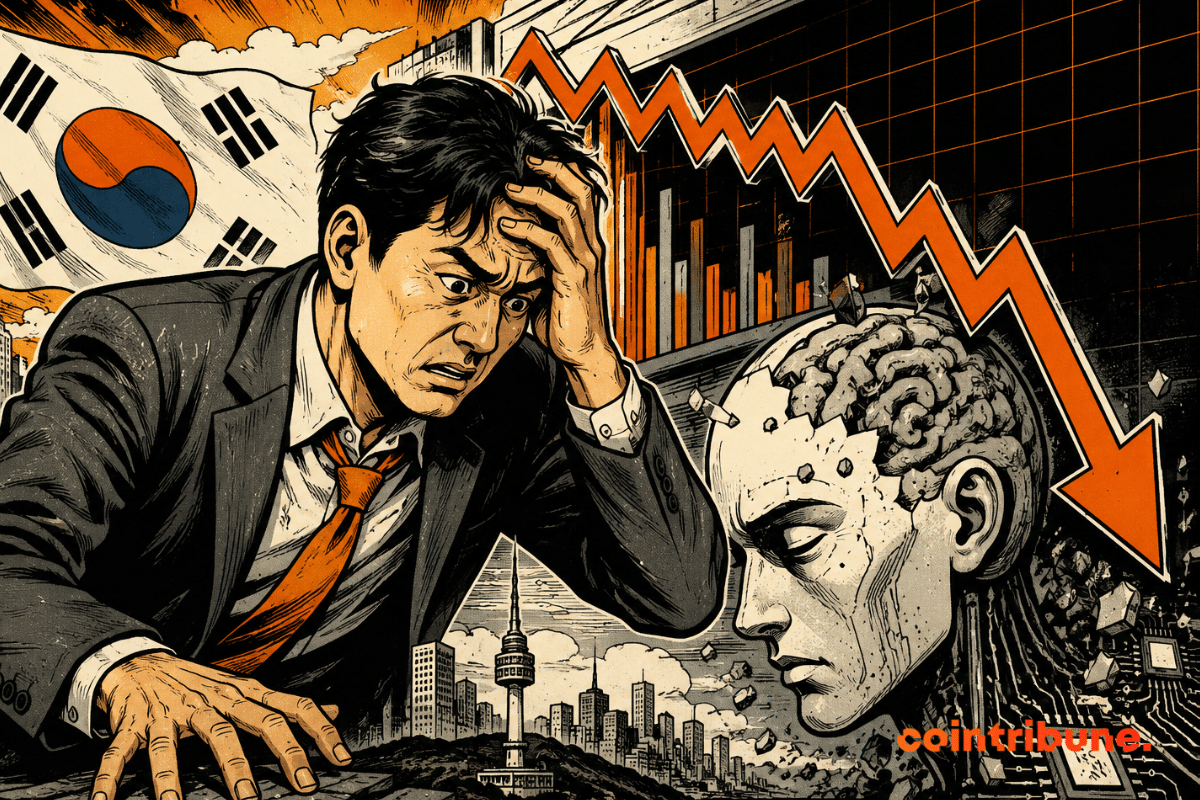
The South Korean market is going through a phase of high volatility which is fueling questions about the valuations of technology companies. In just two sessions, the KOSPI has suffered a historic decline, while tensions are also affecting the bond markets linked to AI. This correction comes as investors had overwhelmingly favored semiconductor and digital infrastructure stocks, considered the main drivers of growth since the start of the year.
In brief
- The KOSPI lost nearly 17% in two sessions, erasing around $620 billion in capitalization.
- SK Hynix’s results, below expectations despite a record profit, triggered the sharp correction.
- Retail investors, who are highly exposed to leveraged ETFs, suffer the greatest losses.
- Fears around AI also extend to bond markets, with a record rise in credit spreads of cloud giants.
- Markets are now watching upcoming results from major tech companies to gauge the strength of investments in AI.
KOSPI falls sharply after SK Hynix results disappointment
The Seoul Stock Exchange recorded a second consecutive session of sharp decline after a fall of around 30% last week, pushing the authorities to react quickly. The circuit breakers once again interrupted trading, illustrating the extent of the selling movements. After these two days, the KOSPI now shows a decline of close to 17%, which represents nearly $620 billion in market capitalization gone. Faced with this situation, the South Korean government called an emergency meeting with financial authorities, as reported on STRAITESTIMES.
The main trigger comes from SK Hynix’s quarterly results. According to Reuters, despite a record operating profit of 60.54 trillion won, up 557% year-on-year, performance remains below the 64 trillion won expected by analysts.
The action thus lost an additional 4% after a fall of 15% the day before according to TradingView data. Along with Samsung Electronics, SK Hynix accounts for almost half of the KOSPI’s weighting, which automatically amplifies the impact of each correction on the entire index.
This reaction also illustrates the particularly high expectations surrounding companies related to semiconductors and AI. Investors had priced in almost perfect growth scenarios. As soon as the results do not fully meet forecasts, profit taking becomes more significant and accelerates sales on the most exposed stocks.
Retail investors pay the price of excessive leverage
The correction comes in a context where individual investors occupy a growing place in the South Korean market. Faced with an expensive real estate market and more difficult employment conditions, many young savers have turned to the most dynamic assets. Traditionally present in cryptocurrencies, they have gradually transferred part of their capital to stocks in the AI and semiconductor sectors.
This development is clearly evident in recent figures. Cryptocurrency trading volumes in Korea declined by 28%, while the KOSPI was still up 31% year-to-date before this correction. The growing interest in technology stocks has been accompanied by greater risk-taking, fueled by the use of leveraged products.
The launch in May of leveraged individual stock ETFs aimed at individuals reinforced this trend. Outstanding amounts of these products exceeded $50 billion in Julyattracting more investors to riskier strategies.
After the heavy losses recorded this week, several politicians have apologized for this authorization and are now calling for a new ban on these instruments for retail investors. This sequence serves as a reminder that periods of rapid rise can also accentuate corrections when leveraged positions are unwound simultaneously.
Tensions are also affecting the bond market of AI giants
Concerns no longer only concern the stock markets. They now extend to the obligations of the main American groups specializing in cloud and AI. Five-year default risk insurance contracts covering several major players in the sector rose from 115 to 162 basis points in a few months, reaching an unprecedented level.
This development reflects a more cautious perception of the financial risk associated with the massive investments made by these companies. The market now estimates the probability of default at around 12% of this group of companies over a five-year horizon. At the same time, their cumulative debt in dollars now exceeds 360 billion, while their free cash flow becomes negative.
Oracle focuses a significant portion of these concerns due to its considerable investments in AI. Although its order book remains high, a significant part depends on OpenAI, presented as a major customer whose cash generation remains limited and whose IPO has been postponed. This dependence fuels questions about the group’s ability to quickly make its investments profitable.
At the same time, Alphabet, Microsoft, Amazon and Meta together plan between $725 and $730 billion in investments in 2026 according to a report from Yahoo Finance. Alphabet has already recorded its first net cash burn in the second quarter, at $5.9 billion, despite 82% growth in its cloud business.
In this context, investors are carefully monitoring upcoming financial releases to assess whether this spending will continue to support growth or weigh further on valuations. The KOSPI could thus remain sensitive to upcoming announcements from major technology players, while markets continue to reassess the pace and cost of investments in infrastructure linked to artificial intelligence. The next results will make it possible to measure whether this dynamic can still support the sector’s ambitions or whether a new phase of adjustment is necessary.
Maximize your Tremplin.io experience with our ‘Read to Earn’ program! For every article you read, earn points and access exclusive rewards. Sign up now and start earning benefits.