
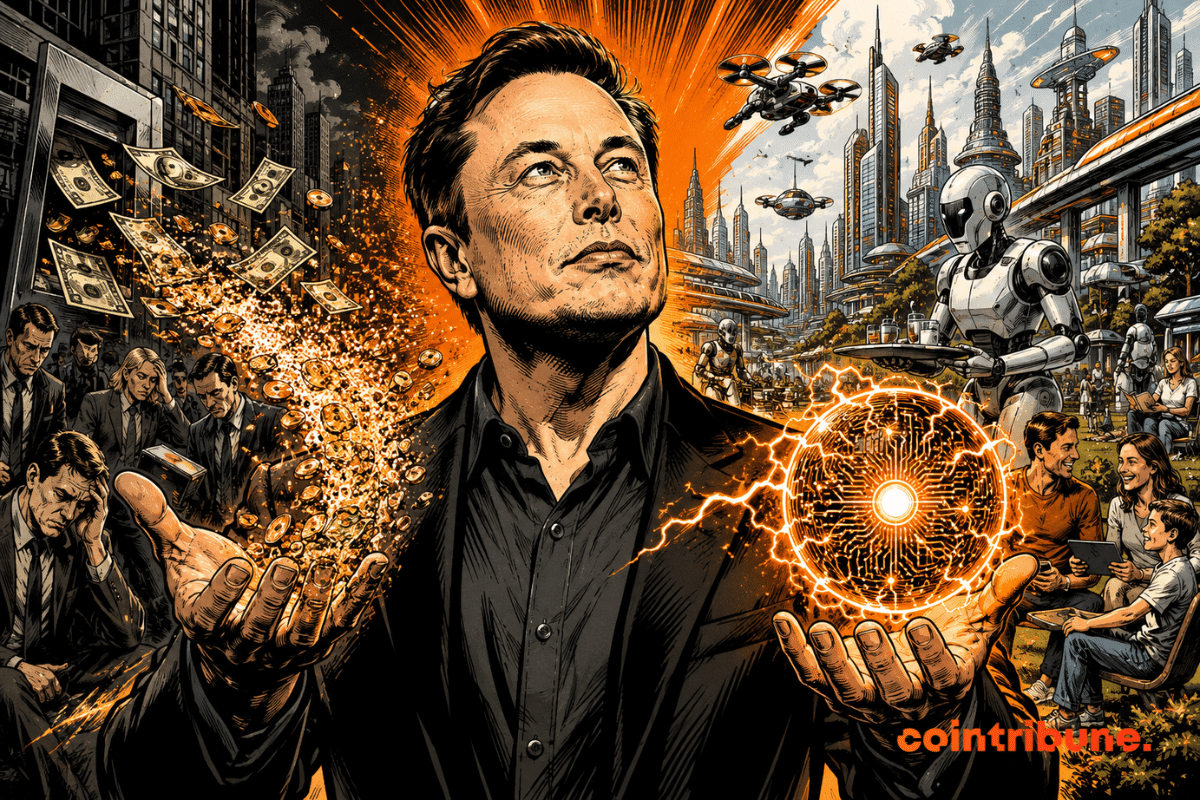
On July 23, 2026, The Economist published a 90-minute interview between its editor-in-chief Zanny Minton Beddoes and Elon Musk. The main topic: the future of AI. One of the answers from the first trillionaire in history, however, went around the world in a few hours. Asked about Tesla and SpaceX’s future revenue streams, Musk doesn’t answer with a revenue figure or market strategy. He says: “I’m going to make another prediction. Money won’t matter in 2036.”
In brief
- Elon Musk estimates that AI will surpass human intelligence in about five years.
- He predicts the job will become optional over the next decade.
- According to him, money will also no longer have the same importance by 2036.
- These announcements come as Tesla falls on the stock market and SpaceX declines after its historic introduction.
AI could make work optional, says Elon Musk
For Elon Musk, the next disruption won’t come only from automation. In fact, he believes that artificial intelligence will exceed the sum of human intellectual capacities in about five years.
This development would open up an economy where machines would perform the majority of productive tasks. Work would then become optional rather than essential. Decryption: everyone could continue to carry out an activity out of personal interest rather than financial necessity.
The billionaire takes this reasoning even further. He considers that money will gradually lose its importance by 2036. The reason is that goods and services will become sufficiently abundant through technological advancement.
This projection is therefore entirely based on continued acceleration of artificial intelligence performance. On the other hand, it does not provide any details on the economic functioning of such a society.
Another key element of Musk’s speech: a global competition around artificial intelligence
During the interview given to The EconomistElon Musk emphasizes the rapid progress made by China. According to him, the country is getting closer to being able to produce its own advanced chips for AI. Enough to reduce its dependence on Western technologies.
He also welcomes the level reached by Anthropic’s Fable model launched in June 2026. He nevertheless believes that the Chinese Kimi K3 model is also quickly reducing its delay.
In order to limit the risks, Musk is proposing a new mechanism: the main AI laboratories would share their new models with their competitors one to two weeks before their launch. Each actor could thus report possible risks to the American and Chinese authorities before any public release.
These statements come in a less favorable context for Elon Musk’s companies
The same day as this interview, Tesla published contrasting quarterly results. Its turnover reached a record $28.24 billion. An increase of 26%! Adjusted earnings per share, however, came to $0.33, compared to $0.51 expected by analysts. The stock ended the session down 14.5%. It is about its biggest fall in more than a year.
SpaceX is also having a turbulent time. Introduced on the stock market in June 2026 in a historic operation, the company saw its valuation decline after reaching a peak of $2.6 trillion. Its thirteenth Starship test flight also aborted before takeoff after several Raptor engines failed.
During the interview, Elon Musk also admits to having devoted too much time to politics during his time at head of the Department of Government Efficiency (DOGE). He claims to have gotten carried away, while continuing to defend several decisions made during this period.
What this would mean for the currency, if the scenario comes true
Analysts are counting on three possible consequences if Elon Musk’s prediction comes true:
- Falling prices on goods and services whose production can be automated on a large scale. This includes electronics, the textile industry and some digital services.
- Growing pressure on states to finance massive income transfers. The fact is that salaried employment would lose its centrality as a mechanism for wealth distribution.
- A shift in scarcity towards energy since land will be available for data centers and robotic factories (and human attention).
In the same context, they raise a fundamental governance question: who decides on the distribution of abundance if the production of AI remains concentrated between a few dominant private actors?
Musk himself acknowledges that this transition would be chaotic. According to him, it could even generate significant social tensions if jobs disappear faster than new roles appear to replace them.
In any case, Elon Musk’s statements extend a conviction that he has defended for several years: artificial intelligence will transform not only businesses, but also the foundations of the global economy. Whether the 2036 deadline is verified or not, the debate it relaunches goes well beyond the Tesla-SpaceX case alone. It joins questions already well known to crypto analysts, central banks and state digital currencies.
Maximize your Tremplin.io experience with our ‘Read to Earn’ program! For every article you read, earn points and access exclusive rewards. Sign up now and start earning benefits.


