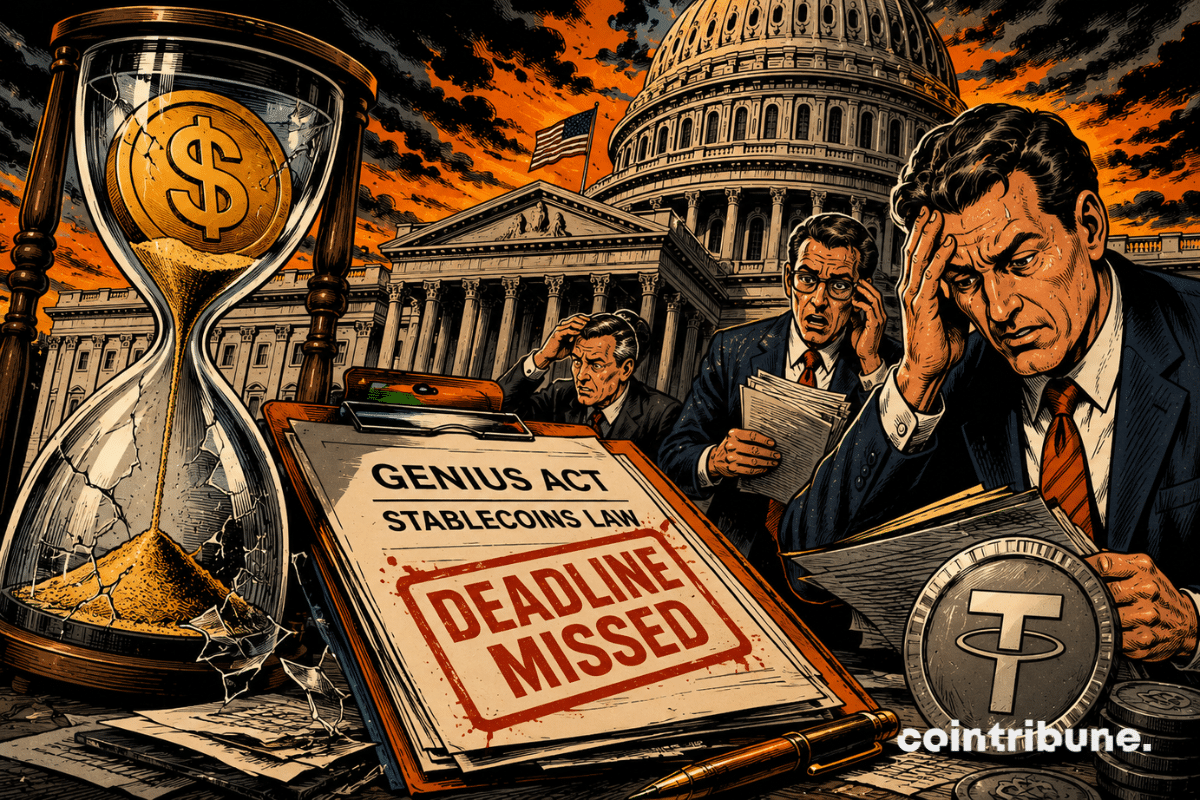
American federal agencies did not adopt the rules for implementing the GENIUS law before the deadline set at one year, settling for ten text proposals. This delay, which occurred on July 18, 2026, leaves stablecoin issuers waiting for definitive frameworks. Will the window of regulatory clarity finally close?
In brief
- Federal agencies missed the GENIUS Act’s one-year deadline of Saturday, July 18, 2026.
- Ten rules were proposed (NPRM), but none were finalized before the deadline.
- Treasury released four proposals, the OCC two, the FDIC one, and the NCUA paved the way for credit unions.
Washington missed its own GENIUS Act meeting
The GENIUS Act (Guiding and Establishing National Innovation for US Stablecoins) opened the first real period of clarity for American stablecoins a year ago. However, a year later, its final framing is still missing.
The movement deserves attention because it touches on the first federal base dedicated to stablecoins. The Treasury, the OCC, the FDIC and the Federal Reserve are among the agencies concerned, according to monitoring by the Chapman firm and the crypto company Paradigm.
Missing this deadline does not drain the GENIUS law of its force. The absence of final texts, however, fuels regulatory uncertainty for issuers. President Donald Trump signed the law on July 18, 2025, establishing the first comprehensive federal framework on stablecoins in the United States. The agencies have increased public consultations without being able to finalize a final regulation before the weekend.
The Treasury has published four proposals since signing
Of the ten Notices of Proposed Rulemaking (NPRM) published since the signing of the GENIUS Act, the Treasury Department has the most active voice with four texts. These cover the overall implementation of the law, criteria for equivalence between state regimes and the federal framework, registration of foreign issuers and anti-money laundering standards, according to Paradigm. The OCC added two NPRMs on nationally licensed issuers and supervisory standards.
The FDIC issued an NPRM targeting institutions under its umbrella, with a focus on reserve management. The NCUA (National Credit Union Administration) has proposed opening up the space to federally insured credit unions.
Finally, the federal banking agencies filed an interagency rule to harmonize supervision between OCC, Federal Reserve and FDIC. The reference article on the regulation of stablecoins details the framework that these texts seek to clarify.
Anchorage pushes Congress to pass the CLARITY Act
On the occasion of this first anniversary, the crypto bank Anchorage Digital relaunched Congress on a second legislative component, the CLARITY Act. This text aims for the first federal framework for digital assets excluding stablecoins. Galaxie Digital lowered its chances of seeing the CLARITY Act adopted in 2026 to 50% on June 26, citing the absence of a common Senate text and the narrow timetable before the elected officials’ break.
On the first anniversary of GENIUS, we renew our call for Congress to pass the CLARITY Act and extend the clear market structure rules that have proven successful for stablecoins to the entire digital asset economy.
Anchorage Digital published this call on the Friday before the deadline. The CLARITY Act passed the Senate Banking Committee in May, but banking groups see it as a risk of returns on stablecoins without the same constraints as a traditional bank.
On July 13, the American Bankers Association and ICBA wrote to senators asking for more clarity on yields, so that payment stablecoins remain transaction tools and not substitutes for deposits.
In short, America missed its own deadline without weakening the GENIUS Act, leaving issuers in a regulatory limbo. The timing of the CLARITY Act, yield trade-offs, and interagency convergence will shape the months to come. The clarity promised by Washington is not dead, but it is falling behind schedule.
Maximize your Tremplin.io experience with our ‘Read to Earn’ program! For every article you read, earn points and access exclusive rewards. Sign up now and start earning benefits.