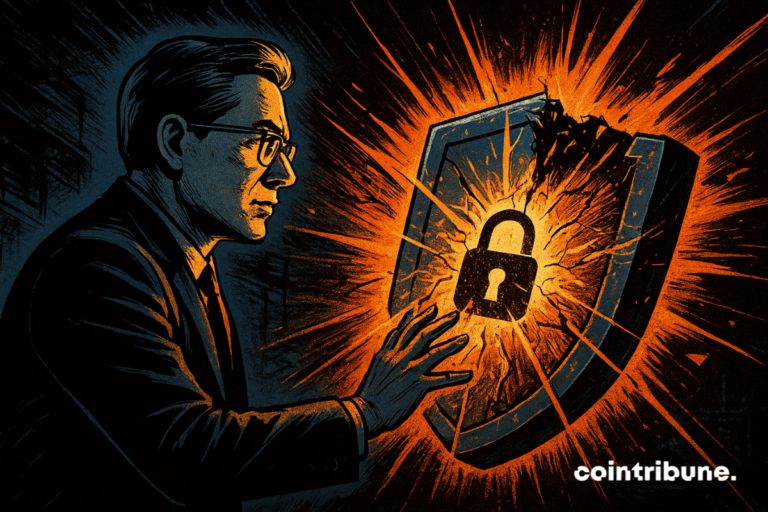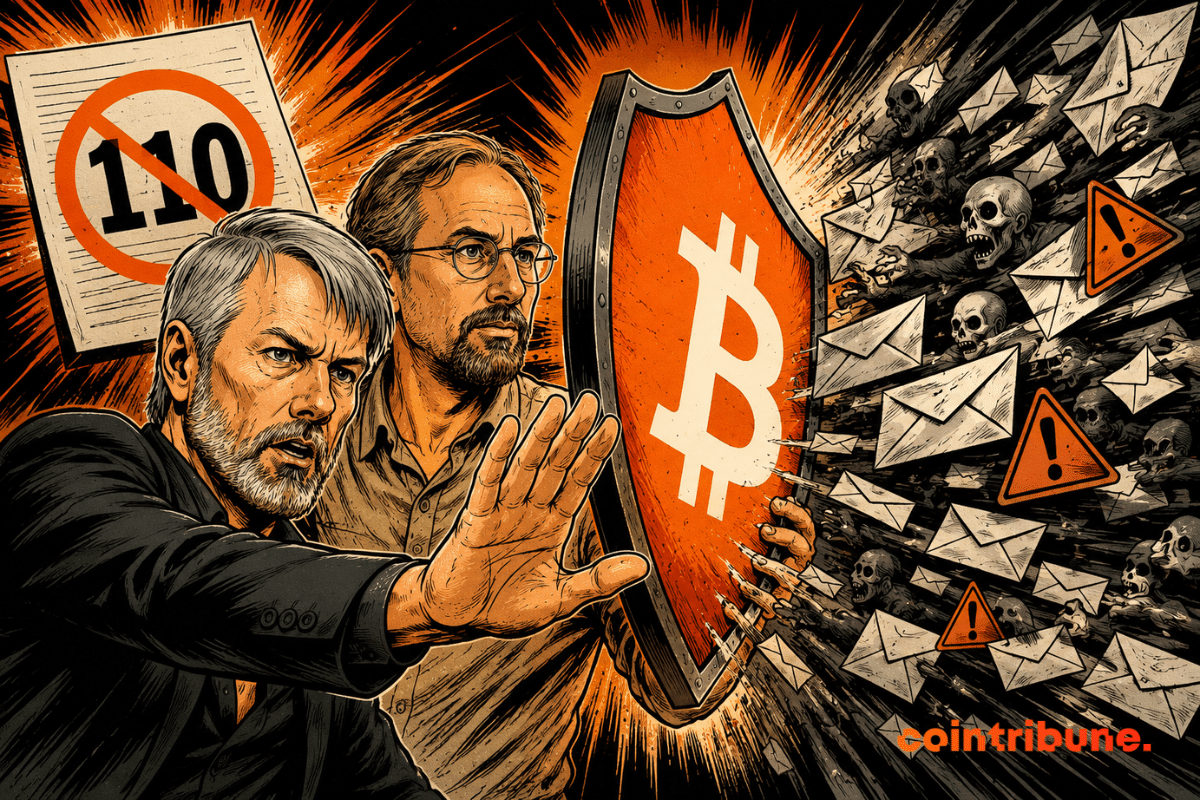
The debate around the evolution of the Bitcoin network is experiencing a new episode with the BIP-110 proposal, designed to limit non-monetary transactions and certain data deemed undesirable. While its defenders believe that it would protect the initial use of the protocol, several influential figures contest this approach. Michael Saylor and Adam Back consider that such a modification could create more risks than it would resolve. Their positions thus relaunch an important discussion on the balance between network protection, decentralization and protocol stability.
In brief
- Michael Saylor and Adam Back oppose BIP-110, saying the proposal poses more risks than the “spam” it seeks to limit.
- BIP-110 aims to restrict Ordinal registrations and non-monetary data in order to preserve the use of Bitcoin as a payment system.
- Opponents fear that this temporary bifurcation will weaken the credibility of the network and invalidate certain transactions.
- Proponents assure that BIP-110 would not cause a chain split and would only limit the effects of Ordinals for one year.
- With only 1% block support in the last reporting period, activation of BIP-110 remains very unlikely.
Bitcoin at the heart of a new debate around BIP-110
The debate around BIP-110 is intensifying within the Bitcoin community, pitting proponents of technical intervention against defenders of the status quo. The BIP-110 proposal was introduced in December 2025 as a mechanism that aims to limit non-fungible token Ordinals listings as well as other arbitrary data on the network. Its goal, according to its developer, is to preserve Bitcoin’s primary use as a peer-to-peer payment system. The promoters of the text believe that these additional uses unnecessarily clutter the blockchain and divert the protocol from its original function.
Michael Saylor, however, expressed clear opposition to this initiative. In a post on According to him, BIP-110 could have a more worrying consequence by invalidating certain ordinary network transactions, which would weaken its credibility among users.
Adam Back shares this analysis. In his post on X, the Blockstream manager considers that “ a modification of this nature goes beyond a simple technical question “. He believes that “ such an approach risks introducing a control logic incompatible with the historical principles of the protocol “. For him, decentralization precisely implies that no group can impose its vision on all the participants.
A proposal that revives a historic disagreement
The debate around soft fork BIP-110 represents one of the most significant technical disputes seen within the community since the block size wars between 2015 and 2017. At that time, developers and ecosystem players were already considering whether to modify the protocol at the cost of risking a chain split. This new controversy is a reminder that fundamental changes remain particularly sensitive in the Bitcoin universe.
The proposal was introduced by pseudonymous developer Dathon Ohm with support from Luke Dashjr, founder of the Ocean protocol. Supporters of the project consider that the proliferation of Ordinals registrations poses a serious threat to the network. They defend rapid intervention in order to limit the swelling of the blockchain caused by this data.
These supporters also dispute the idea that BIP-110 would cause a split in the network. They explain that the measure only provides for a temporary bifurcation lasting one year. According to them, this limit would prevent the lasting effects feared by certain opponents and would not invalidate profitable transactions in the long term.
Support still very limited despite the arguments of supporters
Despite the intensity of exchanges, the activation of BIP-110 appears very unlikely today. The proposal can only come into effect if 55% of the nodes validating the blocks support this development for a specified period. This threshold remains far from being reached according to the latest available figures.
During period number 475, between blocks 955,584 and 957,599, only 1% of blocs signaled support for the proposal. This level of support shows that consensus remains far from the conditions necessary for activation. Thus, this weak mobilization constitutes an important indicator of the current state of the debate.
At the same time, the context of the network has evolved. Activity linked to Ordinals is now at a level close to its historic low. Less than 10,000 daily registrations were recorded on the Bitcoin blockchain over the last month, compared to more than 400,000 during the peak observed in August 2023. This drop indirectly fuels discussions on the need to adopt BIP-110, while the targeted phenomenon seems significantly less important than before.
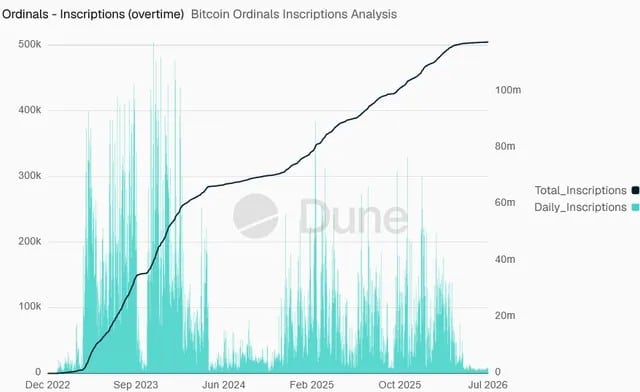
The evolution of this issue will now depend on the ability of the different parties to convince more participants. As long as the level of support remains this low, the proposal should continue to power exchanges without changing the functioning of the blockchain protocol. The next reporting cycles will allow us to observe whether the debate remains essentially theoretical or whether it takes on a new dimension within the Bitcoin community.
Maximize your Tremplin.io experience with our ‘Read to Earn’ program! For every article you read, earn points and access exclusive rewards. Sign up now and start earning benefits.