XRP is going through one of the most delicate periods in its recent history. After several months of decline, Ripple's token left the circle of the five largest cryptos by capitalization, a downgrade which illustrates the pressure exerted by a market shaken by macroeconomic uncertainties. This fall, however, contrasts with a reality often observed in recent years: the third quarter has regularly proven favorable for XRP. Between historical dynamics and current weakness, investors are wondering about the asset's ability to reverse the trend.
In brief
- XRP is recording a series of historic declines, to the point of leaving the ranking of the five largest cryptos by capitalization.
- The market correction is explained by a tense macroeconomic context, fueled by geopolitical tensions and renewed risk aversion.
- The historic performances of the month of July maintain the hope of a rebound, despite a still fragile dynamic.
- Flows into spot XRP ETFs are providing support to the market, although some signs of slowdown are starting to emerge.
XRP pushed to its limits
Data analysis reveals the extent of the correction suffered by XRP. The main factual indicators of this period of turbulence are as follows:
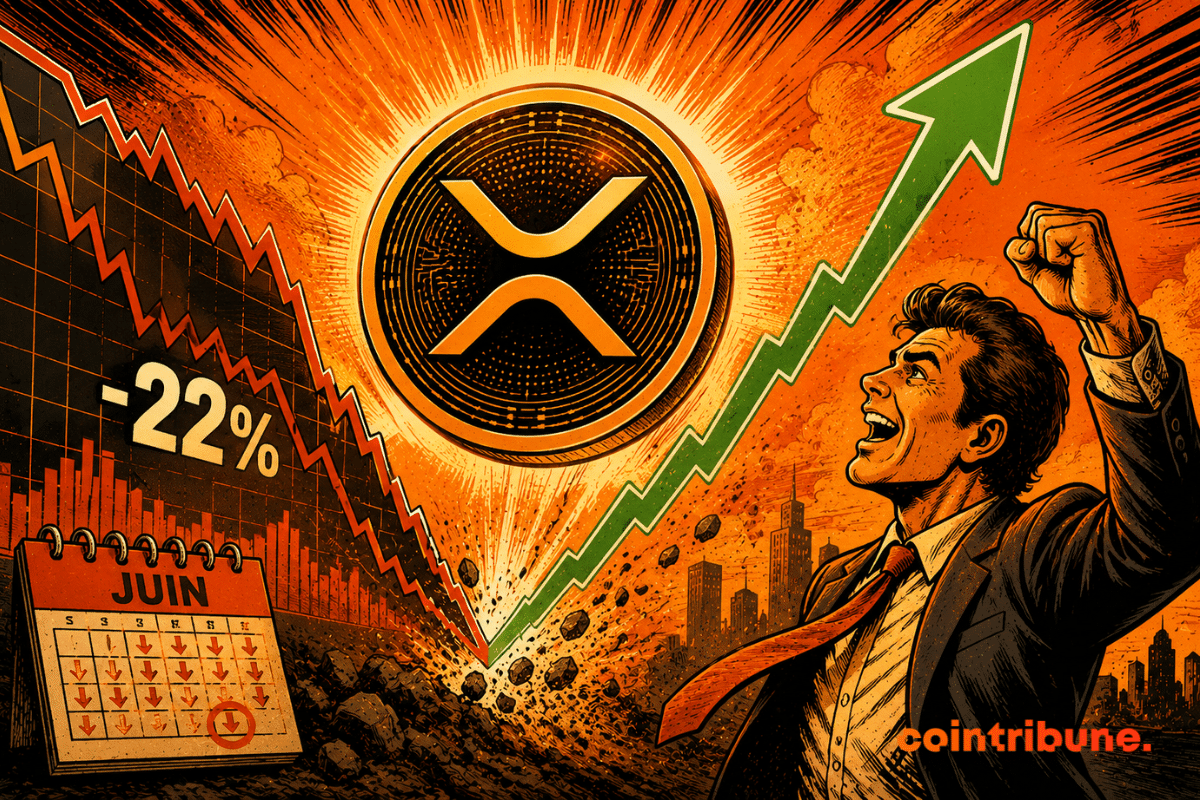
- A severe monthly fall: XRP closed the month of June with a drop of 22.1%, affected by a general climate of risk aversion;
- A multi-year low: selling pressure led to a sudden drop in the price to a floor level of $1.01 on the majority of exchange platforms, a valuation which had not been observed since the end of 2024;
- A structural downgrade: Although the price has begun a technical rebound to settle at $1.15 at the time of market reporting, the asset is now trading behind USDC, Binance BNB, USDT, Ethereum and bitcoin.
This dropout explains itself by a range of exogenous factors, including the intensification of geopolitical tensions in the Middle East and the proliferation of destabilizing rumors, commonly referred to as FUD, which prompted investors to liquidate their speculative positions. The importance of this event lies in its historical significance for the long-term price structure of Ripple's crypto. This monthly drop in June sealed an equally mediocre quarterly performance, resulting in an overall decline of 22.4% over the entire second quarter of the year.
Thus, this is the very first time in its history that XRP has aligned three consecutive quarters in the red, after having already recorded a collapse of 35.4% during the fourth quarter of 2025, followed by a further contraction of 27.1% during the first quarter of this year. This uninterrupted succession of massive losses reflects a prolonged capitulation of buyers, causing the crypto to test major psychological support lines.
Seasonality and institutional flows as drivers of a potential surge
Faced with this gloomy picture, supporters of a trend reversal are turning to statistical cycles, because the month of July has historically established itself as one of the most successful periods for Ripple's token. Performance records indicate that the previous six months through July all posted a positive close for XRP, hence hopes for a quick rebound. The financial years of July 2020 and July 2023 are particularly distinguished by respective upward surges of 48.1% and 47.6%.
Most recently, July of last year saw a spectacular 35% appreciation, following a 31.2% increase seen the previous year. The most moderate increases in this positive series were recorded in July 2022 with 14.6% and in July 2021 with 6.91%. Although the 2026 vintage began its race on an encouraging note, materialized by an initial increase of 9%, analysts point out that between 2015 and 2019, the entire month of July ended with losses, which requires great caution.
Beyond the simple recurrence of past data, the current dynamic is based on a concrete fundamental pillar: the sustained interest of institutional investors in regulated financial products. Financial flows to exchange-traded index funds, or spot XRP ETFs, demonstrate remarkable regularity. These financial instruments have in fact extended their positive streak to reach a ninth consecutive week of net capital inflows.
Such accumulation of capital by institutional entities provides an essential counterpart to the selling pressure experienced by individual investors. However, the most informed observers emphasize that this dynamic is showing its first limits, noting that “cracks are starting to appear” within these capital flows, which could mitigate the impact of this catalyst if the trend were to run out of steam.
Technical and fundamental scenarios for Ripple
The short-term evolution of XRP will depend on the delicate balance between the persistence of these institutional flows and the strength of the resistances born from consecutive months of decline. If the historical trend of the last five years is confirmed, the lasting crossing of the threshold of $1.15 could validate the reversal signal long awaited by the trading algorithms.
Conversely, if the fragilities detected in ETF flows materialize in a drying up of incoming volumes, XRP could risk seeing its rebound invalidated, thus confirming that the overall macroeconomic trend remains dominated by sellers.
Investors will therefore have to monitor with particular attention the behavior of the price of
Maximize your Tremplin.io experience with our 'Read to Earn' program! For every article you read, earn points and access exclusive rewards. Sign up now and start earning benefits.