
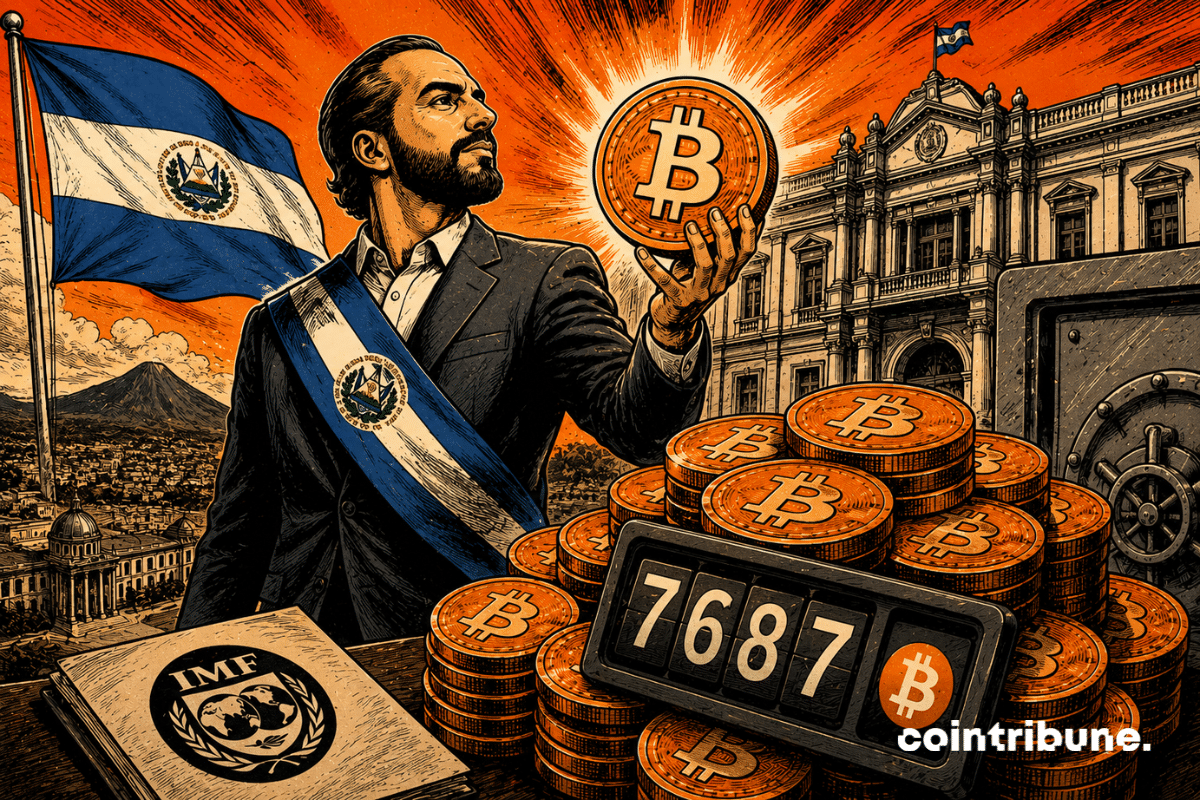
The International Monetary Fund imposes strict rules on countries requesting its financial assistance. Obeying injunctions is often the price to pay to benefit from disbursement facilities. However, El Salvador seems to have found a subtle solution with its bitcoin stories. The country continues to accumulate crypto as if the agreement signed with the Washington institution did not really exist. This situation questions the freedom of nations in the face of economic determinism.
In brief
- El Salvador holds 7,687 bitcoins worth $510 million.
- The country has been buying around one bitcoin per day since November 2022.
- The agreement with the IMF prohibits accumulation, but El Salvador continues.
- Bukele refuses to sell and says bitcoin is a bet for the future.
El Salvador accumulates bitcoin every day, no matter what
Since November 2022, El Salvador has applied a regular acquisition method comparable to price smoothing. Each day sees the addition of approximately one bitcoin to state reserves. Market fluctuations do not influence this daily and immutable rhythm.
This mechanical approach allowed the country to cross the threshold of 7,600 bitcoins. Salvadoran authorities do not seek to anticipate stock market movements. They constitute a strategic reserve in the very long term.
This method contrasts with the speculative strategies often observed in the sector. Between January and April 2026, more than 1,600 bitcoins were added to state holdings.
President Bukele fully assumes this assumed political orientation. He regularly repeats that the country will never sell its assets. This position has become a central element of El Salvador's economic identity.
The standoff with the IMF intensifies
The agreement concluded with the IMF in January 2025 included an explicit and binding condition. The Salvadoran public sector needed to stop accumulating bitcoin without further delay. This requirement was intended to limit the country's exposure to an asset known to be very volatile.
However, purchases continue as evidenced by official data. The Salvadoran authorities even successfully passed an IMF examination. This situation has raised questions about the real scope of the commitment made.
The IMF considers that part of the movements observed do not correspond to net purchases. Rather, these would be transfers of bitcoins already held by the State. The government strongly contests this analysis without providing details. This opacity maintains vagueness regarding the precise amount of the reserves.
The general trend nevertheless remains a constant and regular increase. The situation illustrates a latent conflict between the demands of international financial institutions and the monetary sovereignty of a State. A real philosophical question about the freedom of nations in the face of economic determinism.
Bukele's faith challenges institutions with crypto
Beyond the quantitative aspects, this policy is based on a deep and unshakeable conviction. President Bukele expresses this by the now famous formula “1 BTC = 1 BTC”.
This statement means that the value of bitcoin must appreciate in reference to itself. It does not depend on its price in dollars on the financial markets. This maxim reflects absolute confidence in the digital asset in the very long term.
El Salvador does not view its reserves as a speculative trading position. This is a strategic investment intended to produce gains over several years.
Projects such as the “Volcano Bond” or the “Bitcoin City” are part of this logic. The capital gains tax exemption in crypto aims to attract foreign investors.
The impact on markets remains modest in volume, but significant as a signal of sovereign adoption. This strategy questions the relationship between political will and external constraints imposed by institutions.
The key figures of the Salvadoran strategy
- 7,687 BTC held by El Salvador;
- 1 BTC purchased on average every day;
- 1,600 BTC added between January and April 2026;
- $1.4 billion IMF deal in progress;
- BTC price at $64,077 at the time of writing.
The Salvadoran experience shows that a state can accumulate digital assets despite external pressures. The IMF can reframe any rebellious country. Has he not just fined Nepal for its growing use of cryptos despite the official ban?
Maximize your Tremplin.io experience with our 'Read to Earn' program! For every article you read, earn points and access exclusive rewards. Sign up now and start earning benefits.


