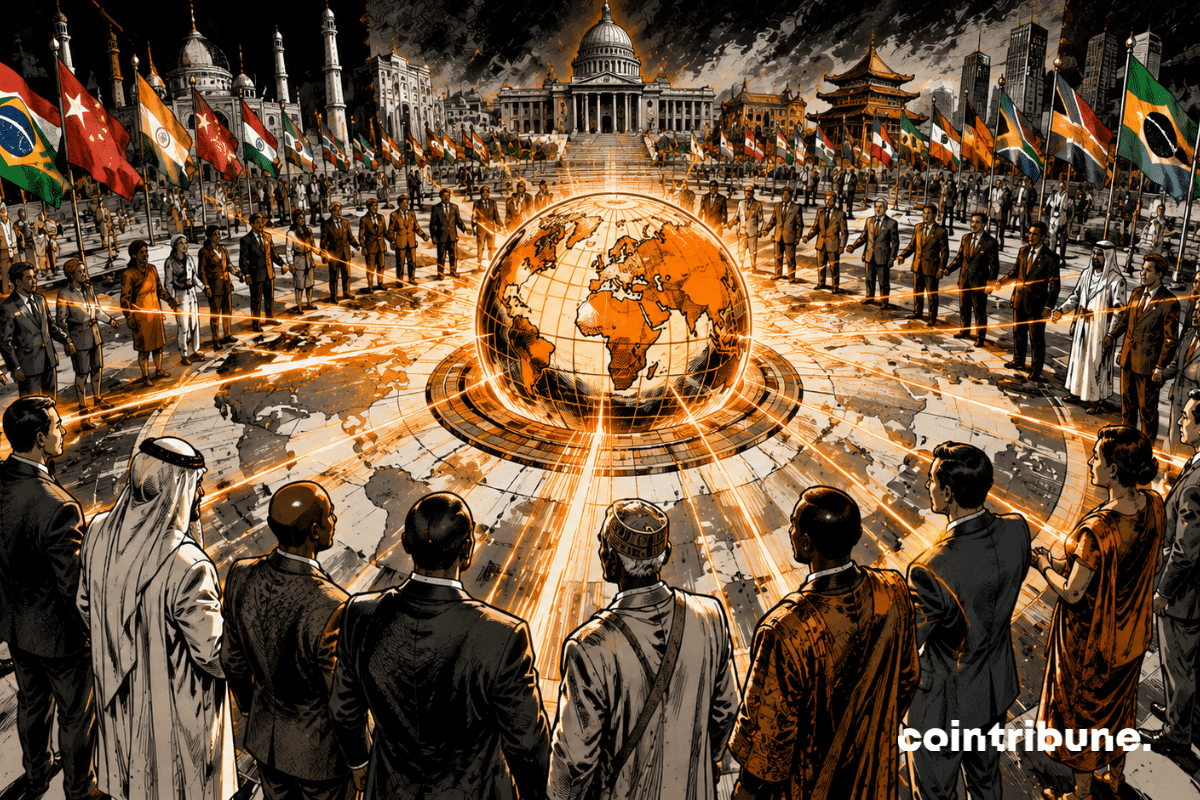
More than 80 countries are now seeking to reduce their dependence on the US dollar, a movement which is taking on unprecedented proportions under the leadership of the BRICS. Between commercial settlements in yuan, rupee or ruble and the proliferation of bilateral monetary agreements, several large economies are accelerating their transition to alternatives to the greenback. While the enlarged BRICS bloc gains influence on world trade, this dynamic is gradually reshaping international financial balances and fueling questions about the future of the domination of the dollar.
In brief
- More than 80 countries are gradually reducing their dependence on the dollar in their trade.
- The BRICS are strengthening their global economic weight and accelerating the use of national currencies.
- China and Russia now settle most of their trade in yuan and ruble.
- This dynamic could contribute to the emergence of a more multipolar international financial system.
More than 80 countries join the dedollarization dynamic
The dedollarization movement reaches a new stage. Thus, more than 80 countries are now participating in initiatives aimed at reducing their dependence on the American dollar in international trade. This dynamic is largely associated with the growing influence of BRICS, whose membership has expanded with the arrival of new members such as Saudi Arabia, the United Arab Emirates, Egypt, Iran and Ethiopia.
Such a development is part of a global strategy aimed at promoting the use of national currencies in trade. The Chinese yuan, the Indian rupee and the Russian ruble are gradually appearing as alternatives to the greenback in several bilateral agreements. For the countries concerned, the objective is to reduce their exposure to financial mechanisms dominated by the United States while strengthening their autonomy in the settlement of their international transactions.
The figures provided make it possible to measure the extent of this transformation:
- More than 80 countries participate in dedollarization initiatives;
- The BRICS now represent 20.4% of global trade;
- The bloc represents approximately 36.8% of global GDP in purchasing power parity;
- The yuan, rupee and ruble are among the main currencies used in these new settlement mechanisms.
These indicators demonstrate the growing economic weight of the grouping and explain why dedollarization initiatives are attracting increasing attention in international markets.
Local currencies gain ground in trade and energy
The most important development concerns economic cooperation between China and Russia, two influential members of the BRICS alliance. According to Yuri Ushakov, diplomatic adviser to the Kremlin, “virtually all payments linked to the $240 billion in trade between the two countries are now made in yuan and rubles, which protects them from Western sanctions”. This declaration reveals a change that is already largely operational: trade between the two powers, valued at around $240 billion, is now settled almost entirely in local currencies.
Furthermore, this transformation is accompanied by an intensification of energy exchanges. Russia exported more than 31 million tonnes of oil to China in the first quarter of the year, an increase of more than a third. At the same time, Beijing is pursuing its international strategy by increasing the number of currency swap agreements. China has reportedly signed this type of agreement with more than 50 countries, including Russia, Saudi Arabia and the United Arab Emirates. For its part, India is also developing its own rupee settlement mechanisms with more than 20 partner countries.
The potential consequences of this development are multiple. The dollar remains the world's main reserve currency today and maintains a dominant position in international financial markets.
However, the proliferation of trade agreements in local currencies shows that several economies are seeking to diversify their payment instruments and reduce their dependence on a single currency. The interest shown by Saudi Arabia in possible partial invoicing of its oil exports in yuan constitutes a signal particularly observed by the markets. If this trend continues, it could help strengthen a more multipolar international monetary system, in which several currencies coexist in global trade.
Maximize your Tremplin.io experience with our 'Read to Earn' program! For every article you read, earn points and access exclusive rewards. Sign up now and start earning benefits.