
The sale of a $1.26 billion IBIT block has reignited questions around cash ETF flows. According to NYDIG analysis, the operation on BlackRock's iShares Bitcoin Trust could come from a large investor wishing to quickly exit its exposure. The block, traded off-exchange on May 26, is especially intriguing due to its amount, its discount and the absence of a clear signal on the futures contracts.

In brief
- IBIT's $1.26 billion sale caught the attention of the crypto market with its unusual scale.
- According to NYDIG, the operation could come from a single large investor looking to quickly reduce their exposure to Bitcoin.
- The steep discount applied to the block suggests that the seller favored speed of execution rather than the best price.
- The absence of significant activity on CME futures contracts makes the hypothesis of a classic core strategy unwinding unlikely.
Bitcoin: an off-exchange sale of unusual scale
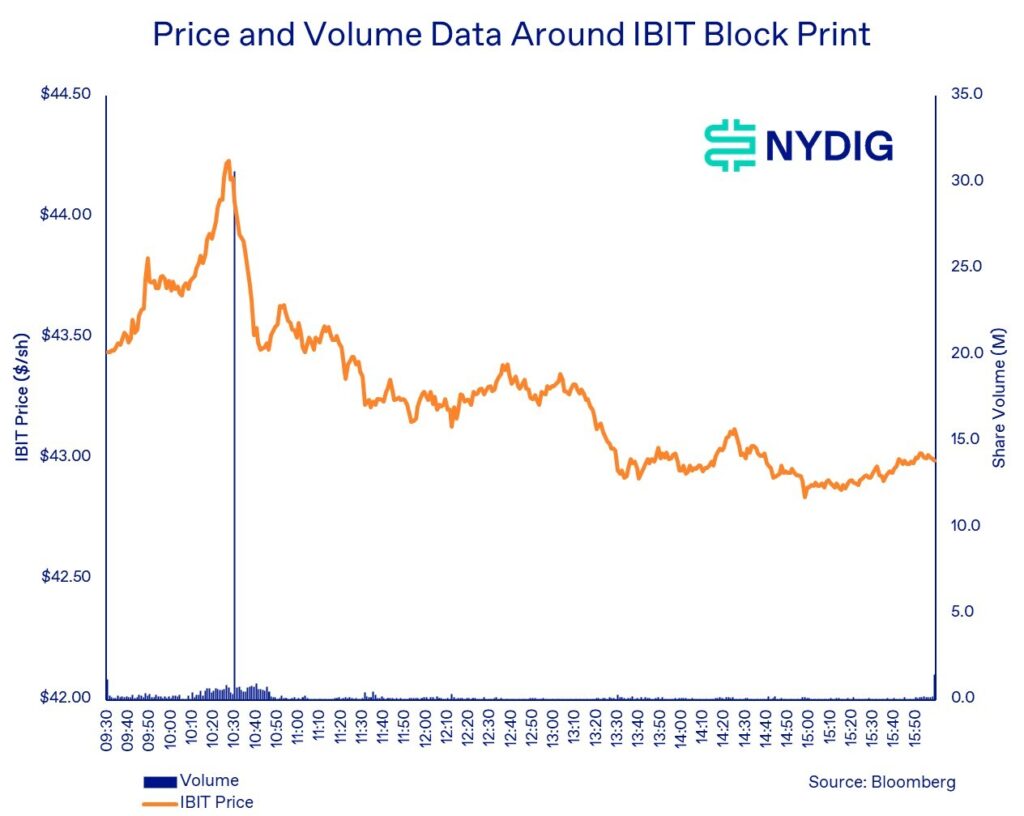
In a crypto market already under pressure, this transaction quickly caught the attention of analysts. The operation involved 29.21 million IBIT shares, traded at $43.16 per unit. The price showed a discount of 1.01 dollars compared to the market price, then located at 44.17 dollars. In other words, the seller agreed to a concession of 2.3%, or nearly $29.5 million in fulfillment costs.
According to theNYDIG company analysisthis difference indicates an explicit priority: obtaining a quick and certain exit. Blackrock's vehicle has therefore undergone a movement that does not resemble a simple portfolio adjustment. Indeed, the size of the block suggests a concentrated decision, led by an actor capable of ceding major exposure to Bitcoin in a single transaction.
BlackRock: the hypothesis of a basic strategy ruled out
Some speakers first mentioned a basic operationa strategy that combines a spot position and short selling of futures contracts. However, NYDIG dismisses this reading. According to his analysis, the discount would have reduced expected returns and weakened the economic interest of such an arrangement.
The company also highlights the lack of notable reaction on the CME. The position linked to BlackRock's fund corresponded to approximately 3,700 Bitcoin futures contracts. Yet only 91 contracts changed hands during the block's one minute run. Thus, the futures market did not show the expected peak.
This observation reinforces the idea of direct disengagement. For BlackRock, the episode above all highlights the sensitivity of large ETF blocks to liquidity needs. For NYDIG analysts, the available elements do not support the hypothesis of a coordinated unwinding.
Outgoing flows that complicate the identification of the seller
The sale comes amid continued drawdowns in US spot Bitcoin ETFs. According to the data from SoSoValuethese products saw net outflows every trading day from May 15 to May 29. Over the same period, the total outstanding amount of the category increased from 107.75 to 94.17 billion dollars.
NYDIG specifies, however, that these feeds do not allow the seller to be directly identified. Although IBIT experienced approximately $720 million in net redemptions between May 26 and 27, there is no public data linking these redemptions to the affected block. The position would also exceed the holdings declared by each IBIT investor in recent 13F filings, further reducing visibility.
The exact reasons therefore remain open. These could be investment redemptions, risk management limits, or a voluntary decision to reduce exposure to Bitcoin. In any case, the move shows that a significant holder accepted a notable discount to exit a Bitcoin-related position, while capital outflows continued.
In the near term, the market should monitor the relationship between ETF redemptions, off-exchange volumes and futures activity. If outflows persist, other Bitcoin-related blocks could attract attention, especially after BlackRock's IBIT sale. However, without more precise data, the exact role of BlackRock and the identity of the seller will remain difficult to establish.
Maximize your Tremplin.io experience with our 'Read to Earn' program! For every article you read, earn points and access exclusive rewards. Sign up now and start earning benefits.