
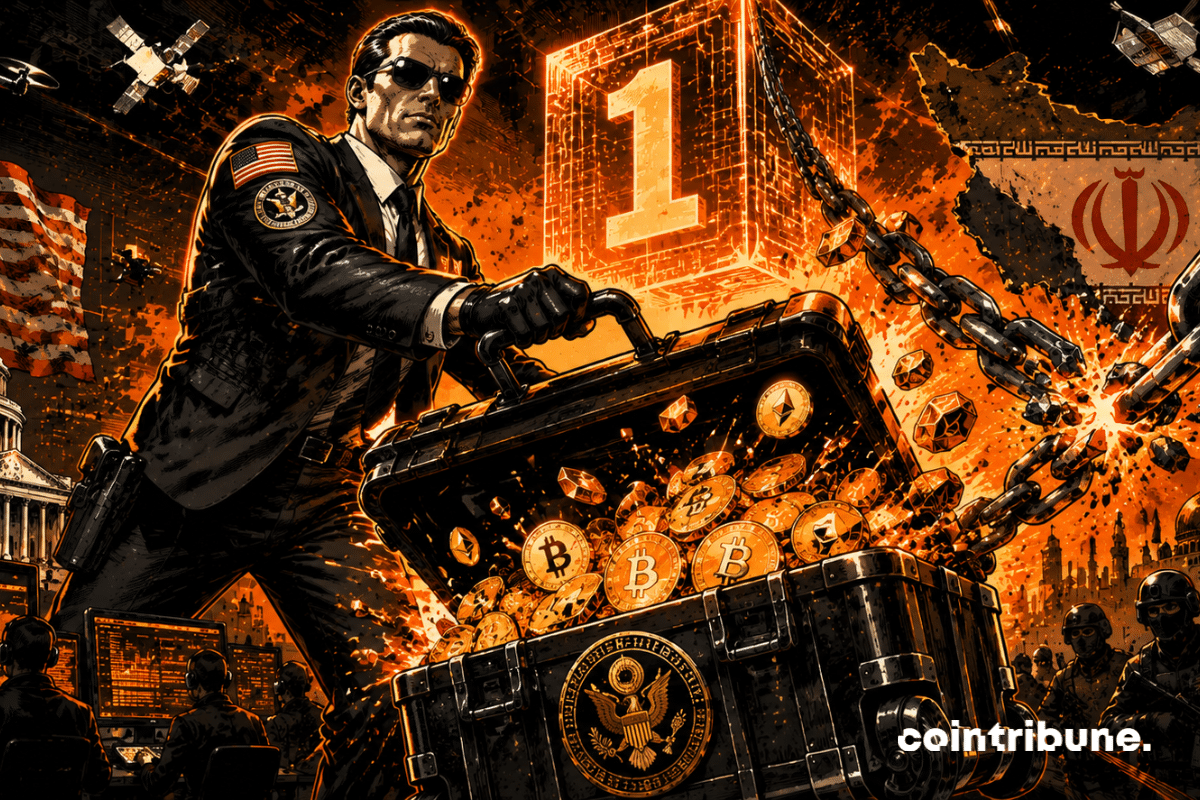
The US Treasury confirmed on Friday the seizure of around a billion dollars in crypto linked to Iranian entities, with some holders still unaware today that their wallets are empty. Scott Bessent's announcement comes in a particular context: the two countries are reportedly close to a peace agreement likely to ease tensions around the Strait of Hormuz.
In brief
- Scott Bessent said Friday that the United States has seized approximately $1 billion in crypto linked to Iranian military entities.
- The Islamic Revolutionary Guard Corps has reportedly promoted a bitcoin-settled maritime insurance platform called Hormuz Safe.
- Individuals linked to Iran have used Tether's USDT to transfer funds, according to Israeli authorities.
US Treasury recovers $1 billion in crypto linked to Iran
Scott Bessent chose the Reagan 2026 National Economic Forum, in Simi Valley, California, to release this information. In front of Larry Kudlow of Fox Business, he detailed the method:
We simply took possession of their wallets. Some may be writing right now, not realizing their wallet has been hacked.
The Secretary of the Treasury, however, did not specify the exact dates of the operations, nor the cryptos concerned. It has also not established a link with the Hormuz Safe system, this maritime insurance platform in bitcoin that the Fars agency, close to the Iranian government, presented this month as a solution to circumvent Western sanctions.
To understand the context, we must remember that the Strait of Hormuz remains at the heart of tensions: nearly 20% of the world's oil transits there, and Iran has controlled considerable levers of pressure there since the start of the conflict in February.
Iran and bitcoin, between circumvention and fraud
The Iranian strategy around bitcoin is not new. In April, the Financial Times already reported that Tehran was considering imposing bitcoin transit fees on oil tankers crossing the strait, with the explicit argument that these payments “can neither be traced nor confiscated due to sanctions”.
The argument has lived on. At the same time, scammers posing as Iranian authorities have targeted shipping companies, demanding fraudulent payments in bitcoin and USDT, according to Reuters.
Furthermore, last year, the Israeli National Office to Combat the Financing of Terrorism claimed that the Revolutionary Guard Corps had received $1.5 billion in USDT via transfers identified by the authorities.
In short, these seizures testify to a reality that Washington is clearly seeking to impose: blockchain does not offer the anonymity that Tehran was hoping for. The ongoing negotiations, reported by Axios as close to an agreement subject to the approval of Donald Trump, could change the diplomatic situation. However, crypto sanctions against Iran do not appear ready to ease. A billion dollars seized without a declaration of war is a clear message.
Maximize your Tremplin.io experience with our 'Read to Earn' program! For every article you read, earn points and access exclusive rewards. Sign up now and start earning benefits.


