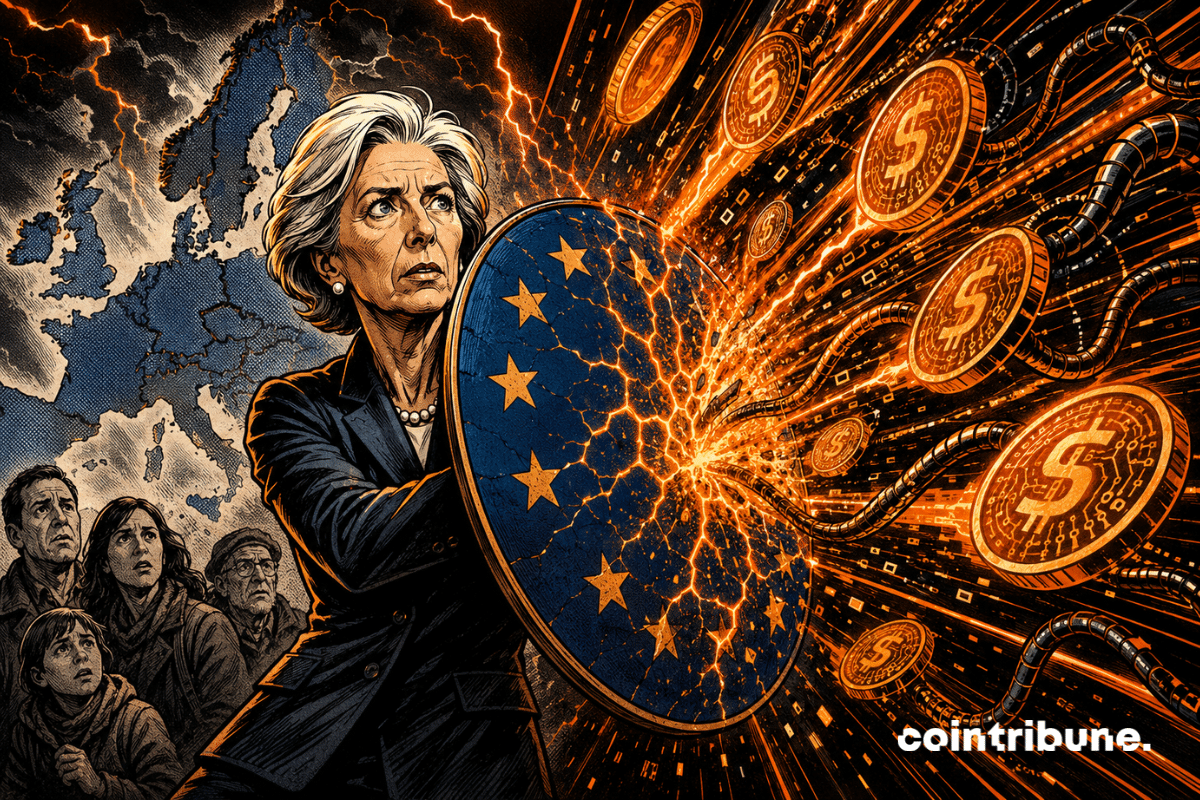
Europe does not want to let the stablecoin become the Trojan horse of the dollar in its digital payments. Christine Lagarde put this subject at the center of the debate, warning that the domination of Tether and Circle could weaken European monetary sovereignty. The ECB does not reject technology. Above all, it refuses to import a model designed elsewhere.
In brief
- Lagarde warns of the risk of digital dollarization driven by stablecoins.
- The ECB does not reject blockchain, but rejects a model dominated by foreign private issuers.
- Europe wants to build a tokenized monetary infrastructure around central bank money.
The ECB sees risk before comfort
Europe must not copy the American model of stablecoins. This alert joins an already visible concern, where the ECB feared a loss of control over the euro in the face of stablecoins. The market now exceeds $300 billion, but it remains dominated by dollar-denominated tokens.
This figure changes the nature of the debate. The stablecoin is no longer just a practical tool for crypto traders. It becomes a payment, savings and settlement layer. When this layer is based on the dollar, Europe loses part of the digital terrain where the currency of tomorrow is being played out.
Lagarde is therefore not talking about an abstract danger. She talks about a habit that can set in quickly. A trader, company or platform chooses the dollar stablecoin because it is liquid, known and available. Then this ease becomes a norm. This is where digital dollarization begins.
The euro stablecoin does not convince Lagarde
The simple answer would be to create more euro stablecoins. Several European players see this as a natural solution. After all, if the dollar advances on the blockchain, why wouldn't the euro do the same thing?
Lagarde considers this response too short. According to her, the case for stablecoins denominated in euros is less solid than it seems. Risk doesn't just come from technology. It also comes from confidence, reserves and the ability to maintain parity in times of stress.
The problem is simple. A stablecoin remains a private debt. Its stability depends on the assets that support it. It also depends on user confidence at the worst time. However, in a crisis, the promise of conversion at parity can become fragile. And this is precisely what central banks refuse to trivialize.
The issue goes far beyond crypto
The debate does not only pit the ECB against crypto companies. He opposes two visions of digital money. On the one hand, private currencies capable of circulating quickly on blockchain. On the other, a public infrastructure where central bank money retains its anchoring role.
Lagarde, however, recognizes the usefulness of technology. Stablecoins have shown that rapid, programmable and available settlement on blockchain meets a real need. Tokenized finance will need a native settlement asset. On this point, the ECB is not closing the door.
But she wants to separate the tool from the objective. It is not because the stablecoin popularized blockchain settlement that it should become the monetary foundation of the system. Moreover, Europe is already exploring other avenues, notably with euro stablecoins carried by European banks. The question is therefore no longer just technical. It becomes strategic.
Europe seeks its own monetary rail
The ECB wants to build its own rail. She works on infrastructures capable of linking tokenized finance to the European monetary system. The objective is clear: to enable digital settlements without letting the dollar become the default currency for tokenized markets.
This strategy is slower than a simple stablecoin launch. It is also more political. Europe is not only seeking to circulate a private digital euro. She wants to prevent the tokenized markets of tomorrow from being settled by default in dollars issued by foreign companies.
The real subject is therefore dependence. If Europe misses this transition, it will not only lose a crypto battle. It will let part of its digital finance be organized around a currency, rules and issuers that do not depend on it. This is why the digital euro project prepared by the ECB becomes a central piece of the puzzle.
Maximize your Tremplin.io experience with our 'Read to Earn' program! For every article you read, earn points and access exclusive rewards. Sign up now and start earning benefits.