Tension is rising around the Strait of Hormuz after Trump refused to accept an Iranian proposal aimed at reopening the sea route before any progress on the nuclear issue. This position maintains pressure on Tehran and is already shaking global markets. Oil reacted strongly, jumping near $120 a barrel, while Bitcoin and Ethereum fell amid tight liquidity. Investors are now monitoring the impact of this crisis on energy, the dollar and risky assets, including crypto.
In brief
- Trump refuses Iranian offer to reopen the Strait of Hormuz before any progress on the nuclear issue.
- Washington maintains pressure on Tehran, using the naval blockade as diplomatic and economic leverage.
- Oil is soaring sharply, with Brent forecast up 7.3%, to $119.45, amid fears of a supply shock.
- Risk markets are declining, notably Bitcoin and Ethereum, penalized by geopolitical tensions, potential inflation and still constrained liquidity.
Trump maintains pressure on Iran
As tensions between China and the United States intensify on economic and financial levels, a new point of friction appears for Washington, this time in the Middle East, around the Strait of Hormuz.
In statements submitted to AxiosTrump wants to maintain the naval blockade as long as Tehran does not accept an agreement responding to American concerns over its nuclear program. Iran reportedly offered to reopen the Strait of Hormuz before resuming nuclear talks later. However, Trump refuses this sequence, because he believes it would weaken Washington's leverage.
Furthermore, the American president presents the blockade as a central tool in the balance of power. According to the information reported, he judges that this pressure is more useful than immediate military action in order to encourage Iran to reach an agreement on its nuclear program, declaring:
The blockade is in some ways more effective than bombing. They are suffocating. And it's going to get worse for them. They cannot have nuclear weapons.
Donald Trump, President of the United States. Source: Axios.
In addition, the American Central Command (CENTCOM), according to the same report, would have prepared a scenario of limited strikes against Iranian infrastructure. For the moment, Trump has not given a military order.
This strategy aims to push Iran to return to the negotiating table. Trump says Tehran is seeking a settlement to loosen the economic stranglehold. It directly links the lifting of the blockade to nuclear guarantees. Thus, it places the Strait of Hormuz at the center of a diplomatic, economic and security standoff.
Oil is soaring and markets are watching the Strait of Hormuz
On the economic front, the outbreak accelerated following Trump's statements to Axios, oil reacted strongly, because any disruption to maritime traffic can weigh on supply and transport costs. The price of Brent jumped 7.3% to $119.45. This increase reflects the fear of a lasting shock, while refineries, transporters and importing countries are already monitoring the risks of new price tensions.
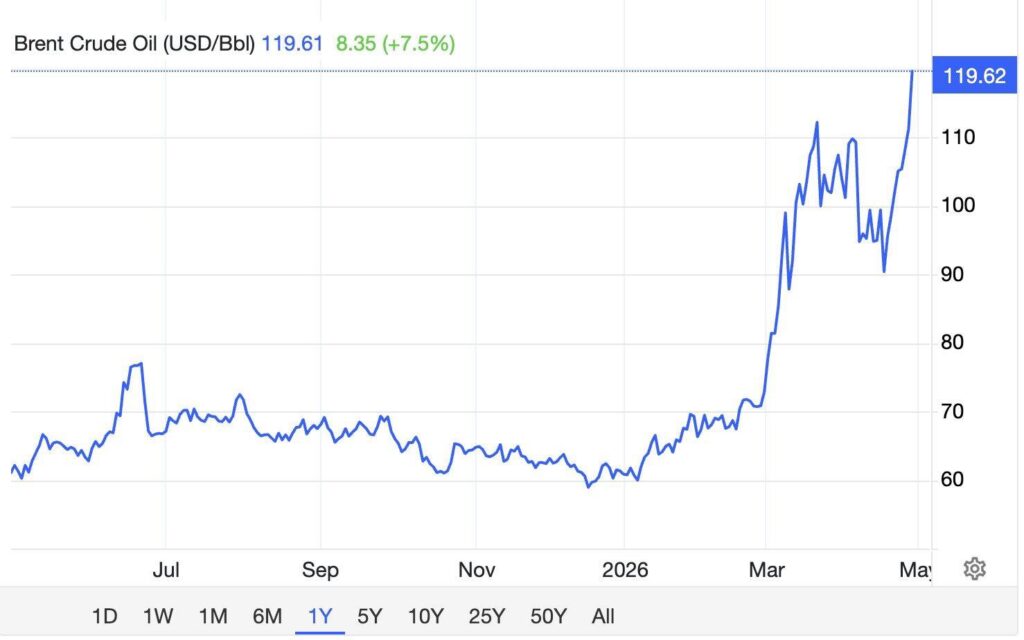
Thus, oil can also revive inflationary pressures. A prolonged increase in energy costs increases costs for businesses, makes transport more expensive and weighs on households. In this context, the Fed had already illustrated the prudence of central banks: it had maintained its rates between 3.5% and 3.75% for the third time, in order to contain pressure on prices. This position confirmed that liquidity was still very constrained, a factor which also weighed on risky assets.
This mechanism also affects crypto. After the Fed's announcement, bitcoin retreated towards $75,100, while ethereum quickly slipped below $2,300. These movements show that digital assets remain sensitive to financing costs, the dollar and monetary policy expectations.
In the short term, the market will mainly monitor two signals: the duration of the blockade and Iran's reaction. If a diplomatic channel reopens, pressure on oil could gradually fall. On the other hand, if the standoff continues around the Strait of Hormuz and geopolitical tensions intensify, Bitcoin and Ethereum could continue to move under pressure. Investors often err on the side of caution when inflation, rates, and international uncertainty rise simultaneously.
Maximize your Tremplin.io experience with our 'Read to Earn' program! For every article you read, earn points and access exclusive rewards. Sign up now and start earning benefits.