
Since the advent of the cryptocurrency market, centralized exchanges (CEXs) have played a key role in providing liquidity to both retail and institutional users. In 2025 alone, the top 12 CEXs processed nearly $21 trillion in volume in spot markets. As the industry matures, focus has shifted to the sustainability of spot trading activity and the health of the underlying reserves that support these massive volumes.

The landscape of centralized exchanges is evolving. While USDT and USDC dominate trading pairs, listing performance remains a challenge for new tokens. With total reserves reaching $225.4 billion in 2026, capital is migrating from institutional giants to high-velocity, retail-oriented platforms. Here is an analysis of the current state of the market.
We've summarized the key points, but be sure to explore the complete 21 slides of the full report.
In Brief
- USDT and USDC are the main stablecoin base assets, accounting for 66.6% of all trading pairs on the top 12 CEXs
- Only about 32% of newly listed tokens experience positive price action immediately after listing on the top 12 CEXs
- The value of underlying assets across the top 12 CEXs increased from $152.1 billion to $225.4 billion between 2024 and 2026
- Individual-oriented exchanges see higher reserve usage compared to those favored by institutions
1. USDT and USDC are the main stablecoin base assets, accounting for 66.6% of all trading pairs on the top 12 CEXs
The majority of spot trading volume on the top 12 CEXs is via stablecoin pairs such as USDT And USDC.
Of the 9,870 stablecoin pairs present on the 12 CEXs, 9,646 are USDT or USDC pairs. This represents 97.7% of stablecoin trading pairs.
Furthermore, there are a total of 4,615 non-stable pairs, which constitutes 31.9% of the 14,485 trading pairs.
Despite this, the share of non-stable pairs does not match their share of trading volume. At its peak in November 2024, the volume of non-stable pairs represented only 23% of the market share.
2. Only about 32% of newly listed tokens experience positive price action immediately after listing on the top 12 CEXs
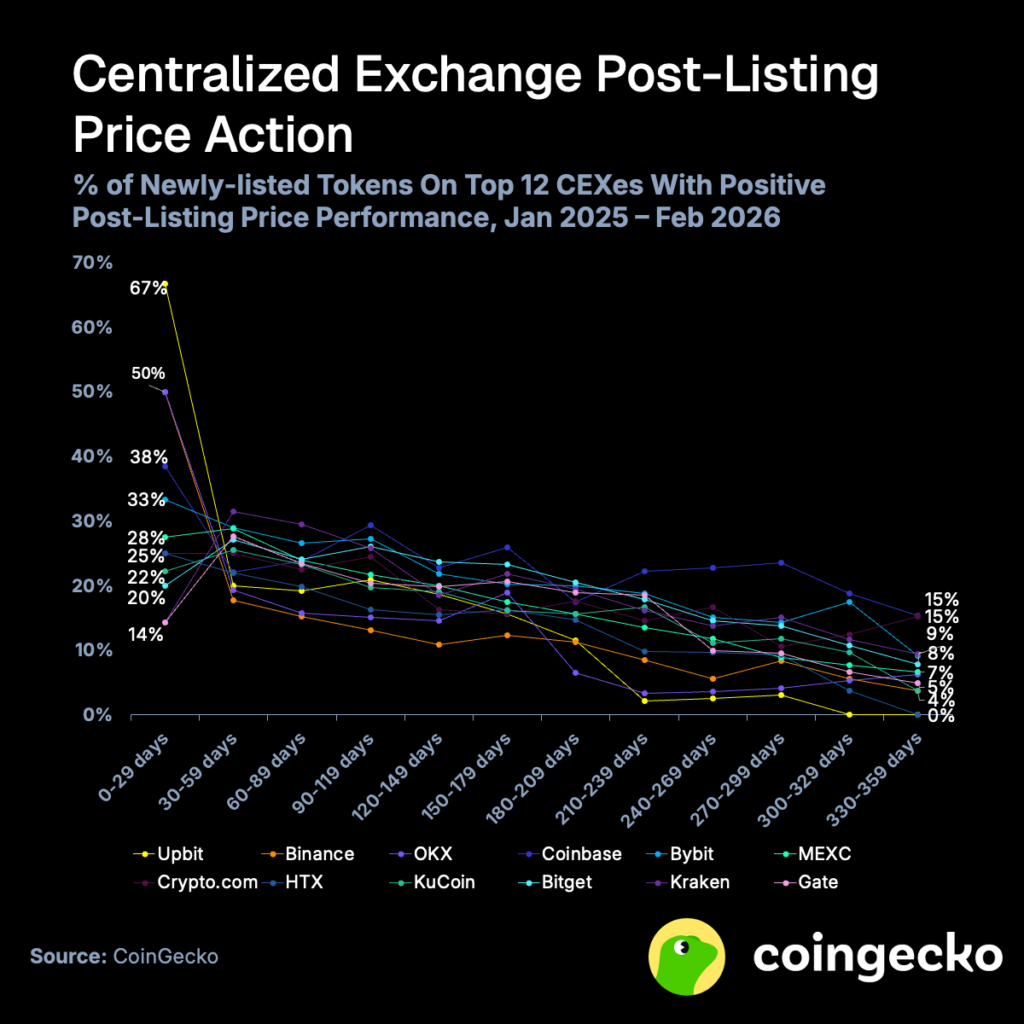
Among the top 12 exchanges, Upbit presents by far the best immediate post-listing performance, with 67% of newly listed tokens in positive territory 30 days after listing. However, it has one of the lowest listing rates. Next comes Binance and OKX with 50%.
There is a large variance in the immediate (0-29 days) post-listing performance of the top 12 exchanges. However, this range narrows significantly after the first 30 days. On average, only 25% of newly listed tokens remain in positive territory after 30 to 59 days.
Over longer periods, this percentage decreases almost linearly across all exchanges. The only exception is Coinbasewhose listed tokens are getting a second wind after the six-month mark since their listing.
At the end of the 12 months, less than 10% of tokens listed on most major exchanges remain above their initial listing price. Notably, the listings on Upbit, which get off to the best start, are also those which decline the fastest, with all newly listed tokens going underwater between 300 and 329 days.
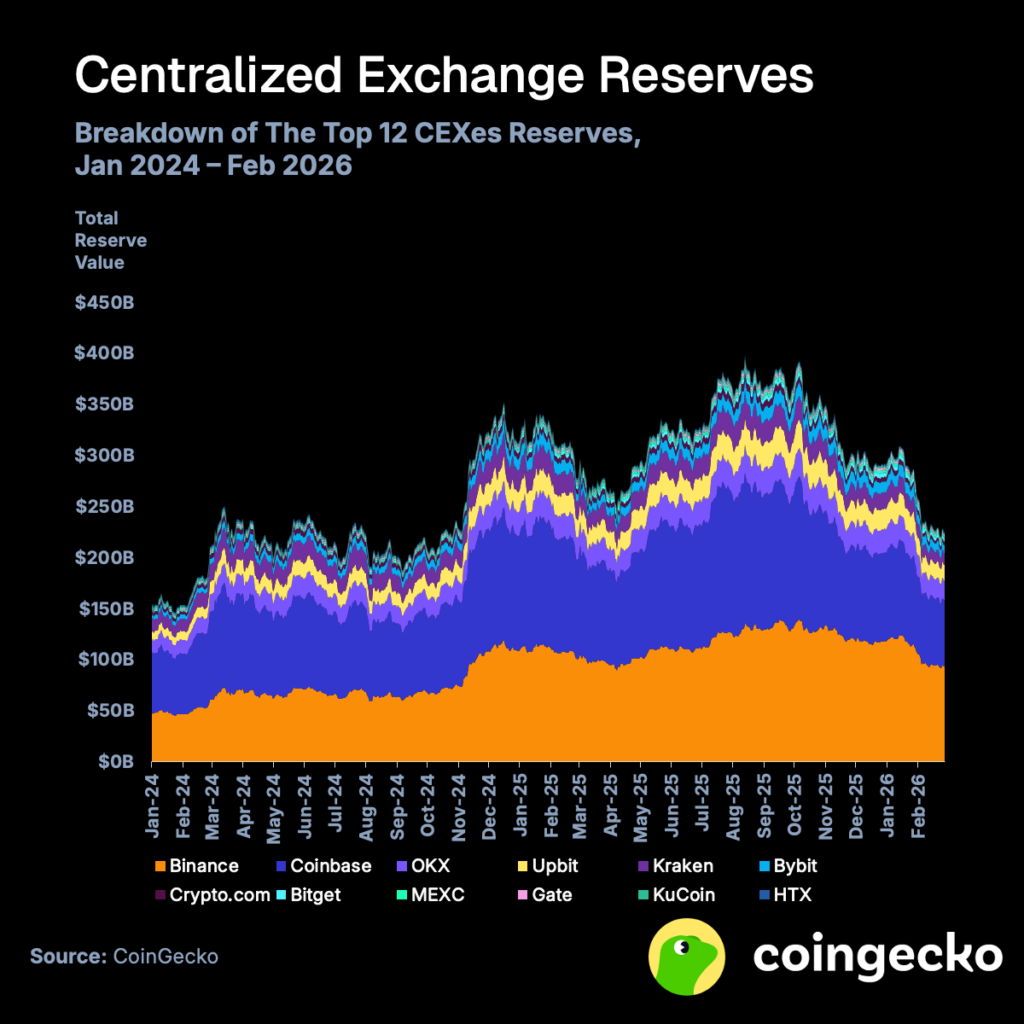
3. The value of underlying assets across the top 12 CEXs increased from $152.1 billion to $225.4 billion between 2024 and 2026
Despite the appreciation of the price of Bitcoin (BTC) and Ethereum (ETH) held in reserve on most exchanges, price volatility and increased regulation are pushing users to reallocate funds from large platforms to other platforms.
The value of underlying assets on the top 12 centralized exchanges increased by an average of 69.6%, from $152.1 billion at the start of 2024 to $225.4 billion at the end of February 2026.
Eight exchanges saw net growth in reserve value during this period, with Binance leading the way. Its reserves doubled from $46.7 billion to $93.4 billion in two years.
Furthermore, Coinbase holds the largest BTC reserves, with over 800K BTC, just ahead of Binance with 669K. Despite the increase in reserve value, Coinbase saw large outflows of -20% and -41% on its BTC and ETH reserves.
Some of these exits were redeposited on smaller exchanges such as Bitget And MEXCwhich recorded significant peaks in their reserve values, +262.0% and +274.6% respectively.
4. Individual-oriented exchanges see higher reserve usage compared to those favored by institutions
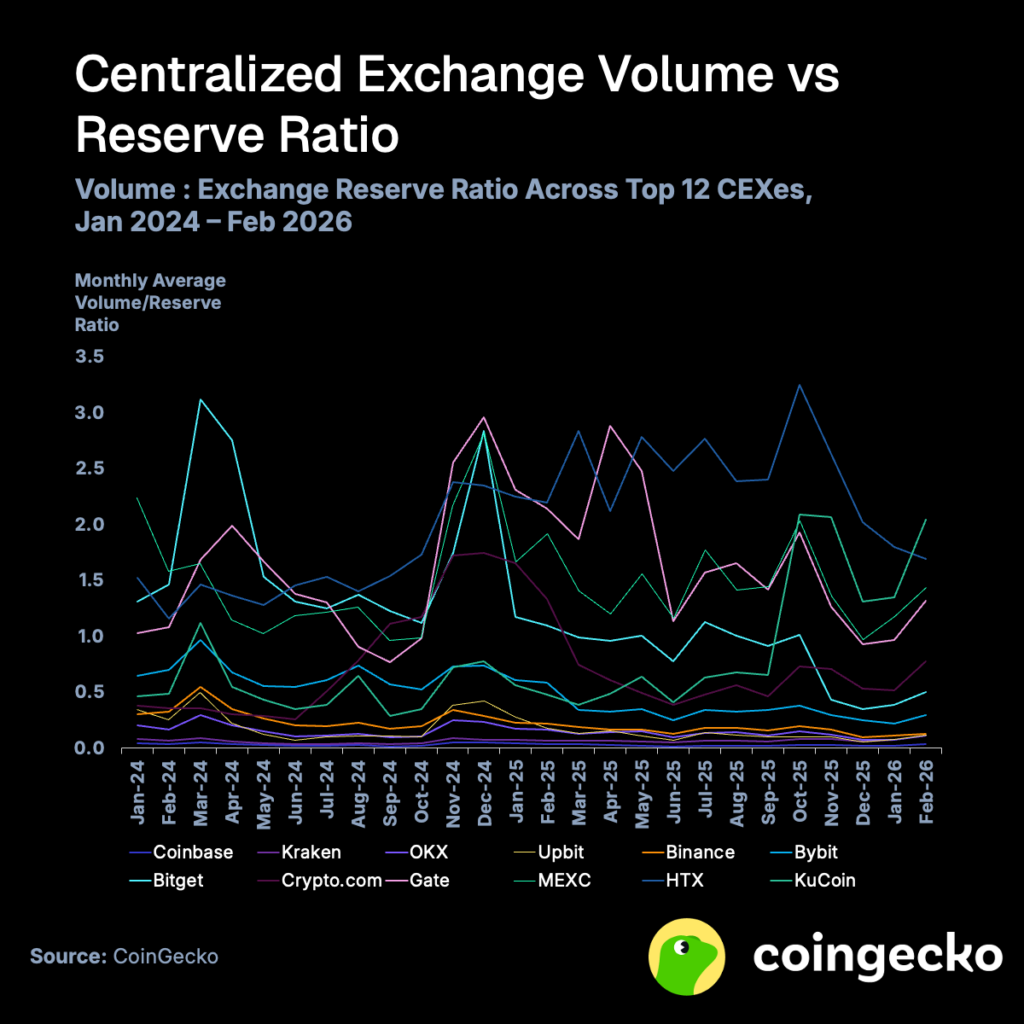
While centralized exchanges hold large reserves of various crypto assets, there is a clear difference in the use of user deposits across platforms.
More regulated centralized exchanges such as Coinbase, Binance, and Kraken have lower volume/reserve ratios, around 0.1. This is potentially explained by a more institutional clientele, who use these platforms more for custody than for trading.
In contrast, exchanges such as Bybit and Bitget show high trading volumes coupled with large deposits, with average ratios of 0.3 and 0.5 respectively, between January 2024 and February 2026.
On the other hand, centralized exchanges with smaller reserves like MEXC, HTXAnd KuCoin showed a wider range of asset velocity from 1.44 to 2.04, indicating that the majority of users are actively trading volumes significantly higher than the reserves of these exchanges.
Maximize your Tremplin.io experience with our 'Read to Earn' program! For every article you read, earn points and access exclusive rewards. Sign up now and start earning benefits.