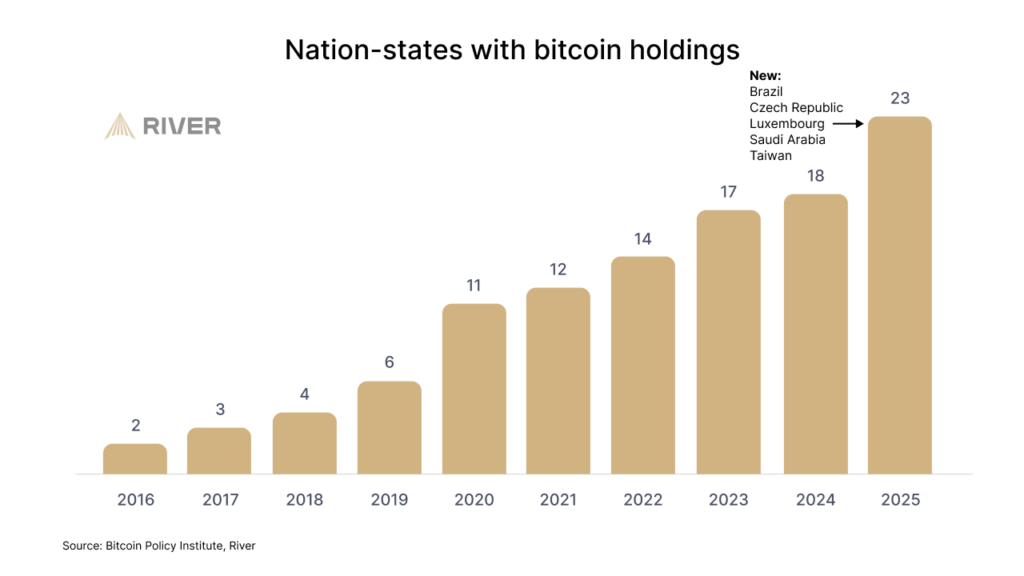
Bitcoin is gradually moving from private wallets to public balance sheets. Governments are no longer mere observers of the market, according to a new report from River. Today, 23 countries hold BTC in various forms, a sign of growing adoption at the state level.
In brief
- Governments collectively hold 432,000 BTC, or 2.1% of the total supply.
- The United States dominates sovereign bitcoin holdings with 328,372 BTC.
- Mining power is distributed globally, reducing concentration risks.
- Thirty-four countries have approved bitcoin-related ETFs or ETP products.
US dominates global sovereign bitcoin holdings with 328,372 BTC
According to River, these holdings come from asset seizures, direct purchases, state-backed mining activities and allocations via sovereign wealth funds. Government exposure now extends to North America, Europe, the Middle East, Asia, Africa and Latin America, a sign that bitcoin adoption is now reaching multiple levels of state infrastructure.
The United States holds the largest sovereign reserve with 328,372 BTC, mainly from criminal asset confiscations. The UK follows with 61,245 BTC. The United Arab Emirates owns 30,382 BTC, through strategies linked to sovereign wealth funds and mining. China, despite the ban on mining on its territory, holds around 15,000 BTC from past seizures.
El Salvador remains the only country to have adopted bitcoin as legal tender, with government reserves of 7,514 BTC acquired on the market. Bhutan holds 5,884 BTC from state-backed mining operations, illustrating how some smaller economies are experimenting with alternative accumulation strategies.
States control 2.1% of BTC supply as hashrate goes global
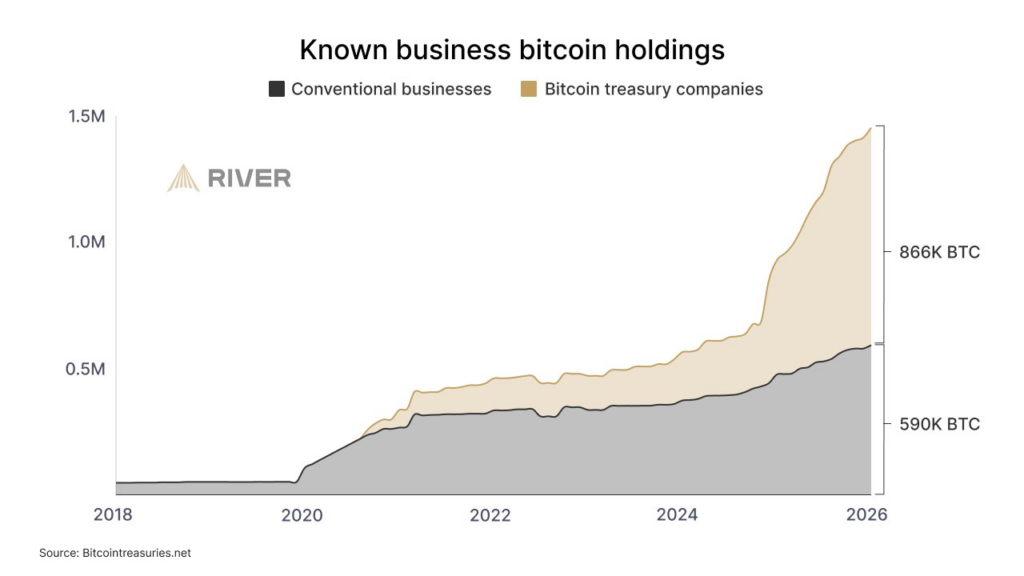
As of December 31, 2025, governments held approximately 432,000 BTC, or 2.1% of the total supply. Individuals remain the main holders, with 14.01 million BTC, or 66.7% of the circulating supply. Funds and ETFs account for 1.49 million BTC, while companies hold 1.45 million. Individual ownership therefore continues to structure the market, despite the rise in power of institutional and sovereign players.
Furthermore, River indicates that 34 countries now represent more than 0.1% of the global hashrate, while 12 exceed 1%. Compared to previous cycles, mining activity today is much more geographically distributed, reducing the concentration risks once associated with a limited number of jurisdictions.
Several structural factors explain the growing interest of States:
- Asset seizures are the main entry point, moving bitcoin directly into government control.
- State-backed mining allows you to gain exposure without going through the market.
- Sovereign funds access bitcoin indirectly through stocks, ETFs and structured products.
- Legal frameworks, like that of El Salvador, integrate bitcoin into tax and budgetary policies.
Beyond governments, institutional participation continues to grow. Hedge funds, asset managers, pension funds, foundations, insurance companies and sovereign vehicles report increasing allocations. Billions of dollars of bitcoin exposure are now integrated into traditional financial systems.
34 countries approve bitcoin ETFs as regulation evolves
In 2025, North America had 6,535 merchants accepting bitcoin, 1,299 more than the previous year. Europe leads slightly with 6,745 traders. Activity on the Lightning Network has increased significantly, with River estimating a 300% increase in transaction volume over the year. Integrations enabling deposits and withdrawals via Lightning have also facilitated higher transaction amounts.
Regulatory developments support this dynamic. Thirty-four countries have approved bitcoin-related ETFs or ETPs. Others have legalized mining, clarified taxation or authorized banks to offer custody services. These advances facilitate the entry of institutional and sovereign capital.
Introduced in the context of the 2008 financial crisis, bitcoin was initially presented as an alternative to state-controlled monetary systems. Seventeen years later, it finds itself increasingly integrated into their balance sheets. What began as a decentralized experiment has now emerged as an asset owned by 23 governments, marking a new milestone in the evolution of bitcoin.
Maximize your Tremplin.io experience with our 'Read to Earn' program! For every article you read, earn points and access exclusive rewards. Sign up now and start earning benefits.