It is extremely rare for an individual miner to validate a Bitcoin block on their own. However, a miner recently managed to achieve this feat, transforming a modest, almost experimental operation into a significant profit. By renting hashrate on demand, he managed to capture the entire block reward, illustrating how small investments in cloud mining can, in some cases, generate significant gains.

In brief
- A solo miner recently achieved the rare feat of mining an entire Bitcoin block, pocketing 3,125 BTC, or approximately $200,000.
- The operation relied on hashrate rented on demand, at a cost of approximately $75 per PH/s, with a 0.5% commission for the solo mining service.
- Bitcoin network difficulty has reached 144.4 trillion, following a recent drop in hashrate.
Solo miner captures full block reward
Braiins, a bitcoin mining company, reported that a solo miner successfully mined block 938092, earning the standard reward of 3.125 BTC, or about $200,000 at current prices. For this operation, the miner rented hashrate on demand, at a cost of 119,000 satoshis (around $75) per petahash per second, plus a 0.5% commission for the solo mining service. The block was validated via CKPool and confirmed around 8:04 UTC Tuesday.
Kristian Csepcsar, marketing director at Braiins, underlined the highly improbable nature of such a gain. According to him, renting 1 PH/s for a single day offers about a one in 8,000 chance of mining a block. Probabilities much higher than those of certain lotteries, but which remain extremely low. However, these opportunities accumulate over time, since a new bitcoin block is mined approximately every ten minutes.
Solo Mining Trends and Bitcoin Network Challenges
Bitcoin mining is mostly dominated by large pools, making full block wins by individual miners particularly rare. However, the rise of cloud mining platforms has changed this, allowing miners to rent computing power without owning equipment. This paves the way for smaller-scale operators to compete with established players and, occasionally, land significant rewards.
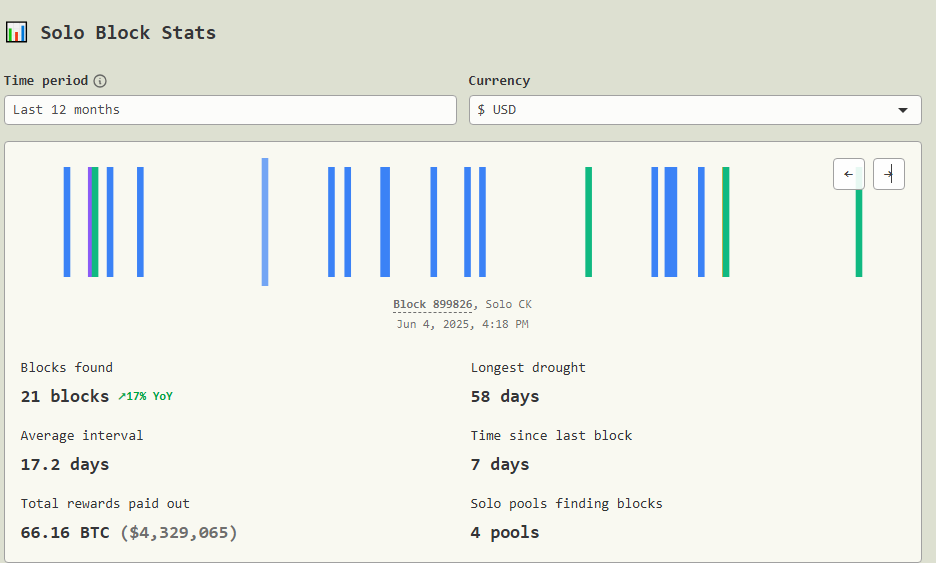
Despite these constraints, data from solo miner aggregator Bennet shows that these performances remain possible:
- Over the past twelve months, 21 miners successfully mined complete blocksfor a total of 66.16 BTC, or approximately $4,329,065.
- This represents a 17% increase in the number of blocks mined solo compared to the previous year, a sign that small-scale mining can still be profitable.
- Blocks were discovered on average every 17.2 days, with a maximum interval of 58 days, illustrating the unpredictability of solo mining.
Separately, Bitcoin network difficulty reached 144.4 trillion, up 15% after an 11% drop in hashrate earlier in the month, linked to harsh winter conditions in the United States. This is one of the most marked declines recently. According to CoinWarz, the next difficulty adjustment, expected on March 5, 2026, could bring the latter to 145.12 trillion.
Maximize your Tremplin.io experience with our 'Read to Earn' program! For every article you read, earn points and access exclusive rewards. Sign up now and start earning benefits.