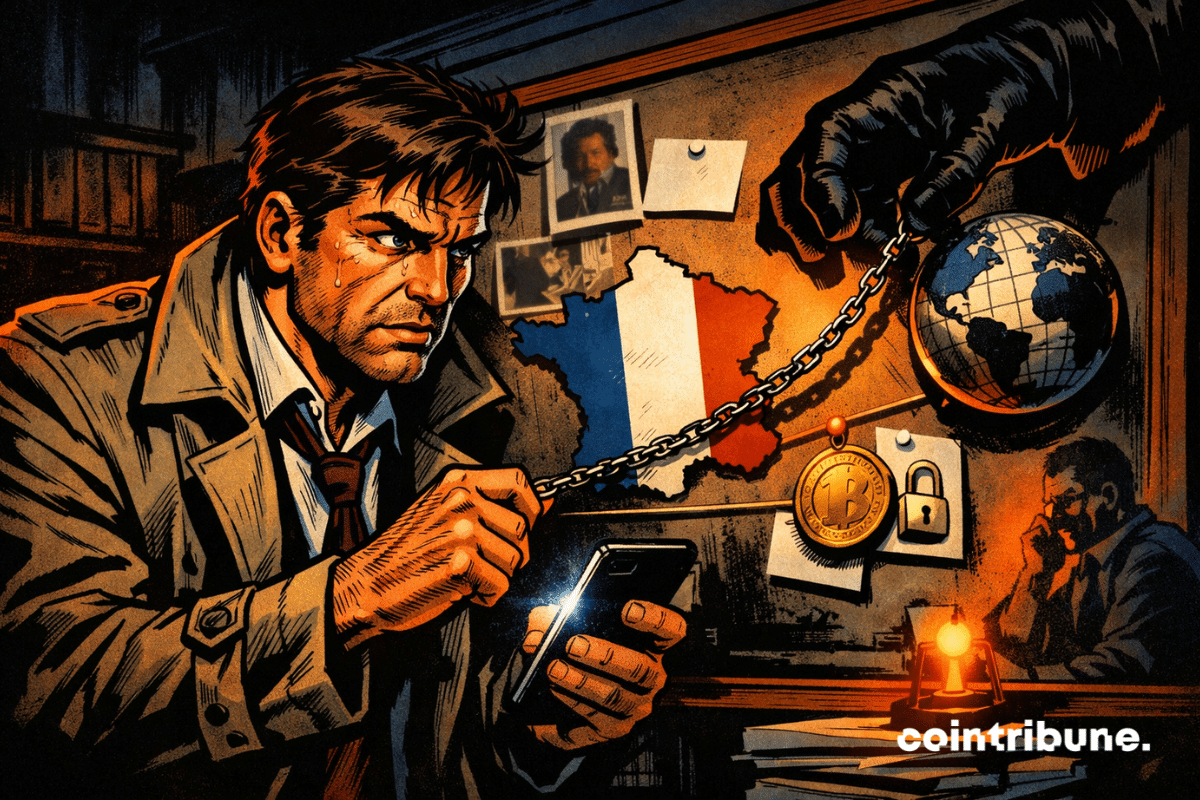
In France, the wave of kidnappings linked to crypto is due less to technology than to the visibility of the victims. According to the police, sponsors based abroad orchestrate these attacks via local relays, following a repeated pattern of identification, recruitment and carrying out the act, where crypto becomes a signal of “easily redeemable” wealth.
In brief
- The police link some of the crypto kidnappings in France to sponsors based abroad, operating via local relays.
- The modus operandi would be structured: recruitment of young perpetrators, online intimidation, then kidnapping and sequestration.
- Victims, often visible on social media, are reportedly targeted because their exposure serves as supposed proof of wealth.
Crime controlled outside borders, carried out at home
According to a police note cited by Franceinfo, investigators link 40 kidnapping cases that occurred between July 2023 and the end of 2025 to motivations linked to crypto. More than half would have directly targeted crypto holders or people working in the sector. The message is clear: the ecosystem has become a category of victims, and the government has reacted to this wave of kidnappings.
The note attributes these orders to “brains” generally located outside France. This detail changes everything: it reduces the risk for the sponsors and complicates the investigation, because the borders become a layer of protection. Crypto crime is going international, while the target remains local.
And 2026 begins with a more nervous rhythm. Recent attempts, including one targeting a crypto sector executive, show an acceleration. Businesses no longer just exist: they multiply, and they test the limits of the security response.
Local “recruiters” and the young workforce
SIRASCO, the analysis service of the judicial police, wrote the document. Their reading is structured: the sponsors go “directly” through intermediaries in France, described as recruiters. These relays play the most underestimated role: they transform a distant order into concrete action.
The perpetrators are often under 30 years old, with a history linked to violent crimes, theft or trafficking. This is not a sociological detail, it is an operational indicator: we do not recruit at random, we recruit where the moral barrier is already cracked.
SIRASCO also describes a division of tasks: some are responsible for intimidating online, others for managing physical constraint and confinement. It's cold, almost “professionalized”. And this is precisely what makes the phenomenon dangerous: it is becoming standardized.
The real fuel: social networks and the “crypto-showcase”
The profile of the victims, according to the policelooks the same: mainly men aged 20 to 35, active in crypto, often investors, entrepreneurs or influencers. Not necessarily the richest. But the most exposed. The nuance is essential: in the imagination of the attackers, the exhibition constitutes proof.
Investigators explain that criminals spot the existence, or even just the rumor, of a crypto fortune via TikTok, Instagram or YouTube. “Lifestyle” content then transforms into involuntary information sheets: habits, journeys, entourage, places frequented.
In this context, every debate on social media privacy fuels distrust, especially whena rumor of a data leak is circulatingeven denied by platforms like Meta. Result: online exposure becomes an additional risk, and a simple Reel can save criminals weeks of detection.
Maximize your Tremplin.io experience with our 'Read to Earn' program! For every article you read, earn points and access exclusive rewards. Sign up now and start earning benefits.