

Bitcoin's underlying supply dynamics are showing early signs of recovery after months of steady distribution. A key on-chain metric, known as apparent demand, has turned positive again for the first time in three months. This change comes as price action remains range-bound and institutional flows remain cautious.

In brief
- Apparent demand swings -141,000 BTC into positive territory.
- Long-term holder supply remains above 15M BTC despite months of volatility.
- Exchange platform reserves fall by 500,000 BTC, tightening the available liquid supply.
- Spot ETFs record $993M in outflows even as on-chain absorption increases.
The structural change of Bitcoin? Apparent demand returns above zero
Apparent demand, measured as the 30-day sum of net accumulation over newly mined supply, rose above zero with a modest reading of +1,200 BTC. This marks a sharp turnaround from the late December low near -140,000 BTC. In total, net absorption has fluctuated by around 141,000 BTC over the past two months.
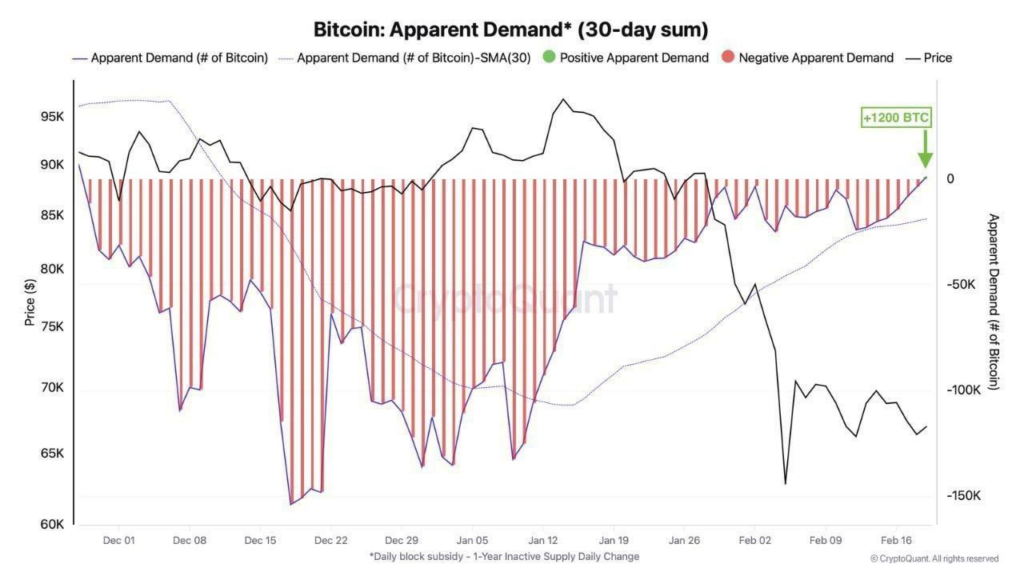
Although this latter value remains low compared to previous phases of expansion, it signals that accumulation is once again exceeding new issuance. During the correction from December to early February, negative readings reflected a persistent distribution as Bitcoin fell from the $90,000 region to a range between $60,000 and $70,000. The return to positive territory suggests that selling pressure is easing even before a major price breakout.
Apparent demand tracks the relationship between newly mined Bitcoins and changes in long-term investor holdings. Negative readings indicate that new supply is not being fully absorbed, often coinciding with weaker pricing conditions. Positive readings indicate that investors are absorbing more Bitcoin than miners are producing, thereby tightening the circulating supply over time.
Bitcoin Liquid Supply Diminishes as Long-Term Holders Refuse to Sell
Data from long-term holders supports this favorable backdrop. The offer held by long-term investors remains near cyclical highs, hovering above 15 million BTC. Despite months of volatility and continued ETF outflows, there has been no structural decline in these holdings.
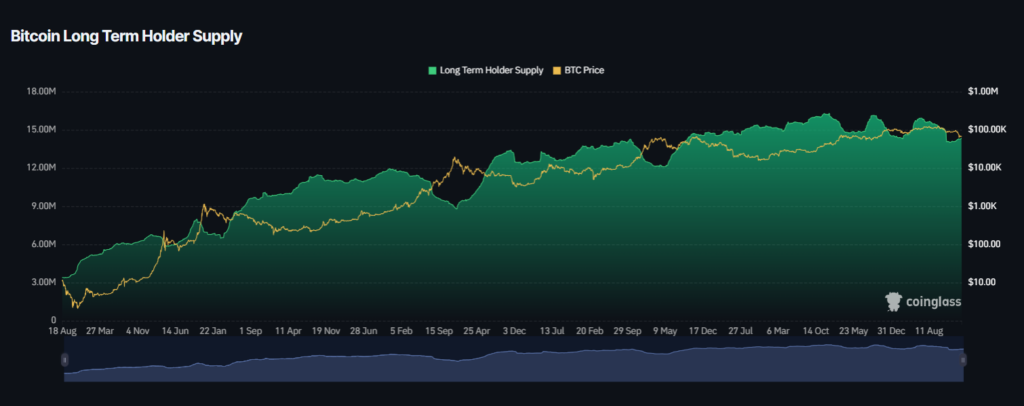
Historically, an increase in supply from long-term holders during price weakness signals accumulation. Conversely, a drop in supply during rallies points to a distribution. Current conditions reflect stability rather than a sell-off.
Several structural signals reinforce the change in underlying demand:
- Accumulation now exceeds newly mined supply on a 30-day basis.
- Long-term holder balances remain near peak levels despite volatility.
- Exchange reserves continue to fall, reducing liquid supply.
- The price has yet to rebound, suggesting that absorption is happening quietly.
Trade data adds another layer to this picture of supply tightening. Bitcoin reserves on trading platforms have fallen by approximately 3.25 million BTC to around 2.75 million BTC over the past year. This represents a structural withdrawal of approximately 500,000 BTC. Importantly, recent price weakness has not caused a sharp spike in trade balances, indicating limited panic redistribution.
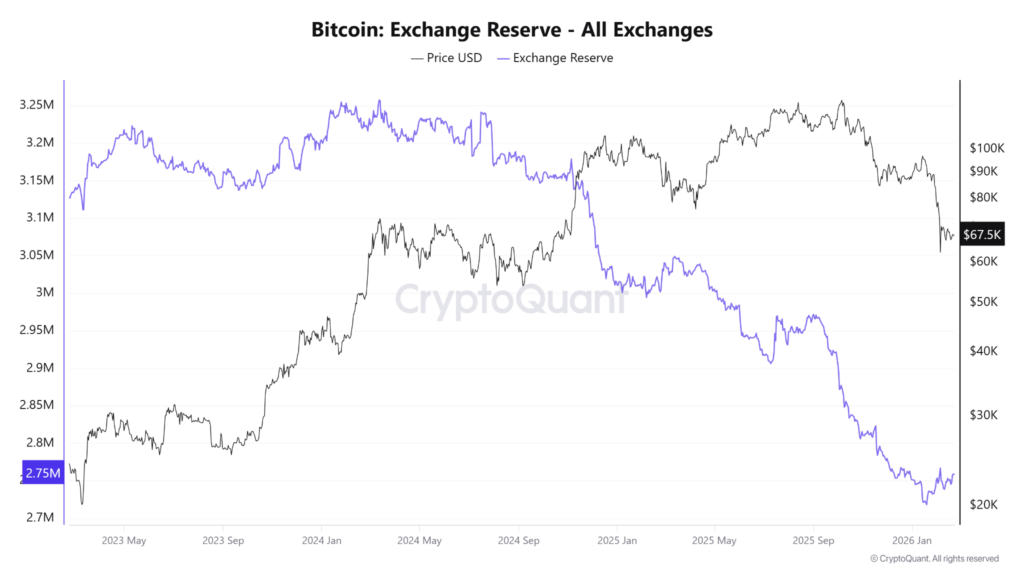
The reduction in supply on exchanges combined with positive apparent demand creates a more constrained liquid environment. Such conditions often precede stronger movements, although the timing remains uncertain. For now, the price continues to consolidate without a decisive expansion.
Whale absorption offsets ETF outflows as price stabilizes
Institutional flows remain the missing piece. US spot Bitcoin ETFs recorded approx. $993 million in net outflows during the most recent monthly period. Total assets under management remain high, close to 85 billion, but significant new flows have not yet returned.
On-chain absorption appears to be driven by whales, long-term investors or off-exchange buyers rather than ETF-led expansion.
Essentially, the data suggests that Bitcoin could be moving from a late-cycle correction to an early phase of reaccumulation. Confirmation would require sustained positive readings of apparent demand as well as a stabilization or recovery in ETF flows. Up to this point, this change reflects structural repair rather than aggressive growth.
Maximize your Tremplin.io experience with our 'Read to Earn' program! For every article you read, earn points and access exclusive rewards. Sign up now and start earning benefits.


