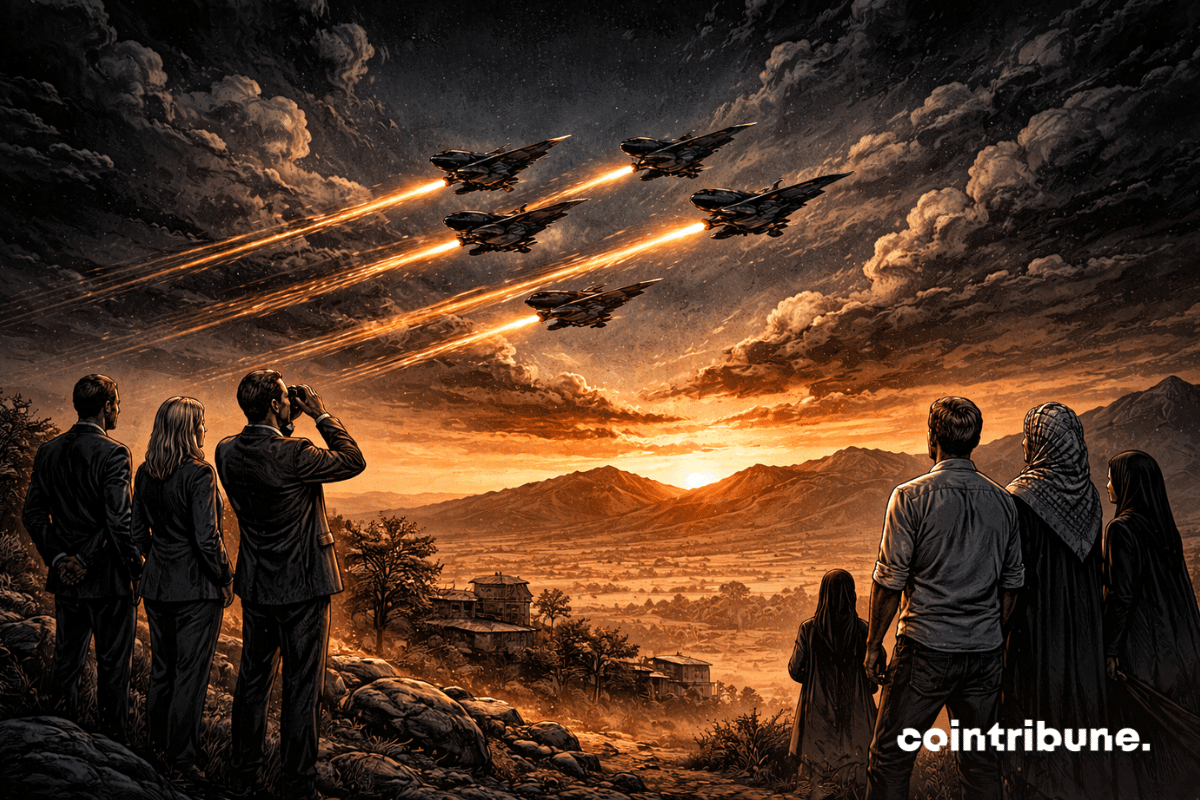
By setting a deadline of around ten days to decide between a diplomatic agreement and military action, Donald Trump has placed Iran at the heart of a sequence of high international tension. The American president said he was considering a limited military strike in order to constrain Tehran on its nuclear program, even though discussions are underway. Between strategic pressure, naval deployment and a tightened timetable, Washington and Iran are now moving forward on a particularly fragile diplomatic line.
In brief
- Donald Trump is considering a limited military strike against Iran to put pressure on Tehran's nuclear program.
- The American president sets a deadline of approximately ten days to decide between a diplomatic agreement and military action.
- Discussions are underway in Switzerland, while Iran is preparing a draft agreement to send to the United States.
- Washington is strengthening its military presence in the region, with the deployment of aircraft carriers and major naval assets.
A limited strike brandished as diplomatic leverage
Donald Trump has indicated that he is considering military action to force Iran to reach an agreement on its nuclear program. THE key statements are as follows:
- He said the world would know “over the next ten days, probably” whether an agreement would be reached or the United States would take military action;
- Asked about the precise nature of a possible intervention, he replied: “I’m not going to talk about it with you” ;
- He added: “we will come to an agreement, one way or another”;
- The United States and its European allies suspect Iran of getting closer to developing a nuclear weapon, something Tehran has always denied.
At the same time, U.S. and Iranian officials met in Switzerland and indicated that progress had been made. In Geneva, discussions were held as American pressure increased.
Iranian Foreign Minister Abbas Araghchi said his country was preparing “a potential draft agreement” which would be handed over in the coming days to the American special envoy Steve Witkoff. The diplomatic sequence therefore fits into a tight timetable, publicly set by Washington.
Military reinforcement
Alongside the discussions, the United States has increased its military presence in the region. The deployment includes the world's largest warship, the USS Gerald R Ford, which appears to be heading to the area, as well as the aircraft carrier USS Abraham Lincoln, accompanied by additional destroyers, gunships and fighter jets.
Satellite images showed that Iran had reinforced some military installations. Iran's Supreme Leader, Ayatollah Ali Khamenei, issued a message warning: “The American president keeps repeating that the United States sent a warship to Iran. However, a warship is dangerous military equipment” .
During the operation “Midnight Hammer”Last July, American officials were still talking about the possibility of successful discussions shortly before American strikes targeted Iranian nuclear facilities. The day before this operation, spokesperson Karoline Leavitt read a statement in which Donald Trump indicated that he would decide “in the next two weeks”to act or not. Today, no specific military objectives have been detailed, although options including a campaign that could last several weeks have reportedly been presented.
This crisis is observed by the BRICS bloc, attentive to any shift in regional geopolitical balances.
The coming days will tell whether diplomatic pressure prevails over the show of force. A military escalation would have repercussions well beyond the Middle East, affecting global strategic balances and financial markets, where nervousness could quickly be reflected, including in the price of bitcoin.
Maximize your Tremplin.io experience with our 'Read to Earn' program! For every article you read, earn points and access exclusive rewards. Sign up now and start earning benefits.