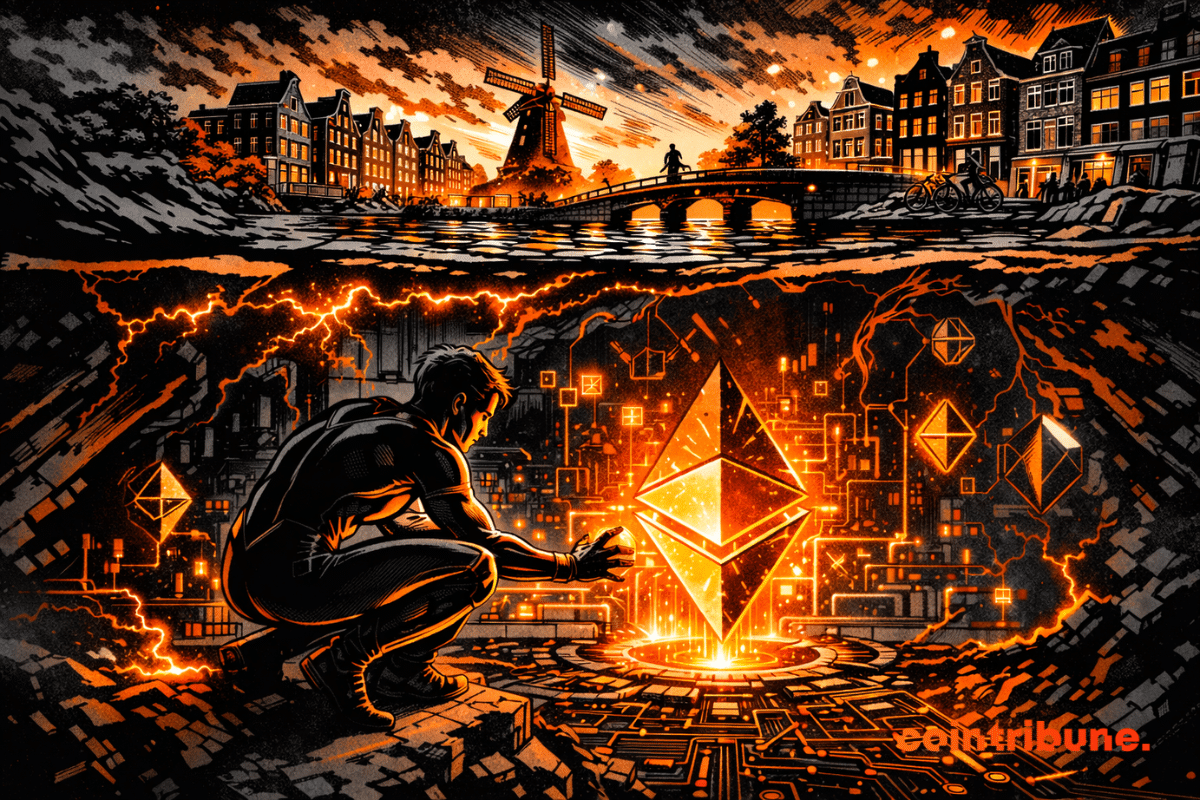
The blockchain ecosystem is going through a pivotal period after a particularly intense year 2025 for the Ethereum protocol. The Pectra and Fusaka updates have already strengthened the network foundations by increasing the gas limit and optimizing data storage. However, the developers don't plan to stop there. A new strategic architecture is taking shape for 2026, aiming to transform the second flagship cryptocurrency on the market into an even more efficient global machine. At the heart of this is Glamsterdam, a major technical upgrade planned for the first half of 2026.
In brief
- Ethereum unveils an ambitious 2026 roadmap, focused on scalability, post-quantum security and improving the user experience.
- The Glamsterdam update, expected in the first half of 2026, targets a gas limit of up to 100 million thanks to parallel execution and PBS integration.
- Native account abstraction will transform the use of wallets by removing technical complexity, while promoting interoperability between blockchains.
- Vitalik Buterin supports careful integration of AI into Ethereum, focused on privacy, ZK proofs, and decentralized governance.
A new era of scaling with the Glamsterdam update
The Ethereum Foundation revealed in a press release its strategic roadmap for the year 2026. The organization defines its new “ protocol priorities » around four major axes. It wants to speed up transactions and make smarter wallets more widespread. It also aims for better interoperability between chains as well as security resistant to quantum computing. At the heart of this system is the modernization of the network via Glamsterdam, planned for the first half of the year.
This update must realize a technical ambition discussed throughout 2025: increasing processing capacity. The foundation confirms its goal of raising the gas limit “up to and beyond” 100 million.
Furthermore, this parameter determines the maximum amount of calculations that a block can perform. To support this scale, Ethereum developers rely on parallel execution and PBS integration. Continuous scaling of blobs will also optimize data storage.
She emphasizes active preparation for the post-quantum era to protect the network in the long term, a foundation security initiative that goes beyond simple performance. Finally, the year 2026 will mark a turning point for user experience. Efforts are focused on native account abstraction to create smart wallets. This technical development will facilitate more fluid and transparent interactions between the different blockchains.
The concrete impact on user experience and overall security
These technical developments are radically transforming access to cryptocurrencies for the general public. Integrating native account abstraction eliminates the biggest barrier to entry: complexity. Users no longer need to secure scary private keys or go through expensive intermediaries.
Smart contracts are becoming the default. This simplification makes transactions as fluid as on a traditional banking application. The user enjoys the service without worrying about the underlying technology.
In addition, the robustness of the network inspires confidence in investors, whether institutional or individual, for a serene future. The deployment of the FOCIL mechanism guarantees the neutrality of the protocol. No centralized entity can censor or block a specific transaction.
This resilience protects the financial freedom of each participant. Additionally, active preparation for the post-quantum era secures assets against future technological threats. ETH is not only growing, it is strengthening its foundation to remain reliable despite increasing traffic.
Vitalik Buterin's approach to controlled AI integration in Ethereum
The foundation's announcement comes just days after Ethereum co-founder Vitalik Buterin shared a pragmatic analysis on where his protocol should go and also discussed a crucial role for artificial intelligence within the network. Far from a frantic technological race, it advocates a human-centered approach and confidentiality.
According to him, AI models should run locally to protect user data. Zero-disclosure (ZK) proofs would then ensure the verifiability of the results without exposing sensitive information.
In this vision, Ethereum becomes the natural economic layer for AI agents. Blockchain would facilitate automated payments, reputation systems and bot interactions. This convergence could also transform decentralized governance (DAO).
AI would assist collective decision-making, making more efficient predictive markets possible. This perspective reinforces the “cypherpunk” ideal by democratizing security auditing and transaction verification.
The year 2026 promises to be decisive for Ethereum with the deployment of Glamsterdam in the first half of the year, followed by the Hegotá update. These technical developments aim to simultaneously strengthen the security, decentralization and scalability of the network. Faced with an increasingly complex architecture, the Ethereum ecosystem relies on a progressive and controlled integration of innovations in order to preserve the accessibility of the protocol and ensure its long-term resilience.
Maximize your Tremplin.io experience with our 'Read to Earn' program! For every article you read, earn points and access exclusive rewards. Sign up now and start earning benefits.